

Most people who fail the ACP-220 exam do not fail because they misunderstood Confluence Cloud. They fail because they walked in expecting a different test than the one waiting for them.
The gap is usually format, not knowledge. You know how to grant space access. You have debugged a permissions conflict. But the exam asks you to do that work inside a fixed clock, across eight weighted domains, with no ability to look anything up. If you have never rehearsed that specific pressure, the first time you feel it is the day you pay for it.
This checklist walks through the ACP-220 exam format section by section: what the questions look like, how the 180 minutes actually get spent, where the domain weights put the most points, and what you should be able to confirm about your own readiness before you book a seat. Work through it in order and you will finish with a clear picture of the test and a short list of gaps to close.
What the ACP-220 Exam Actually Tests
The ACP-220 Confluence Administration for Cloud credential validates that you can configure and manage Confluence Cloud sites at an administrative level, not just use them as a power user. Atlassian's published exam topics put the emphasis on judgment: granting and troubleshooting access, defining the space model, hardening security, and keeping a site healthy as it grows.
Atlassian recommends one to two years of hands-on Confluence Cloud administration experience before sitting the exam, according to the ACP-220 practice exam breakdown published by OpenExamPrep. That recommendation matters for format planning as much as for content. A candidate with two years of real admin work already knows what a permission conflict feels like. What they have not practiced is answering a question about it in 90 seconds.
The practical takeaway: treat ACP-220 prep as two separate projects. One is confirming you know the material. The other is proving you can express that knowledge inside the exam's format constraints. This article covers the second project.
The Eight Domains and Where the Points Sit
The exam blueprint is versioned, and Atlassian's current published topic list is the V1 July 2025 revision. The domain weights are the most useful planning tool you have, because they tell you where a scoring mistake costs the most.
Here is how the blueprint distributes the exam, with the weights as published in the official Atlassian exam topics document:
| Domain | Weight | What it covers |
|---|---|---|
| Access and Permissions | 21% | Site access, space access, permission troubleshooting |
| Space Setup and General Settings | 15% | Space creation, templates, blueprints, defaults |
| Site Configuration | 13% | General configuration, landing page, company hub, attachments |
| Content Administration | 13% | Page lifecycle, archive, trash, labels, templates |
| Security and Data Management | 11% | Macro usage reports, data handling, security controls |
| Automation Rules | 11% | Triggers, conditions, actions, branch rules, smart values |
| Look and Feel | 8% | Theming, navigation, appearance settings |
| Monitor Site Performance | 7% | Site health, diagnostics, monitoring |
Two numbers stand out. Access and Permissions alone accounts for more than a fifth of the exam, and the blueprint's own task list under that domain includes distinguishing administration types, providing and troubleshooting site access, granting space access, and troubleshooting permissions. Permissions are also the area where Confluence's behavior is least intuitive, because space permissions and page restrictions combine rather than override each other.
Automation Rules at 11% is the other one to notice. Automation is newer to the admin role than permissions, and candidates who learned Confluence before automation existed often under-prepare for it. Eleven percent is roughly eight questions on a 70-question exam.
Reading the Weights as a Study Budget
If you have 40 hours of prep time, the weights give you a defensible split. Access and Permissions gets about eight and a half hours. Automation Rules and Security and Data Management get about four and a half each. Look and Feel gets a little over three.
The mistake is spreading time evenly. Even distribution feels fair, but it treats a 7% domain and a 21% domain as equally likely to decide your result. They are not.
One caveat on the weights: Atlassian versions the blueprint, and the July 2025 revision is the current one referenced across prep sources. Before you build a study plan around these percentages, confirm you are looking at the current published topic list rather than a copy from an earlier version. Blueprint shifts are usually incremental, but a domain weight change quietly invalidates an otherwise good plan.
Question Count, Timing, and the Math That Matters
The published exam format is up to 70 multiple-choice questions delivered in 180 minutes, with a passing score of approximately 67%. The exam fee is $249 USD through Kryterion Webassessor, and the certification stays valid for two years, per the same OpenExamPrep format summary.
Those numbers combine into a time budget you should internalize before test day:
- 180 minutes ÷ 70 questions = about 2.5 minutes per question
- A 67% passing score means you can miss roughly 23 questions and still pass
- Missing more than 23 questions means a retake, a new fee, and another study cycle
The 2.5-minute average is misleading if you treat it as a target. Some questions are quick recalls that take 30 seconds. Others are scenario questions with a stem long enough to read twice. If you spend 2.5 minutes on every question, you will run out of clock on the long ones.
A better plan is a two-pass approach. Answer everything you can resolve quickly, flag the rest, and leave yourself 30 to 35 minutes for flagged items at the end. That structure protects you from the specific failure mode where one hard scenario question eats eight minutes and costs you four easy points later.
Why 67% Is Harder Than It Sounds
A 67% threshold sounds generous next to exams that require 80% or higher. For the ACP-220 exam format, it is not, for one reason: the questions cluster around judgment calls rather than definitions.
Consider the kind of thing the Access and Permissions domain asks about. Confluence permissions are additive. A user's effective access comes from a combination of site-level groups, space permissions, and page restrictions, and a page restriction can only narrow access, never widen it. A question that gives you three group memberships, a space permission set, and a page restriction is testing whether you can trace the combination correctly, not whether you know what a space permission is.
Those questions are answerable, but not fast, and not by recall alone. If your prep has been reading documentation, you have the pieces. You have not necessarily practiced assembling them under time pressure.
Question Formats You Will See and How They Behave
The exam is multiple choice, but "multiple choice" covers a few distinct formats that require different handling.
Single-answer recall. A direct question about a setting, a default, or a feature's location. These are the fastest questions on the exam. Answer and move.
Scenario judgment. A described situation with four plausible options, three of which are technically valid Confluence actions. The correct answer is the one that fits the requirement stated in the stem, not the one that is most thorough. Watch for stems that specify a constraint like "without granting additional site access" or "while preserving the existing page hierarchy." Those constraints eliminate options that would otherwise work.
Best-practice reasoning. Questions that ask what an admin should do in a given situation, where the answer reflects Atlassian's intended model rather than a workaround. If an option involves manually replicating something the platform does automatically, treat it with suspicion.
Troubleshooting sequences. A user cannot see a page, or a space is behaving unexpectedly. The answer is the diagnostic path that isolates the cause fastest. Permissions questions in this format usually resolve by checking the most restrictive layer first, because that is where access is lost.
If you want to see how these formats feel before you commit to a test date, running a ACP-220 practice exam in timed mode is the closest thing to a dress rehearsal. ExamJungle's simulator runs the clock the way the real test does, and its Caesar AI tutor will expand the explanation when you get a scenario question wrong, so you learn the reasoning rather than the answer letter.
Question Types That Reward a Different Habit
Each format above rewards a slightly different reflex. Recall rewards coverage. Scenario judgment rewards careful reading of constraints. Best-practice reasoning rewards knowing the platform's intended model. Troubleshooting rewards a consistent diagnostic order.
The trap is applying one habit to all four. Candidates who are strong on facts often rush scenario questions and miss the constraint word. Candidates who are strong troubleshooters often over-think simple recall items and burn clock. Notice which format is costing you time as you practice. That tells you more about your readiness than your raw score does.
Test-Day Logistics and Environment Rules
Format knowledge includes the logistics around the exam, not just the questions. Getting these wrong can end a session before it starts.
Registration and delivery. The ACP-220 exam is delivered through Kryterion Webassessor, and the fee is $249 USD. Registration happens through that platform, not through the Atlassian Community site.
Proctoring. Kryterion-delivered exams commonly run under remote proctoring, which means a room scan, ID verification, and a live or recorded proctor watching the session. Clear your desk completely. A second monitor that is switched off but visible can still be flagged.
Environment. Use a wired connection if you have the option. Close every application you do not need. Notification pop-ups during a proctored exam are a real risk, and the examiner cannot always tell a calendar reminder from a browser tab.
Timing behavior. The 180-minute clock runs continuously. You can flag questions and revisit them within the session, but the clock does not pause between sections, because the exam is not delivered in separately timed sections.
Retake implications. A failed attempt means another $249 and another prep cycle. That is the practical reason this checklist treats timing rehearsal as non-optional rather than nice-to-have.
Validity window. Certification lasts two years, so the clock on recertification starts when you pass, not when you register.
Confirming the Current Exam Version Before You Book
Vendor exams get revised, and prep sources do not always update in lockstep. Before you pay for a seat:
- Check Atlassian's current published exam topics document for the version label. The V1 July 2025 revision is the one referenced across current prep sources.
- Confirm the price on the Kryterion Webassessor listing rather than trusting a number from a blog post, including this one. Fees change.
- Confirm the question count and duration in your registration confirmation. Published figures describe the format; your confirmation describes your session.
- If a source describes a different question count or domain split than the ones above, treat it as outdated until you can verify it against Atlassian's own topics document.
A Readiness Audit You Can Run in One Sitting
Before you register, work through this list. Each item is a yes-or-no check, and any "no" is a specific thing to fix rather than a general reason to worry.
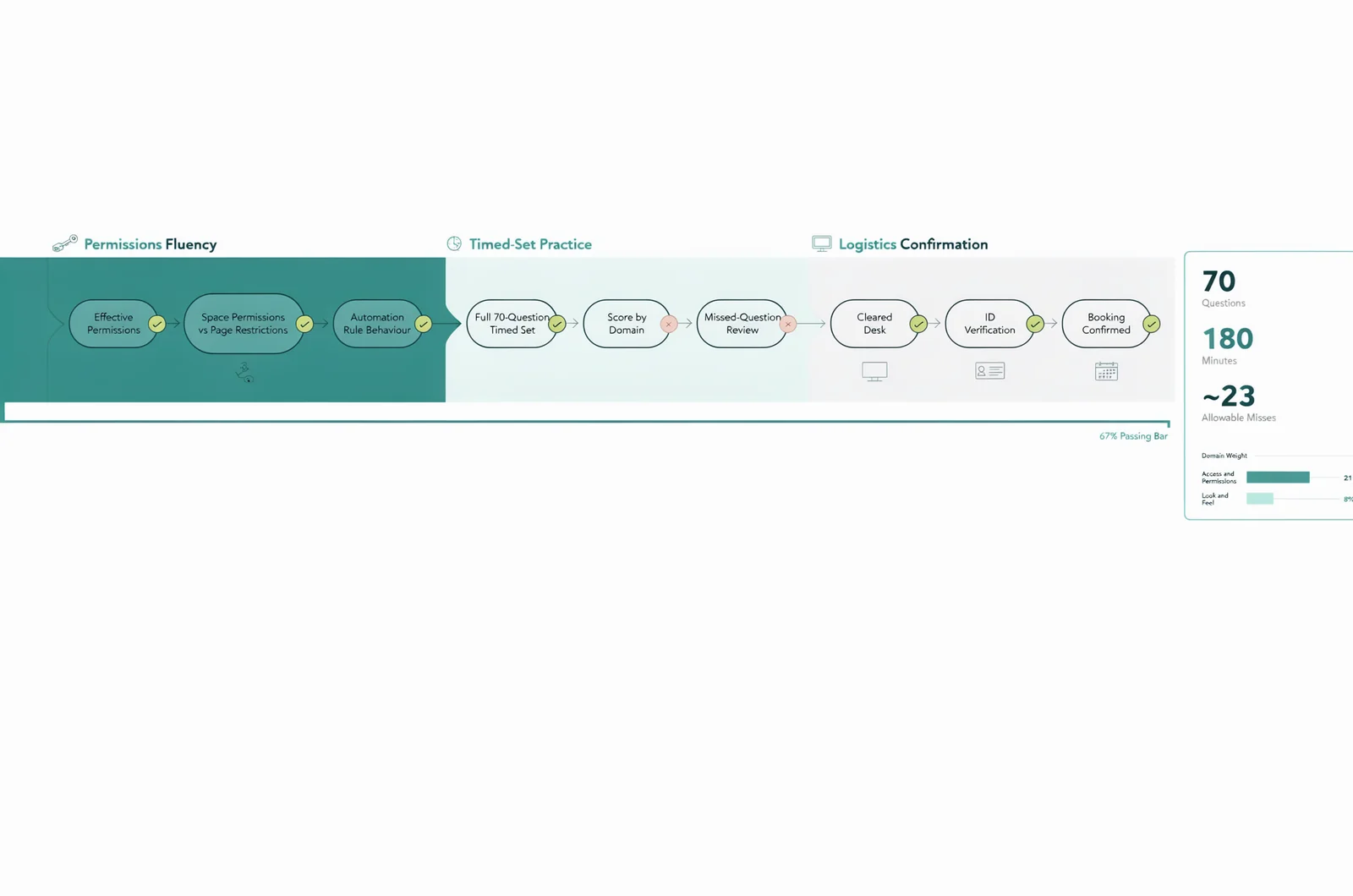
Can you trace effective permissions from scratch? Given a user's group memberships, a space permission set, and a page restriction, can you state what they can see without looking anything up? This is the highest-weight domain on the exam, and it rewards fluency rather than recognition.
Can you explain the difference between space permissions and page restrictions in one sentence? If your explanation includes the phrase "override," you have the model wrong. Restrictions narrow; permissions grant.
Can you describe what an automation rule does without naming a specific app? The blueprint's Automation Rules domain covers triggers, conditions, actions, branch rules, and smart values. Know the vocabulary.
Have you completed a full 70-question timed set? Not a topic drill. A full set, on the clock, no pauses, no notes. If you have not, you do not yet know your pacing.
Do you know your score by domain, not just overall? An overall 72% that hides a 40% in Access and Permissions is a failing score waiting to happen. Track domain-level accuracy. ExamJungle's progress tracking breaks results down so you can see which domain is dragging the total.
Have you reviewed every missed question until you can explain why the right answer is right? This is the step most candidates skip. Reviewing the correct answer is not the same as understanding the reasoning. If an explanation does not land, ask for a deeper one rather than moving on.
Do you have a second-pass timing strategy? Know your flag threshold in advance. A workable rule: if a question is not resolved after 90 seconds, flag it and move.
Is your test environment already set up? Desk cleared, connection wired, room-scannable, ID ready. Do this a week out, not the morning of.
Do you know which three domains are your weakest, and have you scheduled time for them? The weights tell you what matters. Your domain scores tell you where you are actually losing points. Plan against the second number.
Have you confirmed the current blueprint version and fee? Do this in the same sitting as your registration, so the numbers you studied against are the numbers you are paying for.
What a Passing Score by Domain Looks Like
Overall 67% is the bar, but a domain-blind total is a poor readiness signal. A more useful target is no domain below roughly 60%, with your strongest performance in Access and Permissions, where the points are.
If your practice runs show 80% in Look and Feel and 45% in Access and Permissions, your overall score will look survivable while your actual exam result is a coin flip. The high-weight domain has more questions, so it has more room to pull you under. Fix the low domain first, even though the high domain feels better to study.
Building the Last Two Weeks Around Format, Not Content
Once you are scoring above the threshold on untimed sets, shift the balance of your prep toward format work. Content study has diminishing returns at that point; pacing and question-reading do not.
A workable two-week structure:
- Days 1-3: Full timed set, then a full review of every missed question with domain tagging. No new content.
- Days 4-6: Drill your two weakest domains with short untimed sets. Aim for reasoning, not volume.
- Days 7-9: Two more full timed sets on separate days. Track your pace per question, not just your score.
- Days 10-12: Review only flagged and missed items from the timed sets. Rewrite the reasoning for each in your own words.
- Days 13-14: One final timed set no later than three days before your exam. Then stop. Environment setup, logistics confirmation, and rest.
The reason to stop active drilling a few days out is that late cramming trades confidence for marginal recall, and the exam rewards steady pacing more than it rewards the last few facts. If you want a harder version of a question you got right, Caesar AI can generate variants on demand, which is a better use of the final days than re-reading documentation you already understand.
If you are also weighing the adjacent Atlassian credentials, it helps to know how this format compares to the sibling admin track. The ACP-520 Cloud Admin exam covers organization-level administration rather than site-level work, and candidates often sit it after ACP-220.
Reader Questions About the ACP-220 Exam
How many questions are on the ACP-220 exam?
Up to 70 multiple-choice questions, delivered in a single 180-minute session. The count is published as "up to 70," so treat the timing math as approximate and plan for the higher end.
What score do you need to pass?
Approximately 67%. On a 70-question exam that allows roughly 23 missed questions, though the exact scoring model is not published in enough detail to guarantee a specific number of misses.
How much does the exam cost?
$249 USD through Kryterion Webassessor, per the current format summary from OpenExamPrep. A retake costs the same amount, which is the strongest argument for rehearsing the format before you book.
Are the questions scenario-based or definition-based?
Both, and the mix leans toward scenarios in the higher-weight domains. Access and Permissions questions frequently ask you to trace effective access across groups, space permissions, and page restrictions rather than define a single setting.
How long is the certification valid?
Two years from the date you pass. Plan recertification from that date, not from your registration.
How much Confluence Cloud admin experience should I have first?
Atlassian recommends one to two years. That is a content recommendation, not a format one, and it is worth taking seriously before spending $249.
Can I use notes or documentation during the exam?
No. It is a proctored, closed-book exam. Everything you need has to be in your head, which is the whole reason pacing practice matters.
What happens if I fail?
You pay the fee again and re-sit. There is no partial credit structure that carries domain scores forward, so a retake means another full prep cycle.
Where the Format Work Pays Off
The ACP-220 exam rewards admins who know Confluence Cloud and can prove it inside a fixed format. Eight weighted domains, up to 70 questions, 180 minutes, and a 67% bar. The blueprint tells you that Access and Permissions is where a fifth of your score lives and that Automation Rules is worth more than most candidates assume. The clock tells you that a two-pass strategy beats even pacing.
The candidates who pass on the first attempt are usually the ones who treated format as a skill, not a detail. They rehearsed the question types, tracked their accuracy by domain, and walked in knowing roughly how many minutes each question style was allowed to take.
You can start that rehearsal today. Running a timed, full-length set is the fastest way to find out whether your readiness is real.
References
- ACP Transparency Data Collection System — 25 ... Appendix ... 26 ... 26 ... 1.1 ... 26 ... 2 Plan Detailed Data Field Information ... Detailed Data Field ... 8 7 ... FCC adopted a Fourth Report ... Order establishing the
More Exam Format Breakdowns Worth Reading