

If you’re checking ACT test fee waiver eligibility after hearing that the rules changed, start with the dated policy behind that claim. No specific eligibility change is confirmed in this article. A revised income threshold, different student requirement, or added preparation benefit should remain unconfirmed until you have the applicable ACT wording. Before registration, establish which rules cover your intended test date, how your circumstances fit those rules, and which charges any approved waiver would cover.
A reported change needs an effective date
For an ACT waiver update, ask for two things together: the exact provision that changed and the date it takes effect. We should leave any claim of expanded eligibility unconfirmed until both are established.
Identify the provision behind the announcement
Ask whoever shared the update to identify the relevant paragraph, table, or announcement. Then narrow the question: does the reported revision concern who qualifies, what an approved waiver covers, or how someone requests assistance?
Keep those questions separate as you read. If the notice discusses registration coverage, ask whether it also changes eligibility. If it describes preparation access, ask whether the qualifying requirements remain the same. Don’t extend an announcement beyond its actual wording.
For a useful comparison, place the earlier and later wording beside each other. Record the document dates and the specific sentence under discussion. Avoid summarizing the difference until you can point to it.
If you have only one version, ask for the earlier provision before describing anything as new. Until then, use the current wording to frame your questions without claiming a documented change.
Match the date to your registration plans
Before relying on an announcement, ask what its effective date applies to. Does it concern the registration date, the test date, a named school year, or another period? Request that distinction in writing if the wording leaves room for interpretation.
Suppose, hypothetically, that a notice names a future testing period. Before applying its terms to an earlier registration, ask whether the notice expressly includes that registration.
Keep the announcement date and effective date on separate lines in your notes. If the document supplies only one, ask what that date means. End the comparison with a precise question: which provision applies to my intended registration?
Student status and household finances need separate answers
When assessing a possible ACT eligibility revision, work through the student requirements and any financial requirements separately. Ask for the complete applicable criteria before deciding that one matching detail settles your eligibility.
Check which student requirements apply
Ask your school counselor which student requirements, if any, appear in the applicable policy. Request the exact wording rather than relying on a broad description such as financial assistance for students.
Questions worth resolving include:
- Does the policy specify a grade level or enrollment status?
- Does it name a location or testing arrangement?
- Does it address your particular schooling circumstances?
- Who should confirm whether you meet each requirement?
Treat these as questions to investigate, rather than a list of confirmed ACT requirements.
If your situation falls outside the examples in the document, describe it plainly. Explain your current enrollment, intended test date, and the point that needs clarification. Ask for an answer tied to the relevant provision.
Avoid changing your description to resemble an example more closely. Give the reviewer your actual circumstances and ask how the wording applies.
Read any household criteria with their definitions
If the applicable policy includes household income, ask which income definition and reporting period to use. Before comparing a figure, establish whether the instructions request annual income, another period, or a particular measure.
Follow the same approach with household size. If there is a table, confirm which row applies before making a comparison. Ask how the policy instructs you to count household members, especially if your living arrangements need explanation.
For example, imagine a household whose income recently changed. Ask which period the policy requires and how to document that period. Don’t substitute a different period because its figure appears more favorable.
If the document lists qualifying circumstances beyond income, ask whether they are alternatives or additional requirements. Read the connecting words carefully, then request clarification if necessary.
Keep your financial questions focused. Ask what information is required, who needs it, and how to provide it through the designated process. Request those instructions before sending personal documents.
Check eligibility and coverage separately
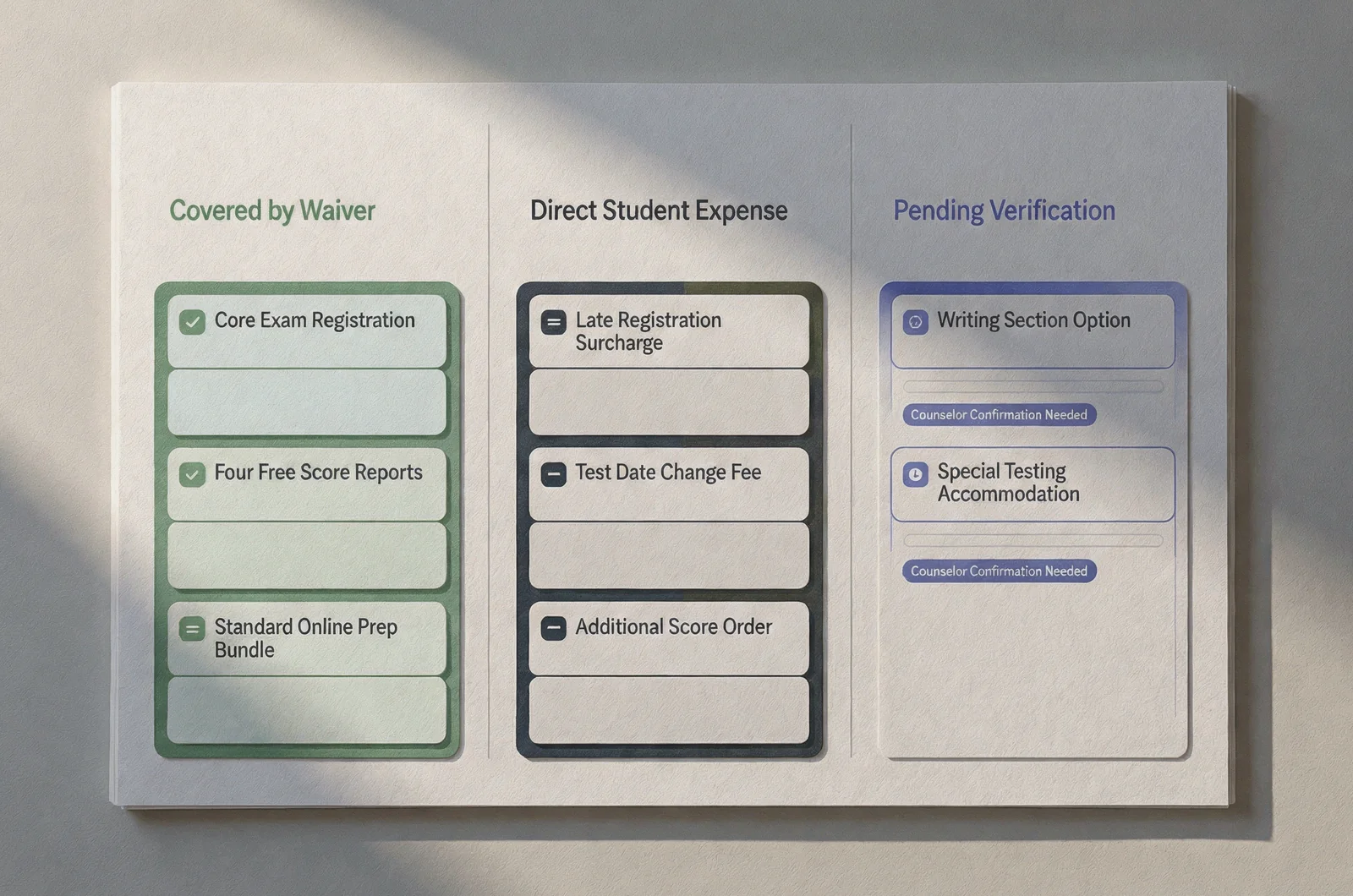
Before treating an ACT waiver as part of your exam budget, ask for written confirmation of both qualification and coverage. Verify each charge you expect to encounter.
Examine the registration you intend to make
Start with your planned registration rather than a general description of the test. Identify the intended date, selected options, and any additional items you are considering.
Then ask which of those items the applicable waiver terms include. Request a clear answer for anything that remains outside the listed coverage.
If a report describes an expanded benefit, ask what changed at the level of an individual charge. Which item is newly included? When does that coverage begin? Does it apply to the registration you intend to submit?
For a hypothetical budget, create three categories: confirmed coverage, confirmed personal cost, and unresolved cost. Leave the final category open until you receive an answer.
Keep any ExamJungle practice work on a separate line from registration expenses. Include it in your waiver calculations only if an applicable benefit expressly names that expense.
Ask about changes to your plans
Before selecting a date, ask what the applicable terms say about changing or canceling a registration. Request separate answers for each action you might realistically need to take.
If you are considering another test attempt, ask whether the policy addresses that situation. Check for any stated limits, conditions, or required approval. Avoid making a second registration on the assumption that the first decision covers it.
Use a hypothetical question if you haven’t decided yet: if I need a different date, what instructions should I follow, and what would I need to pay?
If you have already paid, ask directly whether any adjustment is available under the applicable terms. Leave reimbursement out of your budget until you receive an explicit answer.
Before submitting payment, compare the displayed charges with the coverage you were told to expect. Pause over any unexplained difference and ask for clarification through the appropriate registration channel.
Treat preparation access as its own benefit
If an ACT waiver announcement mentions preparation resources, examine that provision on its own terms. Ask for the named resource, access instructions, and any stated limits before adding it to your study plan.
Establish exactly what access means
Request the resource’s full name and a description of what the benefit includes. Ask whether the applicable terms identify practice questions, explanations, timed activities, instruction, or another form of preparation.
Then check how access begins. Does the document describe an activation step? Does it specify when access becomes available or when it ends? Follow the actual instructions rather than assuming access starts immediately.
Ask whether the benefit requires a separate account or registration action. If you receive an access message, keep it beside your waiver correspondence so you can distinguish the preparation instructions from the registration instructions.
For any unresolved detail, write a narrow question. Instead of asking whether preparation is included, ask which resource you may access and what you must do to begin.
Leave the benefit unconfirmed in your study budget until you have those answers.
Build study activities around confirmed access
Once you have confirmed a preparation benefit, decide how you intend to use it. Choose a specific activity, such as reviewing an explanation, completing a timed exercise, or revisiting a topic you found difficult.
If ExamJungle is already part of your study routine, put any separately confirmed ACT preparation access beside it in your schedule. Assign each study session a purpose rather than adding resources without a plan.
For a hypothetical practice session, select one topic and write down what you want to understand. Afterward, record the reasoning you need to review and the question you still cannot explain.
Keep those study notes separate from eligibility correspondence. Ask the designated reviewer to settle waiver questions, and use your study sessions to work on the test content you intend to practice.
Before paying for additional preparation, compare the proposed purchase with the access you have actually confirmed. Make the purchase decision from that comparison.
Build your registration plan around confirmed details
For a reported ACT waiver update, use a short written record to connect the policy, your circumstances, and your planned registration. Keep unanswered questions visible until someone resolves them.
Send one focused request for clarification
Prepare a concise message for your school counselor or the contact identified in the applicable instructions. State your intended test date and explain that you want to confirm the waiver terms before registration.
Include the document or announcement you are asking about. Identify the paragraph that seems relevant and describe the part you cannot confidently interpret.
Ask for answers to the questions that affect your decision:
- Which policy applies to my intended registration?
- Which requirements should I check against my circumstances?
- Who confirms eligibility, and what information do they need?
- Which selected charges would the waiver cover?
- What should I do after receiving a decision?
Adjust the list to your situation. If one question is already settled, include the answer in your notes and focus the message on what remains open.
Ask for a secure way to submit any requested personal information.
Keep a useful record of the response
When you receive an answer, record its date and the specific question it resolves. Preserve the response alongside the policy wording rather than rewriting it into a broader promise.
If the response covers eligibility but says nothing about preparation access, keep the preparation question open. If it addresses one registration, ask before applying it to another.
A useful interactive record would let a student enter an intended test date, attach policy wording, and mark each question as confirmed or unresolved. Design it to organize correspondence without predicting eligibility.
You can use the same approach in a simple document. Give each unresolved issue its own line, followed by the contact who can answer it and the date you sent the question.
Before registering, read the unresolved items once more. Decide which answers you need before proceeding, then request those answers directly.
Questions to resolve about a reported waiver update
If an ACT update leaves you uncertain about a particular situation, ask a question tied to that situation. Use the following prompts to request a decision rather than infer one.
Can I qualify after a recent change in household income?
Ask which reporting period and income definition the applicable policy requires. Explain the change and request instructions for presenting it accurately.
If you have figures from more than one period, identify the periods clearly. Ask which figure belongs in the review instead of choosing one yourself.
Request the documentation instructions before submitting financial records. Keep the eventual answer with the policy provision used to reach it, and use that answer for the registration it addresses.
Does an earlier eligibility decision still apply?
Ask whether you need a fresh review for your intended registration. Provide the date and scope of the earlier decision so the reviewer can assess the actual circumstances.
If your student status, household situation, or intended registration differs, state the difference directly. Avoid treating silence about a change as approval.
Request confirmation of the applicable decision before relying on the earlier one. Record whether the answer concerns eligibility, coverage, or both.
Should I pay while the waiver question is unresolved?
Ask the appropriate contact what steps you should take before the registration deadline. If you are considering payment, request an explicit answer about how that choice would affect any later adjustment.
Don’t include a refund in your budget without confirmation. Instead, write down the amount you are considering paying and the question you need answered first.
If a deadline is approaching, name the exact date in your message. Ask which action the applicable instructions require before that date.
Can I use the same decision for another exam?
Request the terms for the exact exam and registration you are considering. Ask whether the existing decision expressly covers them.
Keep the test name visible in your correspondence. If you are deciding between admissions tests, settle the waiver question for each intended registration separately.
Avoid extending an ACT-related answer to another assessment without written confirmation. Ask the responsible contact to identify the provision that supports any broader use.
What should I do if the policy and registration screen disagree?
Save the relevant policy wording and the details displayed during registration. Exclude payment information and unrelated personal data from anything you share.
Describe the discrepancy precisely. Identify the item you expected to be covered, the wording behind that expectation, and the charge displayed.
Ask which instruction to follow before completing the transaction. Preserve the response, then compare the final registration details with the resolution you received.
Keep the policy beside your registration record
Before acting on a reported ACT eligibility change, bring the policy wording and your individual decision together. Review the documents for the registration you actually intend to complete.
Make unresolved details easy to find
Keep a compact record with the policy date, intended test date, eligibility response, and expected charges. Add preparation access only after its terms are confirmed.
Mark open questions plainly. Avoid turning a tentative response into a settled answer when you rewrite your notes.
If you receive conflicting guidance, place the two responses together and ask which applies. Identify the exact point of disagreement so the reply can address it directly.
Keep your wording narrow throughout: approved for this registration, covered under this provision, or still awaiting confirmation.
Check the final details before submission
Compare the registration with your record before submitting it. Review the selected test, date, options, and displayed charges against the answers you received.
If a code or other authorization is provided, follow its accompanying instructions. Check the resulting registration details instead of assuming the authorization applied as expected.
Preserve the confirmation and any correspondence needed to explain the decision. Keep personal financial records in the location recommended by the designated reviewer.
Until a dated ACT provision establishes a change, leave claims of expanded eligibility or added benefits unconfirmed. Base your registration decision on the applicable wording and the answer to your own circumstances.
Weigh the ACT against your other admissions option