
Best Entry-Level IT Certifications for Career Changers
Switching to IT? Certifications are your best first step. Here's what you need to know:
- CompTIA IT Fundamentals (ITF+): Beginner-friendly, costs $138, covers basics like hardware, software, and security. Great for testing the waters in IT.
- CompTIA A+: The go-to for IT support roles. Costs $506, covers hardware, networking, and troubleshooting. Leads to jobs like Help Desk Technician ($64K average pay).
- Google IT Support Professional Certificate: Online, self-paced, $49/month. Prepares you for IT support roles in 3-6 months with a focus on networking, security, and operating systems.
- Microsoft AI-901 (Azure AI Fundamentals): Entry-level AI certification, $99. Covers machine learning, computer vision, and generative AI. Ideal for transitioning into AI-related roles.
- Microsoft AI Business Professional (AB-720): $99, focuses on using AI tools like Microsoft 365 Copilot for business tasks. No coding required, perfect for non-tech professionals.
Quick Tip: CompTIA A+ is highly recognized for IT support roles, while Microsoft AI certifications are gaining traction in AI-focused careers. Choose based on your career goals.
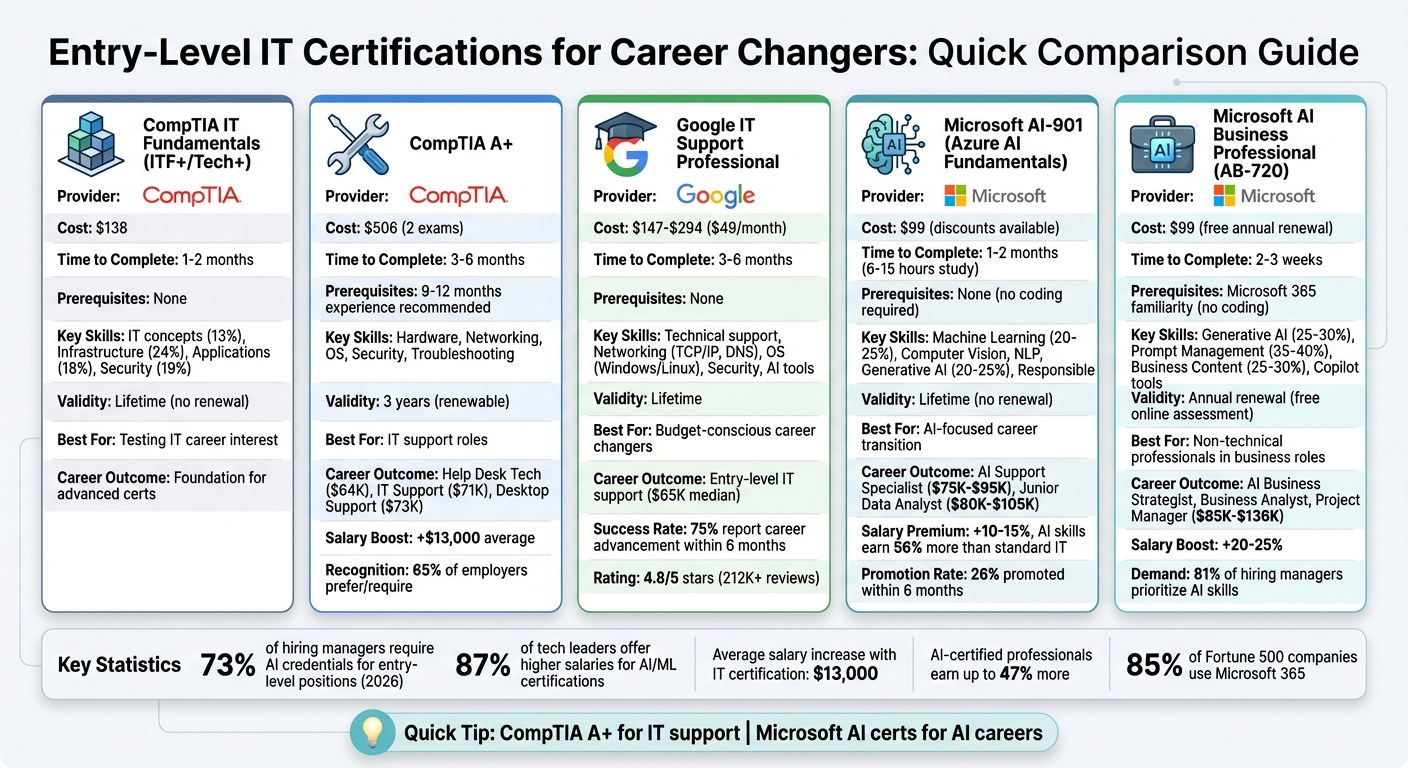
Entry-Level IT Certifications Comparison: Cost, Skills, and Salary Outcomes
Best Entry Level IT Certifications
1. CompTIA IT Fundamentals (ITF+)
The CompTIA IT Fundamentals (ITF+) certification, which will be rebranded as CompTIA Tech+ (Exam FC0-U71) starting July 16, 2024, is specifically tailored for beginners. It requires no prior experience, academic degree, or advanced math knowledge, making it ideal for those just starting out. According to CompTIA, this certification is designed to help you decide whether a career in technology aligns with your interests. The exam costs $138 and includes up to 70 multiple-choice questions, which must be completed in 60 minutes. To pass, you'll need a score of 650 out of 900 points [7][8].
Skills Covered
Tech+ focuses on six key areas: IT concepts (13%), infrastructure (24%), applications/software (18%), software development (13%), data/databases (13%), and security (19%) [7]. The updated exam incorporates modern topics like generative AI, chatbots, and cloud service models (SaaS, PaaS, IaaS). It also features hands-on troubleshooting simulations. You’ll learn to identify hardware components such as CPUs and RAM, understand networking basics like IP addresses and routers, and explore security essentials, including encryption techniques and password best practices [7].
Career Outcomes
Tech+ provides a solid foundation for pursuing advanced certifications, such as CompTIA A+. According to Team Nuggets at CBT Nuggets, starting with ITF+ makes earning subsequent certifications like A+ more manageable [9]. Once earned, the certification is valid for life - it never expires and doesn’t require renewal [7]. For career changers, it offers a low-pressure way to explore various IT fields before committing to a specific career path [5]. In a job market increasingly influenced by AI, acquiring basic tech skills through Tech+ can be a crucial first step toward more advanced certifications, including Microsoft’s AI-focused exams. Next, we’ll dive into CompTIA A+ for those looking to expand their foundational knowledge.
2. CompTIA A+
Building on the basics you might pick up with ITF+, the CompTIA A+ certification takes your technical skills to the next level. The good news? There are no strict prerequisites for this certification, making it a great option if you're looking to transition into IT [5]. That said, CompTIA suggests having 9 to 12 months of hands-on experience in a technical support role before tackling the exams [5]. To strengthen your preparation, try practical tasks like assembling a PC, configuring a home network, or experimenting with different operating systems - these activities can make a big difference [11].
Cost
To earn the CompTIA A+ certification, you'll need to pass two separate exams: Core 1 (220-1201) and Core 2 (220-1202) [5]. Each exam costs $253, bringing the total to about $506. However, bundle options that include practice tests or retake vouchers might lower your overall expenses to somewhere between $464 and $506 [5]. While the upfront cost may feel steep, the certification's vendor-neutral approach ensures the skills you gain are useful across many technologies and platforms [5].
Skills Covered
The two exams cover a broad range of topics. Core 1 dives into hardware, networking, mobile devices, virtualization, and cloud computing. Core 2, on the other hand, focuses on operating systems, security, software troubleshooting, and operational procedures [12]. You'll learn how to identify and connect hardware components, install and manage operating systems like Windows, macOS, Chrome OS, Android, and Linux, and troubleshoot issues on PCs and mobile devices [5]. The exams also test your knowledge of TCP/IP, Wi-Fi, SOHO networks, and common security vulnerabilities. Each exam includes up to 90 questions in formats like multiple-choice, drag-and-drop, and performance-based scenarios. You’ll have 90 minutes to complete each, with passing scores set at 675 for Core 1 and 700 for Core 2, out of a possible 900 [12].
Career Outcomes
CompTIA A+ is often considered the go-to certification for breaking into IT, leading to roles like Help Desk Technician (median pay: $64,000), IT Support Specialist ($71,000), Desktop Support Specialist ($73,000), and Field Technician ($58,000), as of November 2025 [13]. On average, IT professionals with this certification report a salary bump of $13,000 [5]. Plus, 65% of employers include CompTIA A+ as a preferred or required qualification for help desk and support positions [10]. Big names like Dell, Intel, HP, Nissan, and Blue Cross Blue Shield either recommend or require this certification for certain roles [13].
3. Google IT Support Professional Certificate
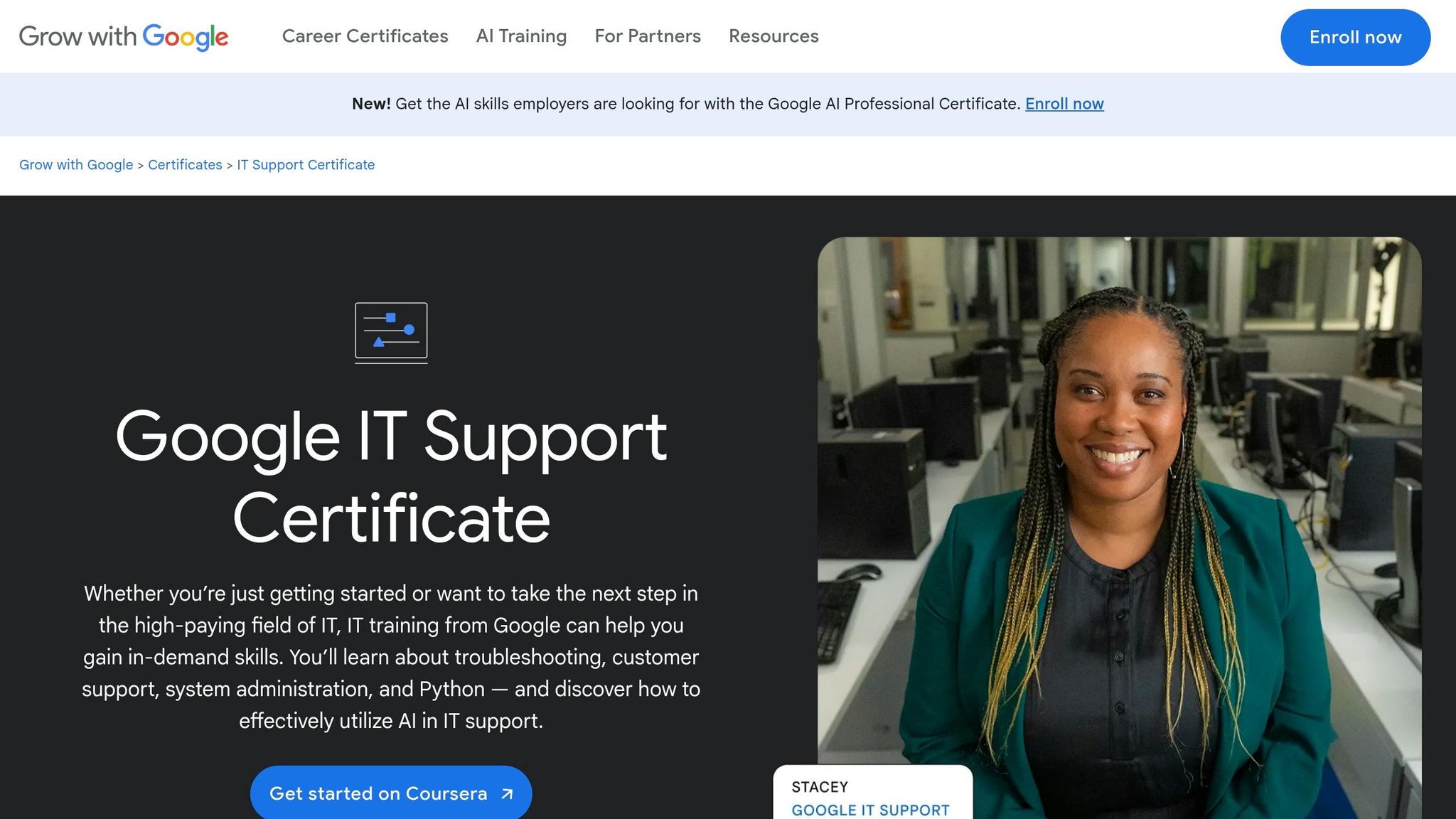
The Google IT Support Professional Certificate is a great starting point for anyone looking to switch careers. It’s an online, self-paced program designed to prepare you for entry-level IT roles in just three to six months, with under 10 hours of study per week. With over 2 million learners enrolled and a 4.8/5 star rating on Coursera from more than 212,000 reviews, it’s proven to be a popular choice for aspiring IT professionals [14].
Cost
The program costs $49 per month after a 7-day free trial. If you complete it in three months, you’ll spend about $147, while taking six months will cost around $294. Financial aid is available for individual courses, and the program is ACE® approved, meaning you can earn 12 to 15 college credits - equal to four or five bachelor’s degree-level courses [14].
Skills Covered
This program includes five courses that cover a range of essential IT topics:
- Technical support fundamentals
- Networking concepts like TCP/IP, DNS, and DHCP
- Operating systems, including Windows and Linux
- System administration
- IT security
The curriculum also introduces AI tools to enhance troubleshooting and automate repetitive tasks, giving you a modern edge in IT support. Additionally, the certificate aligns with CompTIA A+ objectives, so graduates who pass the CompTIA A+ exams can earn dual credentials from both organizations [14].
Career Outcomes
About 75% of graduates report achieving a positive career milestone - such as landing a new job, earning a promotion, or receiving a raise - within six months of completing the program [14]. Entry-level IT support roles offer a median salary of around $65,000, and there are over 295,000 open positions across the U.S. Graduates also gain access to CareerCircle and a hiring network of more than 150 companies, including big names like Deloitte, Verizon, and Walmart, all actively seeking candidates with this certification [14].
As one graduate, Yvonne J., shared:
"Obtaining the certification changed my life, and now I'm living my dream. I'm excited about my new job and the future" [14].
This program not only prepares you for IT support roles but also introduces AI-driven troubleshooting, paving the way for advanced certifications. Up next, we’ll dive into Microsoft’s AI certification tracks and how they cater to the increasing demand for AI expertise.
sbb-itb-119ea25
4. Microsoft AI-901 (Azure AI Fundamentals)
The Microsoft AI-901 (Azure AI Fundamentals) certification is an entry-level, no-code credential designed for those looking to transition into AI-related fields. It doesn’t require prior experience in data science or software engineering, making it an accessible option for beginners. With the growing demand for AI expertise, this certification offers a practical way to start learning AI concepts without needing a technical background.
Cost
The exam is priced to be affordable for a broad audience, with a standard fee of $99 USD [16]. However, discounts are widely available. Students with a valid .edu email can pay as little as $0–$15 in certain regions. Employees at organizations participating in Microsoft's Enterprise Skills Initiative (ESI) may qualify for discounts ranging from 50% to 100%. Additionally, Microsoft events like Ignite or Build often provide free exam vouchers through their Cloud Skills Challenges. For those looking for extra preparation, the Exam Replay bundle costs about $160 and includes an exam voucher, a retake, and a practice test [16].
Skills Covered
The AI-901 exam has been updated to include generative AI, which now comprises 20–25% of the test content [15]. Topics include:
- AI Workloads and Machine Learning: Regression, classification, and clustering principles.
- Computer Vision: Tasks like image classification, object detection, and optical character recognition.
- Natural Language Processing (NLP): Techniques such as sentiment analysis, entity recognition, and translation.
- Generative AI on Azure: A newer focus area reflecting industry trends.
The exam also emphasizes Microsoft's six principles of responsible AI: fairness, reliability/safety, privacy/security, inclusiveness, transparency, and accountability. Test-takers will face 40–60 questions, with a time limit of 45–60 minutes. A passing score is 700 out of 1,000 [15].
To prepare, candidates can follow the official Microsoft Learn "Azure AI Fundamentals" learning path [16]. Most people need just 6–15 hours of study time [18]. For hands-on practice, Microsoft’s Azure Free Account provides $200 in credits.
Career Outcomes
Though an entry-level certification, the AI-901 can significantly boost career prospects. It validates foundational AI skills and can lead to roles such as:
- AI Support Specialist: Salaries typically range from $75,000 to $95,000.
- Junior Data Analyst: Average pay is about $80,000 to $105,000.
- Cloud Support Associate: Another common career path [16].
This certification can increase earning potential by 10–15%, and 26% of certified individuals report receiving a promotion within six months [19]. Additionally, professionals with specialized AI skills often earn a 56% premium compared to standard IT roles [19].
The AI-901 also serves as a gateway to advanced certifications like Azure AI Engineer Associate (AI-102) and Azure Data Scientist Associate (DP-100). Unlike higher-level Microsoft certifications, the AI-901 does not require annual renewal and remains valid indefinitely [17]. Keep in mind, however, that the AI-900 exam will be retired on June 30, 2026, making AI-901 the primary entry-level certification for AI on Azure [15].
5. Microsoft AI Business Professional (AB-720)
Microsoft has expanded its certification offerings to meet the growing demand for AI skills, catering to both technical and business professionals. The Microsoft AI Business Professional certification (Exam AB-730, also referred to as AB-720) is designed for individuals looking to leverage AI tools without diving into coding. While the Microsoft AI-901 certification focuses on technical roles, this one is tailored for non-technical professionals, helping them incorporate AI into daily business workflows. It certifies proficiency in using tools like Microsoft 365 Copilot, Researcher, and Analyst to streamline operations. This certification is particularly relevant for those in marketing, sales, operations, HR, and finance who want to enhance their AI capabilities and demonstrate their expertise in AI-driven processes.
Prerequisites
This certification does not require any coding experience. However, candidates should have a basic understanding of Microsoft 365 applications, including Teams, Word, Excel, Outlook, and PowerPoint. Familiarity with AI-powered features in Microsoft 365 tools is also important. Additionally, a general understanding of common business tasks, such as drafting emails, creating presentations, and managing documents, is necessary. Now, let’s explore the cost details.
Cost
The exam fee is $99 USD. Unlike advanced Microsoft certifications that require paid renewals, this credential can be renewed annually for free through an online assessment on Microsoft Learn. During promotional events, such as the recent Credentials AI Challenge, discount vouchers can reduce the exam cost by as much as 50%.
Skills Covered
The 45-minute exam requires a minimum score of 700 out of 1,000 to pass [20]. It focuses on three key areas:
- Generative AI Fundamentals (25–30%): Covers topics like Copilot privacy, security, responsible AI practices, and mitigating risks such as hallucinations and prompt injections.
- Managing Prompts and Conversations (35–40%): Tests skills in crafting effective prompts, referencing resources, and managing AI-powered conversations effectively.
- Drafting and Analyzing Business Content (25–30%): Assesses your ability to create documents, summarize meetings, and transfer insights across Microsoft 365 applications.
For those already familiar with Microsoft 365, preparing for the exam typically takes about 2–3 weeks.
Career Outcomes
Earning this certification opens doors to roles like AI Business Strategist, Business Analyst, Project Manager, or AI Transformation Consultant. Salaries in these positions range from $85,000 to approximately $136,700, often with a 20–25% salary boost compared to non-certified professionals.
Liberty Munson from Microsoft highlights the value of this certification:
"This new Certification shows employers that you're an AI-ready professional who can drive better outcomes in any business role, that you're fluent in using AI in your day-to-day projects."
With 81% of hiring managers placing a high priority on AI skills when evaluating candidates, this certification offers a clear edge for those transitioning into AI-focused roles [1].
Advantages and Disadvantages
Choosing the right certification can make or break your career transition into IT. Each certification comes with its own set of benefits and challenges, and understanding these can help you make a well-informed decision about where to invest your time and money. Below is a breakdown of the strengths and weaknesses of key certifications, focusing on factors like cost, industry relevance, and their ability to help you land an entry-level IT role.
| Certification | Strengths | Weaknesses |
|---|---|---|
| CompTIA IT Fundamentals (ITF+) | Affordable at just $138; provides a low-risk way to explore whether IT is the right career path [5] | Limited value in the job market; too basic for most entry-level IT roles [5] |
| CompTIA A+ | Widely recognized as the "gold standard" in IT certifications; holders earn, on average, 30% more than non-certified peers [4] | Costs $530 for both required exams; requires passing two separate tests [4] |
| Google IT Support Professional Certificate | Budget-friendly at about $234 for six months; 75% of graduates report career benefits within six months [2] | Less widely recognized by traditional corporate IT departments compared to CompTIA certifications [4] |
| Microsoft AI-901 (Azure AI Fundamentals) | Quick to complete in 1–2 months; AI-certified professionals can earn up to 47% more [6] | Only covers foundational concepts; primarily serves as a stepping stone to more advanced certifications [6] |
| Microsoft AI Business Professional (AB-720) | Leads to high-paying roles ($85,000–$136,700) without requiring coding skills [1] | Newer certification still gaining traction; most effective for those with 2–3 years of business experience [1] |
These certifications reflect a shifting job market where AI expertise is increasingly in demand. For instance, 87% of technology leaders report offering higher salaries to candidates with AI and machine learning certifications, highlighting the growing importance of Microsoft's AI-focused credentials [4].
If you're looking for immediate employment, CompTIA A+ remains the most sought-after certification for help desk roles. On the other hand, the Google IT Support Professional Certificate is a cost-effective way to break into IT and can serve as a stepping stone toward earning the A+ later [4]. For those transitioning from non-technical fields into roles like business strategy or consulting, the Microsoft AI Business Professional certification offers a direct path to high-paying opportunities - no coding required [1].
Conclusion
Breaking into IT in 2026 isn’t just about mastering technical skills - it’s also about earning the right certifications to match what the industry is looking for. With 73% of hiring managers now requiring formal AI credentials for entry-level positions, the certifications covered here reflect how AI is reshaping the job market [3].
For traditional IT support roles, CompTIA A+ remains a solid choice. It’s widely respected and comes with a bonus: earning a new IT certification has been linked to an average salary bump of $13,000 [2]. On the other hand, for those targeting corporate environments built around Microsoft 365 - used by 85% of Fortune 500 companies - the Microsoft AI-901 (Azure AI Fundamentals) or AB-720 certifications offer a way to combine IT basics with AI-driven automation skills.
If you’re just starting out, the Google IT Support Professional Certificate is a great option. At around $49 per month, it’s affordable, and 75% of graduates report career advancements within six months [2]. Plus, its recent update, which includes AI-assisted troubleshooting, makes it a smart choice for modern help desk roles.
For those focusing on AI-specific skills, certifications like the Microsoft AI-901, priced at $99, can lead to significant financial rewards. AI-certified professionals have been shown to earn up to 47% more than their non-certified counterparts [6]. Before committing, it’s wise to research job postings on platforms like LinkedIn to see which certifications are most sought after in your area. The right certification can do more than just get your foot in the door - it can fast-track your career into specialized and higher-paying roles.
FAQs
Which certification should I start with if I have zero IT experience?
If you're just stepping into the world of IT, the CompTIA A+ certification is a great way to begin. It focuses on essential skills such as hardware, troubleshooting, and basic networking - perfect for those aiming for entry-level positions. Often referred to as the "gold standard" for help desk roles, this certification demonstrates your foundational IT knowledge and provides a strong technical starting point for beginners or those transitioning into the field.
How do I choose between CompTIA A+ and Google’s IT Support Certificate?
Choosing between CompTIA A+ and Google's IT Support Certificate comes down to what you want out of your career.
The CompTIA A+ certification is well-known in the industry and dives deep into hardware, software, and security topics. It’s a solid choice if you're aiming for roles with higher salary potential and want a credential that carries weight across IT sectors.
On the other hand, Google's IT Support Certificate is a more affordable and flexible option. It emphasizes hands-on learning, making it great for beginners. However, it doesn’t carry the same level of industry recognition as CompTIA A+.
If you want to stand out, consider pursuing both. This combination gives you the practical skills from Google’s course along with the respected certification of CompTIA A+, boosting your job prospects significantly.
Should I take Microsoft AI-901 or AB-720 if I want AI skills fast?
The Microsoft AI-900 (Azure AI Fundamentals) exam is perfect for beginners looking to grasp the basics of AI and Azure services. It’s relatively straightforward, with many candidates managing to pass after dedicating just 6–15 hours of study time.
On the other hand, the AB-720 exam is more specialized, focusing on AI administration within Microsoft 365. This makes it a great choice for those with prior experience in the field, but it does demand more extensive preparation compared to the AI-900.
If you’re aiming to pick up AI skills quickly, the AI-900 is the faster and more accessible route.