

If you’re weighing Cisco continuing education credits vs recertification exam options, start with your renewal goal and the study time you can protect. I’d favor eligible coursework when the learning fits your work and your schedule. I’d favor an eligible exam when you already want that exam outcome and can prepare for it realistically.
Make eligibility your first check. Confirm the current requirements for your exact credential, including accepted activities, credit totals, qualifying exams, and completion deadlines. The recommendations below help you compare personal fit; they don’t establish those policy details.
I’ve ordered these five tradeoffs around the decisions to make before committing: study time, total spending, assessment pressure, career relevance, and deadline margin. For each, compare a specific course plan against a specific exam plan. Leave neither side as an appealing idea without a calendar or budget.
1. Study time: compare the whole workload
For the CE-versus-exam decision, I’d compare two complete schedules before choosing either route. Avoid assigning yourself an exam date or buying coursework based only on the advertised learning duration.
Build a coursework schedule you could actually follow
For each activity you’re considering, record its stated duration, completion requirements, and applicable submission steps. Verify its eligibility and credit value separately.
Then build your own time estimate around those details. Include room for exercises, unfamiliar concepts, note review, and any required assessments. Treat that estimate as a planning assumption rather than a promise about completion time.
Suppose you can protect two evenings each week. Assign actual activities to those evenings. Leave some sessions open for unfinished work instead of filling every available hour from the start.
I’d lean toward coursework if you prefer steady progress and can identify eligible learning you want to complete. The limitation to test is whether you’ll sustain that schedule. If your proposed plan depends on uninterrupted evenings during a busy project, revise it before paying.
Choose a weekly completion target you can describe clearly: finish a specified module, complete its required work, and record the result.
Estimate exam preparation from your starting point
For the exam route, begin with the exact exam code and current objectives. Mark each objective as ready, uncertain, or needing substantial study.
Use questions and practical exercises to challenge your initial ratings. For every topic marked ready, try explaining your reasoning without notes. For every uncertain topic, identify the work you would do next.
Build the calendar from those gaps. Include study sessions, practical review, timed rehearsal, and a final readiness check. Keep the exam appointment separate from your estimated preparation hours.
I’d lean toward testing when your review suggests a manageable set of gaps and the exam fits a goal you already have. The drawback to examine is how much unfamiliar material your initial estimate overlooks.
Before deciding, compare both schedules against the same working month. Include on-call duties, travel, family commitments, and planned leave. Choose the route whose weekly workload you can defend on that calendar.
2. Financial cost: compare complete budgets
For recertification spending, I’d compare the full amount you expect to pay under each proposed plan. Keep your personal spending separate from employer reimbursement, and confirm reimbursement conditions before relying on them.
Price the learning you need to complete
For coursework, request or record the current price of each eligible activity you intend to use. Check what the purchase includes, how long access lasts, and whether your proposed completion schedule fits those terms.
Avoid treating an existing subscription as sufficient until you’ve matched its included activities to your renewal plan. Likewise, treat a possible promotion or free activity as an option to verify before including it in the budget.
Use three spending categories:
- Already paid and usable under the proposed plan.
- Additional purchases needed to complete it.
- Optional resources you would buy only for extra learning.
If your employer is paying, ask which purchases qualify, who must approve them, and when reimbursement happens. Record any conditions that would leave you responsible for the bill.
I’d favor CE on cost when you can identify eligible learning within an approved budget and want the material for your work. The limitation is the total purchase you must make to complete your particular plan.
Give the exam route a second budget
For testing, record the current booking price and applicable terms for your selected exam. Add the preparation resources, travel, or other expenses you expect to incur.
Then write a separate contingency budget. Decide what you would be willing to spend if you needed more preparation or another attempt. Verify any applicable waiting periods and booking rules before putting that possibility on your calendar.
Keep hypothetical arithmetic clearly separate from current Cisco pricing. For example, if your own coursework estimate is $600 and your exam plan totals $450, compare those two documented estimates. Don’t present either figure as a standard renewal cost.
I’d choose the exam route on price only after budgeting for the preparation I intend to use. Its limitation is whether the initial budget leaves enough room for a change of plan.
Finish with two numbers for each route: expected spending and maximum affordable spending. If either exceeds your limit, change the plan before purchasing.
3. Assessment pressure: choose a process you can rehearse
For the CE-versus-testing decision, assess the work and assessment conditions you’re willing to prepare for. I wouldn’t label either route comfortable without reviewing its actual requirements.
Review the coursework completion conditions
Before choosing CE, inspect each activity’s assessment and completion rules. Ask what you must submit, which exercises you must finish, and how you will confirm completion.
If you prefer working through material over several sessions, use that preference in your decision. Still, build your plan around the activity’s stated requirements rather than an assumption that attendance or viewing alone will suffice.
Consider a hypothetical week when a work incident interrupts your schedule. Decide in advance which session you would move and how you would recover the missed work.
I’d lean toward coursework if you’re comfortable managing that ongoing process. The drawback to consider is whether you’ll keep track of several unfinished activities without a firm weekly routine.
Put a short review on your calendar. At each review, record what you completed, what remains, and the next scheduled session.
Rehearse the exam conditions you’re concerned about
For an exam plan, name the source of your concern precisely. Is it pacing, unfamiliar topics, technical setup, or choosing between plausible answers?
Match the preparation activity to that concern. Use timed sessions to examine your pacing. Use practical exercises for topics you can recognize but struggle to apply. Review the current delivery requirements before arranging your test environment.
If you’re preparing for 200-301, you could include ExamJungle’s CCNA 200-301 practice test in your rehearsal plan. For each question you review, explain your reasoning before checking the answer.
Separate incorrect answers from correct answers you guessed. Give both groups a place in your review schedule. Avoid choosing a readiness threshold solely because a percentage looks reassuring.
I’d favor testing when you’re willing to rehearse the conditions that concern you and can explain the material behind your answers. The limitation is whether you’ve reserved enough time for that preparation.
Write one readiness requirement for knowledge and one for pacing. Revisit the appointment if your preparation hasn’t met either requirement.
4. Career relevance: give the study a second purpose
For renewal through CE or an exam, I’d prioritize a plan that supports a specific work goal. Define that goal before comparing course titles or exam names.
Choose coursework around an actual task
Write down something you want to do more confidently at work. Make it concrete enough to evaluate: explain a design choice, investigate a recurring fault, or complete a configuration task.
Compare that task with the learning outcomes of each eligible activity. Ask what you intend to practice and what you would produce afterward.
For example, suppose your team expects you to contribute to an automation project. Before choosing a course, identify the workflow you want to understand and the exercise you hope to complete. Verify the course content against those expectations.
I’d favor CE if the eligible learning closely matches that task and you have room to apply it. Its limitation is whether you’re choosing material for its relevance or merely because its credit value fits an unfinished total.
Set a small output for the learning: a lab record, an explanation in your own words, or a repeatable procedure. Keep that output alongside your completion records.
Choose an exam around a defined credential goal
For testing, name the outcome you want beyond renewal. It might be maintaining your current focus or pursuing a different credential.
Verify each intended outcome separately. Match the exam code to the renewal requirement, then check what else that exam would contribute toward your career plan.
If enterprise networking topics are relevant to that plan, use the SDA and SD-WAN practice questions only as a topic-specific study resource. Check exam status and renewal eligibility independently before building a certification plan around that code.
I’d lean toward an exam when its verified outcome matches a goal you already intend to pursue. The drawback is whether you’re committing to preparation for a credential you don’t otherwise want.
Write two separate completion statements: “My current credential is renewed” and “My intended career milestone is met.” Identify the evidence you would need for each. Choose a route only after you can explain how it supports the statements that matter to you.
5. Deadline margin: compare what remains unfinished
As your renewal deadline approaches, compare the remaining work under each route. I’d make that comparison from verified requirements and completed progress rather than from your original plan.
Put coursework completion and record checks on the calendar
For CE, list every unfinished activity. Beside each one, record the remaining learning, assessment, documentation, and submission steps that apply.
Verify the relevant completion and reporting rules. Keep separate dates for finishing the activity, submitting anything required, and checking your certification record.
Choose an internal finish date earlier than the official deadline. Set the size of that margin around the steps you’ve verified and the interruptions you can reasonably anticipate. Avoid assuming that finishing the last lesson completes every administrative requirement.
I’d favor coursework near a deadline only if the remaining work fits your available hours and applicable rules. Its limitation is any unfinished step you haven’t included in that estimate.
At each scheduled review, check completed progress against the internal finish date. If the plan no longer fits, reassess the available eligible options immediately.
Put exam readiness and booking conditions on the same calendar
For testing, verify appointment availability, booking terms, result handling, and any rules relevant to another attempt. Compare those details with your current preparation.
Choose a readiness checkpoint before the appointment. At that checkpoint, review your knowledge gaps, pacing, and remaining study sessions.
If your plan depends on another attempt being possible, verify that the applicable timing would fit before relying on it. Keep the contingency as a documented option rather than an assumed spare date.
I’d favor the exam route near a deadline only when preparation and booking details support it. The limitation is whether the proposed date leaves enough room for the specific uncertainties you’ve identified.
For either route, use a short checklist with four fields: requirement, remaining work, planned finish date, and confirmation evidence. An interactive version could flag dates that extend beyond your chosen internal deadline. Enter verified requirements yourself; keep the tool’s role limited to organizing your plan.
Finish by identifying the next incomplete requirement and its scheduled completion date.
Match the route to your current certification level
Use this scorecard after confirming which routes apply to your credential. Treat each row as a planning recommendation, conditional on eligibility.
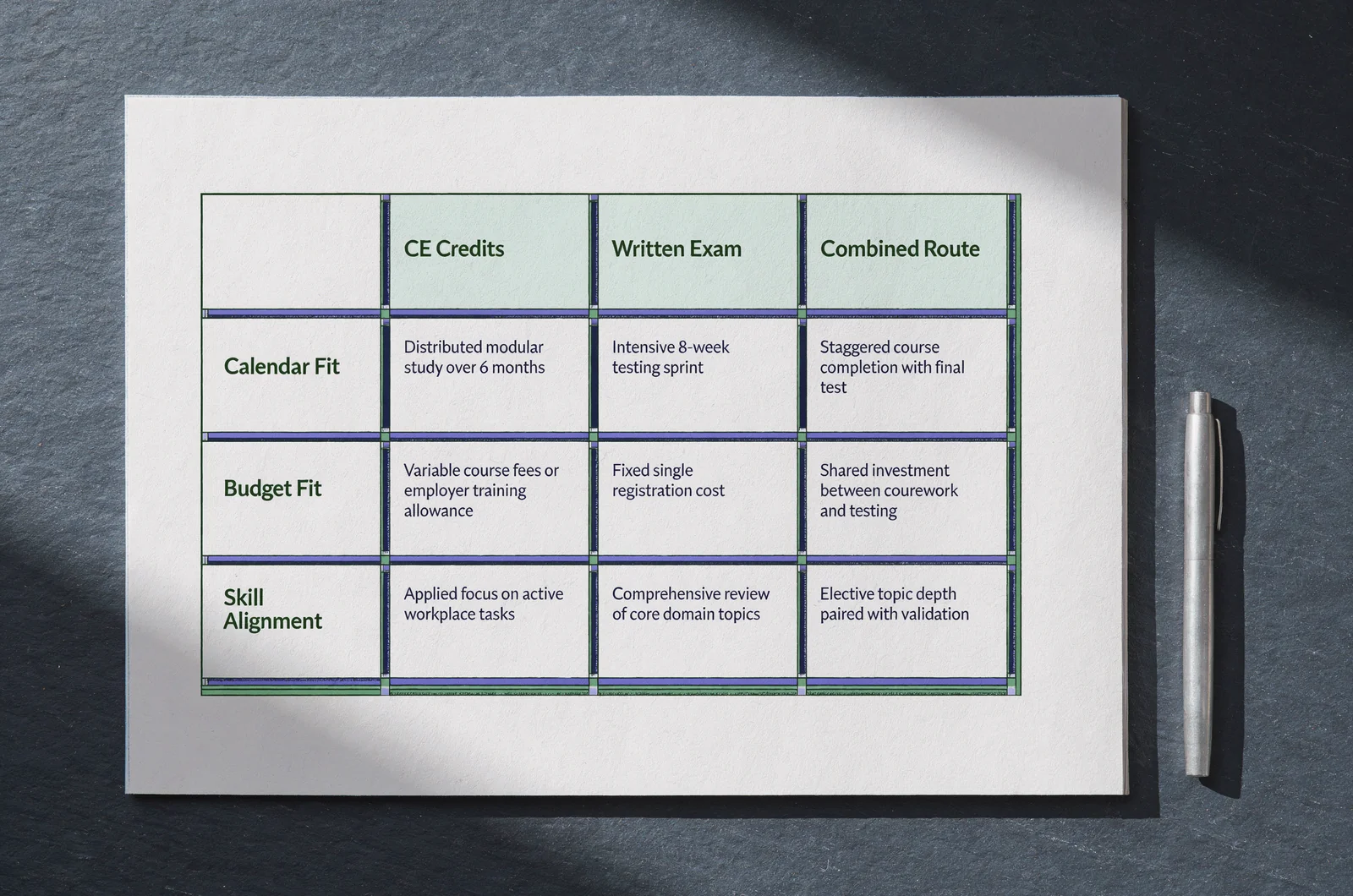
| Route to consider | Schedule to protect | Spending to verify | Reason to choose it |
|---|---|---|---|
| Eligible CE activities | Recurring learning sessions plus completion and reporting time | The activities needed for your full plan | Their learning outcomes match work you want to do |
| Eligible examination | Preparation sessions, rehearsal, and an available appointment | Booking, preparation, and contingency expenses | The verified exam outcome fits an existing goal |
| A permitted combination | Both learning sessions and exam preparation | The complete cost of both components | Your verified progress makes the combined plan practical |
Apply the scorecard to your renewal goal
If you hold CCNA and want to maintain it, compare your specific eligible learning plan with the eligible exam options you’ve verified. I’d choose based on remaining workload, affordability, and the study process you’ll follow consistently.
If you hold a professional-level credential, write that exact credential at the top of the comparison. Check each proposed route against its requirements. If advancement matters too, document that outcome separately before judging the exam route.
If you hold an expert-level credential, make the same comparison using your exact certification status and applicable rules. Account for every credential you intend to maintain rather than assuming a single plan covers them all.
For each case, give the available routes one point for fitting your calendar, one for fitting your budget, and one for supporting your learning goal. Treat those points as your preferences, not an official Cisco scoring system.
If the scores tie, choose the plan with fewer unverified assumptions. Resolve the remaining eligibility or timing questions before spending.
Questions to settle before committing
Use these questions to check the CE or exam plan you’ve selected. Keep your answers beside the requirements and dates you verified.
Can I combine credits with an exam?
Plan around a combination only after confirming that the current rules for your exact credential permit your proposed combination. Record the required components and how you would complete each one.
If you’ve already finished some learning or passed an exam, verify whether that progress applies before counting it toward the plan.
Will any Cisco exam renew my certification?
Require an explicit match between the exam code and your credential’s current renewal requirements. Don’t infer eligibility from the Cisco name, an appealing topic, or a preparation page.
Record the qualifying exam code in your plan before booking or buying study materials for renewal.
What if my certification has already expired?
Check the requirements that apply to your current status before purchasing coursework or arranging an exam. Describe your goal accurately when seeking clarification: maintaining an active credential and addressing an expired one are separate questions to ask.
Use the answer to rebuild your calendar and budget.
Should I pick CE simply because I’m anxious about testing?
I’d first identify the assessment process you’re willing to prepare for. Review the coursework requirements, then compare them with a realistic exam preparation plan.
If eligible coursework fits your learning goals and schedule, choose it on those grounds. If you still want the exam outcome, reserve time to address the specific conditions that concern you.
For the practice pages below, choose only topics that match your study plan. Verify exam status and renewal eligibility separately.
Practice for the Cisco topics in your plan