

AWS exam diagnostic score report interpretation starts with your overall result, followed by the feedback for each exam domain. AWS uses scaled scoring to account for differences between exam forms, while section-level feedback gives a broad picture of performance. Read those pieces separately: the overall result determines whether you passed, and the domain feedback helps direct your review. AWS’s scoring explanation describes that distinction.
If you’ve received a disappointing result, I’d start by recording what the report actually says before choosing another test date. If you passed, use the same approach to decide what deserves further study. Either way, work toward a practical outcome: an accurate reading of the result and a focused list of topics to investigate.
Where do you find your official AWS score report?
Access your report through your AWS Certification Account and open the exam history area. AWS’s published policy says exam results are available within five business days after completing the exam. Use the account record for your official result and score report. AWS exam result policies explain access and reporting timelines.
Before interpreting anything, check the exam name, exam code, and attempt date. Keep the report beside the exam guide for that certification. Avoid relying on a screenshot with the identifying information cropped out.
For your own notes, copy these details:
- The certification and exam code.
- The date of the attempt.
- The overall pass or fail result.
- The reported scaled score and passing threshold.
- Each domain name and its performance classification.
Copy the wording exactly. Leave a blank where information is absent rather than filling it from memory or another candidate’s report.
If the published reporting window has passed and you still cannot find your result, follow the support instructions associated with your Certification Account. Keep your registration details available.
I’d also save an unchanged copy before annotating it. Put interpretations, study priorities, and questions in a separate document. That gives you a clean record to revisit when deciding whether your review plan still matches the original feedback.
What does your scaled score actually tell you?
Your scaled score tells you where your performance sits relative to the exam’s passing standard. AWS’s August 2020 scoring explanation describes a scale of 100–1000, with passing thresholds of 700 for Foundational, 720 for Associate, and 750 for Professional and Specialty exams. Scaling accounts for differences in difficulty between exam forms; these thresholds are scaled scores rather than percentages correct. Confirm the threshold against your own report and exam guide. AWS’s scaled scoring explanation explains the mechanism.
Consider a hypothetical report showing 710 against a passing threshold of 720. Record the difference as ten scaled points. Avoid translating that into a number of questions you needed to answer differently.
Similarly, don’t rewrite a score of 780 as “78% correct.” Keep the number in its original form and attach the exam code when recording it.
I’d use the overall score for two decisions:
- Record whether the attempt met the reported passing standard.
- Choose whether to investigate the domain feedback for further preparation or continued learning.
Resist building a retake plan around a tiny numerical gap alone. Instead, ask what you can now explain, apply, and distinguish more confidently.
For example, replace “I need ten more points” with a concrete study objective: “I will review the deployment tasks flagged by my practice results and explain the reasoning behind each answer.” Keep your progress notes tied to those tasks.
What do the domain performance ratings mean?
Read domain ratings as broad feedback about a section’s performance. Where your report uses “Meets Competencies” and “Needs Improvement,” those classifications describe performance relative to the expected competency level. AWS cautions against treating section feedback as a precise measurement because individual sections contain fewer questions than the overall exam. AWS’s section feedback explanation provides that context.
Copy each classification beside its domain name. Do not assign a hidden percentage to it, calculate a domain score, or rank two equally labeled domains without additional evidence.
If a domain is flagged for improvement, use it to open an investigation:
- Locate that domain in the guide for your exam code.
- Read its task statements.
- Mark tasks you want to investigate through practice or study.
- Record the specific reasoning you want to improve.
For a broader orientation, consult the AWS exam domain breakdown, then return to the official guide when choosing individual tasks.
Suppose two domains carry the same improvement label. Don’t decide that one was worse simply because you remember feeling less confident about it. Review both against your practice notes before choosing an order.
I’d also avoid treating a satisfactory classification as permission to abandon that domain. Keep a small amount of mixed practice in your plan, while directing your deeper review toward the tasks you’re struggling to explain.
Preserve the report’s labels and write your study decisions beside them.
Can you pass with a weak domain?
Yes. The AWS Certified Developer – Associate exam guide explicitly describes a compensatory scoring model: candidates need to pass the overall exam rather than achieve a passing score in every section. Under that model, a successful overall result can coexist with weaker section feedback. The Developer Associate guide states the scoring rule.
Read your overall result first. Then use the section classifications to choose what to study further. Avoid replacing the reported outcome with your own judgment based on the number of weaker domains.
If you passed, I’d make a smaller follow-up plan. Choose one task from the weaker domain and work through its reasoning before moving on to another certification.
If you failed, avoid the opposite interpretation: counting satisfactory domain labels and deciding that the overall result must be wrong. Keep the result and the diagnostic feedback in their separate roles.
For another AWS certification, check the scoring section in that exam’s own guide before applying an exam-specific detail.
A useful way to organize your notes is to give the two decisions separate lines:
- “Official outcome: copy the reported result.”
- “Learning priority: list the tasks I want to strengthen.”
Under the second line, write an objective you can demonstrate. For example, plan to explain a service choice against the scenario’s requirements without consulting the answer explanation.
Can the report tell you which questions you missed?
AWS does not provide a question-by-question account of correct and incorrect answers in its certification score reporting. The feedback supports review at the section level rather than reconstruction of individual exam answers. AWS’s score reporting policy describes the information available after testing.
Use the report to choose a domain, then investigate your understanding with practice questions and the exam guide. Avoid trying to recreate the exam from remembered wording.
After a practice question, I’d write a brief explanation answering four prompts:
- What requirement drove my answer?
- Why did the selected option satisfy that requirement?
- Why did the closest alternative fall short?
- What change in the scenario would change my choice?
Keep that exercise tied to practice material rather than remembered live exam items.
Suppose a hypothetical practice scenario asks you to choose an architecture under a specific operational constraint. Write the constraint in your own words before reading the explanation. Then compare your reasoning with the explanation and identify what you overlooked.
Give each review note a task-level label, such as “identify the access requirement” or “compare deployment approaches,” instead of a vague heading like “security.”
If you cannot explain why you chose an answer, keep that task on your review list even when the selection was correct. Revisit it with a different practice scenario and write a fresh explanation.
How should you use exam-domain weights?
Use domain weights alongside the report’s classifications when choosing study priorities. For DVA-C02, exam guide version 1.4 assigns 32% to Development with AWS Services, 26% to Security, 24% to Deployment, and 18% to Troubleshooting and Optimization. These percentages describe the distribution of exam content, while section classifications describe performance. The DVA-C02 exam guide lists those weights.
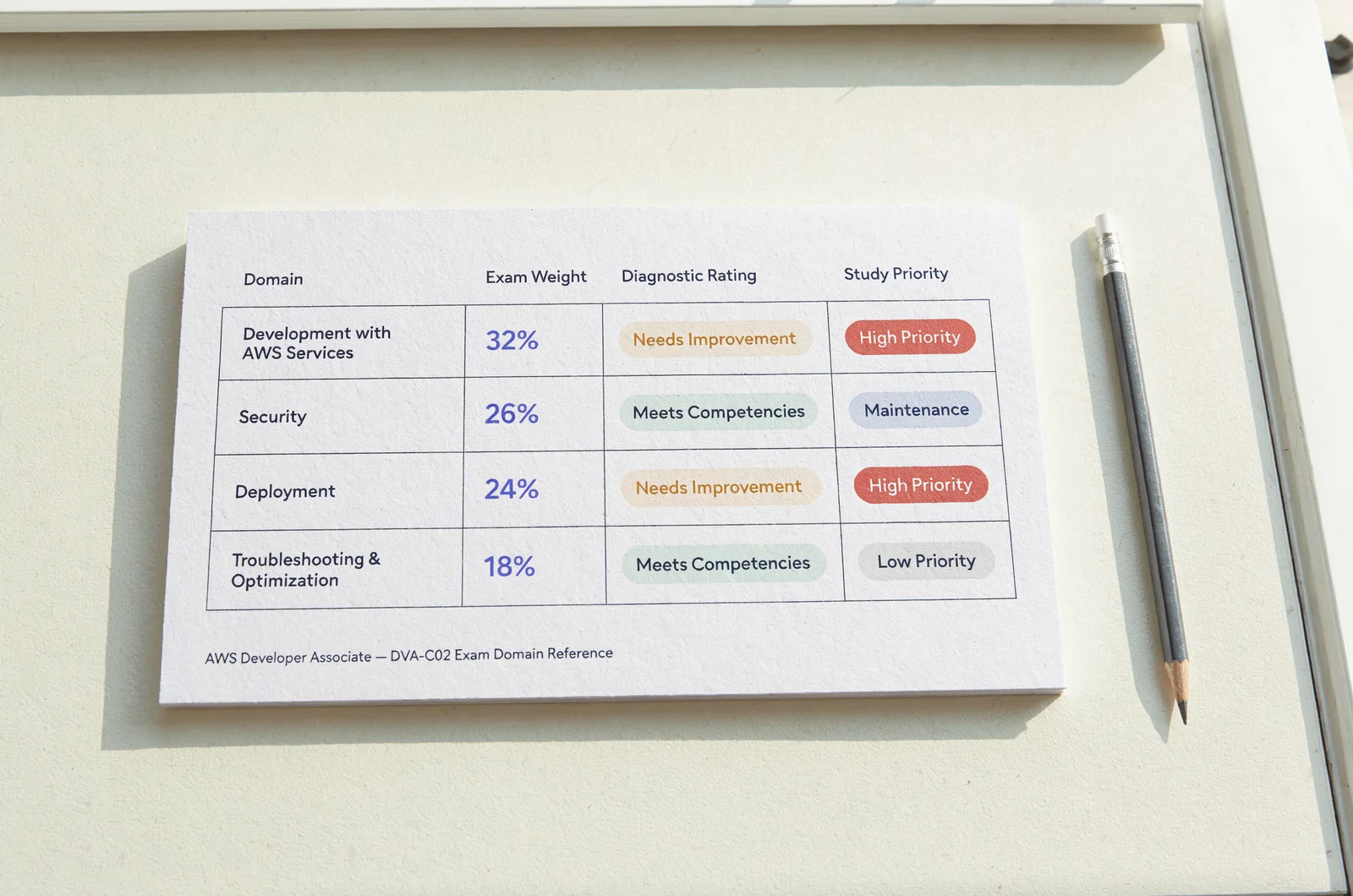
Keep those two kinds of information in separate columns in your notes. Avoid reading a domain’s content weight as your score for that domain.
For a hypothetical DVA-C02 report with Development and Troubleshooting flagged for improvement, consider starting with Development. Then reserve a separate review session for Troubleshooting.
Treat that order as a planning choice. Adjust it if your practice explanations reveal a more specific gap elsewhere.
I’d prioritize using this sequence:
- Start with a domain flagged for improvement.
- Identify a task you cannot explain confidently.
- Consider that domain’s weight in your exam guide.
- Choose a review activity that addresses the task.
- Reassess the priority after another practice set.
Avoid dividing study hours mechanically according to the weights. Instead, assign each session a task and a way to check your reasoning afterward.
Before applying any numbers from an example, compare the exam code and guide version with your own preparation materials. Write the applicable weights beside your domain labels, then select your first review task.
How do you turn the report into a focused study plan?
Turn each weaker domain into a short list of tasks, then give every study session a specific purpose. I’d begin with the report and exam guide open together, and leave scheduling the next exam until after this first review.
What should you record before studying again?
Create a working document with a row for each domain. Record its classification, the tasks you want to investigate, and the evidence you intend to collect through practice.
Use prompts rather than broad judgments:
- “Can I explain this requirement without opening my notes?”
- “Can I distinguish the two closest answer options?”
- “Can I identify the detail that changes the solution?”
- “Can I apply the same idea when the scenario changes?”
Keep your first review cycle manageable. Select a few tasks and assign an activity to each: reread the relevant explanation, work through a practice scenario, or write out the decision process.
When choosing supporting practice material, use the exam code as your starting point. Consult ExamJungle’s AWS practice collection and select the certification that matches your preparation.
If you’re preparing for CLF-C02, use ExamJungle’s Cloud Practitioner practice exam as a place to investigate the concepts on your review list. Keep your notes aligned with the tasks in your exam guide.
Write what you intend to learn before beginning the session.
How should you review a weak task?
Work through one practice question without consulting notes. Record your answer and your reasoning before opening the explanation.
Then review the explanation in detail. Identify the requirement that decided the answer and compare it with the requirement you used. If those differ, rewrite your reasoning.
Finish with a short explanation in your own words. Avoid copying the answer commentary into your notes. Include the condition under which a different option would become appropriate.
For example, frame a hypothetical review objective as: “I will explain how changing the operational requirement changes the service choice.” Keep the objective narrow enough to complete in one session.
On your next review, choose a different scenario covering the same task. Explain the decision again before checking the answer. Leave the task open if your reasoning remains unclear.
A useful interactive checklist for this process would accept an exam code, domain classifications, and available study hours. It could help organize a task-based review schedule without predicting an official exam score.
End each session by writing the task to revisit and the question you still need to resolve.
How do you judge progress with practice exams?
Judge progress through your reasoning across unfamiliar practice scenarios, alongside the reported practice result. I’d keep practice percentages and official scaled scores in separate records and avoid converting between them.
What should you measure beyond accuracy?
For each practice set, record the exam code, whether you used notes, and whether the questions were new to you. Keep those conditions consistent when comparing sessions.
Add a short explanation review after scoring:
- Identify correct answers you chose with uncertain reasoning.
- Review incorrect answers and name the requirement you overlooked.
- Mark questions where you struggled to distinguish alternatives.
- Record items where you needed more time to make a decision.
Choose your next study task from those notes. Avoid treating every incorrect answer as the same kind of problem.
For a hypothetical missed question, you might decide to review a concept, practice reading the scenario’s constraints, or work on comparing two plausible options. Write the chosen action beside the question.
If you remembered an answer from an earlier session, set that item aside when assessing your reasoning. Use a different scenario to check whether you can explain the underlying decision.
For professional-level preparation, apply the same review process to ExamJungle’s DevOps Professional practice test, with DOP-C02 objectives beside your notes.
When should you use a timed practice set?
Use a timed set after completing focused review, so you can assess your decisions under a time constraint. Choose the settings appropriate to your exam preparation and complete the session without opening explanations along the way.
Before starting, decide what you will review afterward. Include unanswered items, uncertain selections, and questions where you spent longer than intended.
Afterward, separate the score from the review notes. Ask whether you rushed a requirement, struggled with a concept, or hesitated between alternatives.
Then return to focused study for the tasks you identified. Avoid repeating the same full practice set immediately as your only follow-up activity.
For your next readiness review, choose unfamiliar material and compare your explanations with the objectives you wrote earlier. Record what you can now explain clearly and which tasks still need another session.
When can you retake the exam, and when should you?
AWS requires a 14-day wait after a failed exam before another attempt, and its policy requires payment for each exam attempt. That waiting period establishes the earliest permitted retake; choose your study schedule separately. AWS’s exam retake policy sets out the requirements.
I’d select a retake date after checking three things: whether you completed the planned review, whether you can explain the previously weak tasks, and whether you have completed a timed practice session under the conditions you chose.
Use those checks as a personal decision process rather than a promise about the next result.
If an employer or project deadline influences your timing, write down the study hours you actually have available. Assign those hours to specific tasks before committing to a date.
For a hypothetical candidate with a few evenings available, prioritize the tasks supported by both the report and practice review. Avoid filling the schedule with another complete course unless that is the review activity you deliberately choose.
Before booking, write a short preparation note:
- The tasks I reviewed.
- The reasoning I can now explain.
- The uncertainties I still need to resolve.
- The study time available before the appointment.
If substantial uncertainties remain, choose another review cycle. Let the final scheduling decision follow your preparation notes, the official waiting requirement, and the time you can realistically commit.
Which AWS study resources fit your report?