
For AICP American Institute of Certified Planners certification, passing the exam and earning the credential are separate milestones. APA members may take the exam while completing their planning experience. After passing, they submit an education and experience assessment once they meet the professional experience requirements. APA explains this sequence in its certification pathway guidance.
I recommend planning two timelines: one for exam preparation and another for documenting qualifying work. Decide when you want to test, identify the experience requirement attached to your education, and prepare evidence of your responsibilities. This guide walks through those decisions, including the different timing implications of the 2026 standard and pilot exams.
What AICP certification recognizes
AICP certification reflects education, professional planning experience, planning knowledge, and ethical practice. Certified planners also commit to continuing professional education. APA describes these commitments in its overview of AICP certification.
Start by connecting that credential to the work you want to do. Review the requirements in your target job descriptions. Ask your employer whether certification affects advancement, assignment eligibility, or reimbursement. Record the answers before choosing a preparation budget.
If you’re coming from IT, approach the pathway through your actual responsibilities. Describe any involvement in community planning, policy development, public engagement, or evaluating development alternatives. Then ask APA how that work fits its experience criteria.
Keep separate credentials in separate study plans. If your role combines planning and drafting, you might also prepare with ExamJungle’s AutoCAD certification practice test. Give that preparation its own objectives and schedule. For your AICP application, explain the planning responsibilities behind your work.
Before committing to certification, write a short answer to this question: Which planning responsibilities do I want the credential to support? Use that answer to guide your conversations with your employer and APA.
Match your education to the experience requirement
For your AICP timeline, begin with the education category attached to your professional experience requirement. Assemble your degree records before estimating an application date.
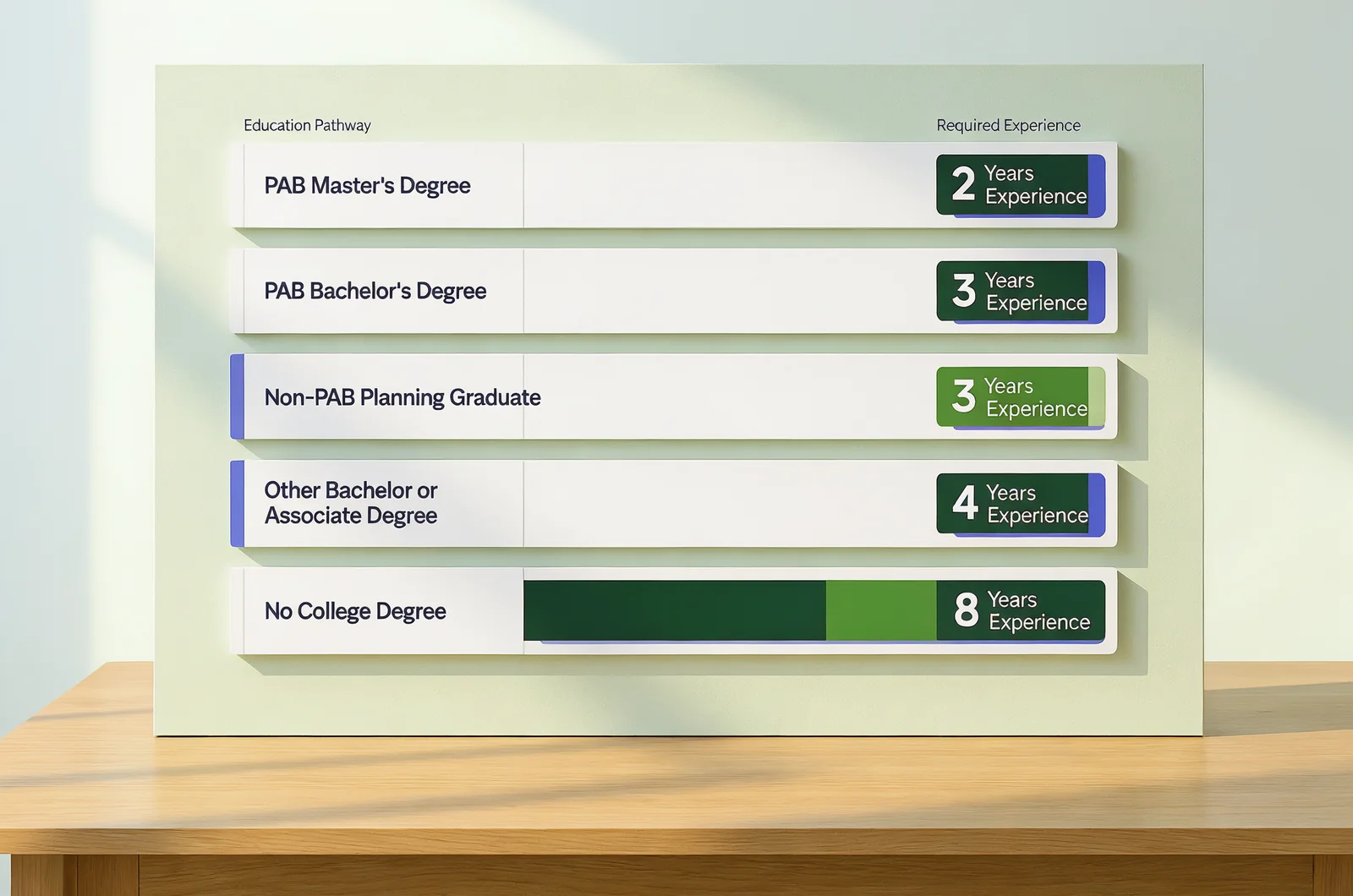
Confirm the degree category
APA’s published categories require two years of professional planning experience for a PAB-accredited planning master’s degree; three years for a PAB-accredited planning bachelor’s degree; and three years for a non-PAB-accredited planning graduate degree. Other undergraduate or graduate degrees, including associate degrees, require four years. Applicants without a college degree, or without degree information, require eight years. PAB means Planning Accreditation Board. APA also specifies that an accredited degree must have been earned during the program’s recognized accreditation period. These categories appear in its certification eligibility checklist.
Check the program’s exact name, your degree type, and your graduation date. Avoid choosing a category because the wording on your diploma sounds close to planning. If the classification is uncertain, ask APA before building your timeline around it.
For a non-accredited planning graduate degree, compare your coursework with the current curriculum guidance. Gather course descriptions if you need clarification. Keep the question specific: identify the degree, institution, graduation date, and category you believe applies.
Estimate the remaining experience carefully
Create a dated employment record. For each position, list your start and end dates, working hours, planning responsibilities, and any periods that need clarification.
Flag overlapping jobs instead of assuming both periods count in full. Mark internships, academic work, volunteer responsibilities, and mixed technical roles for individual review. Ask how each uncertain period should be treated.
A useful personal eligibility estimator would accept your degree category, employment dates, and hours worked. It should flag overlapping periods and leave disputed experience uncounted until clarified.
Choose a tentative application date only after resolving those questions. Keep your exam date in a separate field.
Document planning work for the experience assessment
Your AICP experience assessment should explain what you did and how it meets the current criteria. Start preparing that explanation before the submission window approaches.
APA’s assessment asks for education verification, employment history, and evidence addressing three professional planning experience criteria. Applicants select applicable activities and provide brief, specific examples. APA also supplies an experience worksheet, assessment template, and interactive experience calculator. Its submission instructions state that applications cannot be changed after submission and that status is emailed within four weeks. These details are in the education and experience instructions.
Build an evidence record from your own responsibilities
For each potential example, note the planning problem, your assignment, the information you assessed, your recommendation, and the resulting document or decision. Identify your contribution separately from the team’s work.
Keep the record concrete. Replace a broad description such as “supported neighborhood planning” with a description of your actual task. Explain which alternatives you compared, whose needs you considered, and what recommendation you developed.
Use dates and project records to check your memory. Remove unsupported claims about your authority or contribution. If a colleague drafted the policy and you prepared supporting analysis, describe the analysis accurately.
Before using an example, match it to the exact criterion language in the current assessment template.
Describe judgment alongside technical tasks
Say you used geographic information systems, or GIS, to compare proposed transit routes. In your draft, explain which planning question the analysis addressed. Describe the alternatives, the residents potentially affected, and how your findings informed a recommendation.
Then check that example against APA’s criteria. Keep it only where you can support the connection.
Apply the same approach to database, software, or visualization work. Ask yourself what planning decision your contribution helped someone make. If your draft describes only the tool you operated, add the context and responsibility you can document.
For an uncertain example, prepare a concise question for APA rather than expanding the description until it sounds more impressive.
Review the assessment as a complete record
Read your education information, employment dates, and examples together. Check that each example belongs to a position you have listed and falls within its dates.
Follow the current form’s instructions for length and supporting documents. Avoid writing a long narrative first and forcing it into the submission fields later.
Ask a reviewer to identify unclear responsibilities, unexplained acronyms, and inconsistent dates. Have them point to passages that need clarification. Keep the underlying account in your own words.
Schedule a final review before submission. Compare the completed form with your source records, confirm the fee, and save your working documents.
Choose a 2026 exam window and budget
For the 2026 AICP cycle, choose your exam window with the result date and assessment timeline in mind. Record the window name alongside every deadline in your calendar.
APA lists a $305 standard exam, with registration from May 4 through September 1 and testing through September 30, 2026. Standard results are immediate. Its special pilot costs $100, with registration October 1–30 and testing November 2–28. Pilot results are delayed while a passing score is established; APA warns that passing candidates will receive results too late to submit an assessment in 2026. The experience assessment costs $305, with submissions May 4–November 30. These dates, fees, and distinctions appear on the 2026 certification calendar.
Choose the window around your certification goal
For a November pilot appointment, allow time after testing for the result before estimating your assessment date. Do not promise an employer a certification completion date immediately after the exam.
If you’re still considering when to test, compare your preparation readiness with your intended assessment timeline. Ask whether you need a result by a particular employment or reimbursement deadline.
Before paying, confirm the current registration cutoff, available appointments, applicable preparation materials, and result schedule. Put those answers in one document so you can review the whole decision.
If a deadline has passed, plan around the next published opportunity. Avoid assuming the following year will repeat the same dates.
Budget for the whole pathway
List membership, the applicable exam fee, assessment, preparation materials, and any travel expenses separately. Add a contingency line for changes or another attempt, using the current rules when assigning an amount.
Ask your employer which expenses it reimburses and when reimbursement becomes available. Keep any approval with your budget.
If you’re pursuing a construction credential alongside AICP, give work on ExamJungle’s PMI construction practice test a separate budget and schedule. Decide which exam takes priority before purchasing preparation for both.
Review your total against the credential’s role in your career plan. Set a spending limit before adding optional study resources.
Study the planning decisions behind the answers
For AICP preparation, organize study around the planning concepts you need to explain and apply. Give each session a defined topic and a task that demonstrates your understanding.
APA’s core competencies describe the foundational knowledge, skills, experience, and values expected of planners. They connect the certification application, exam, and continuing professional development. Use the AICP core competencies for professional context, then organize detailed preparation around the content outline applicable to your exam administration.
Turn the applicable outline into a study plan
Confirm which outline and preparation guidance apply to your appointment, particularly when choosing a pilot administration. Record the document’s version or date at the top of your study plan.
For each topic, identify what you can already explain and what needs work. Write specific tasks: compare alternatives, interpret information, choose an appropriate process, or explain a professional responsibility.
Divide your available study time into reading, practice, and review. Reserve space for revisiting weak topics. Choose a schedule you can maintain alongside work and family responsibilities.
As a planning exercise, you could use a 12-week calendar. Start by assessing each topic, assign focused study sessions, and reserve the final portion for mixed practice and reviewing errors. Treat those 12 weeks as your chosen schedule, rather than an official preparation requirement.
At the end of each week, replace vague entries such as “study more” with a named topic and a measurable task.
Explain why your chosen answer fits
After answering a practice question, write the reason for your choice before reading the explanation. Identify the decision the question asks you to make and the facts that should influence it.
For each missed question, record whether you misunderstood a concept, overlooked a detail, or chose an action in the wrong sequence. Then assign a correction task.
Use hypothetical variations sparingly. For example, imagine a transportation proposal with strong technical support and unresolved community concerns. Compare possible responses, such as recommending approval immediately or gathering further input. Explain which additional facts you would need before deciding.
Keep practice examples tied to the applicable objectives. Set aside material whose relevance you cannot explain.
For timed sessions, record unfinished questions and points where you lost focus. Review the reasoning behind correct guesses as carefully as clear errors. Before moving on, explain the concept without referring to the answer options.
Practice ethical reasoning with the actual code
The AICP Code separates aspirational principles from enforceable rules of conduct and includes enforcement procedures. It identifies serving the public interest as planners’ primary obligation and addresses responsibilities involving professional judgment, disclosure, and conduct. Use the published AICP ethics code when studying these distinctions.
Build hypothetical cases around a particular rule or principle. State who is involved, what responsibility applies, and what information the planner has.
Then justify your proposed response by pointing to the relevant provision. Avoid deciding solely from how agreeable an answer sounds.
When you confuse an aspiration with an enforceable rule, record the distinction in your review notes. Revisit it with a different hypothetical scenario.
Prepare your appointment and exam-day routine
For your AICP appointment, prepare the administrative details alongside the study material. Write an exam-day plan early enough to resolve outstanding questions.
APA describes a 3.5-hour exam and both in-person and remote testing through Prometric. After registration, APA emails an eligibility ID and scheduling instructions. First and last names must match the official identification used for testing. APA also states that passing scores remain valid while APA membership is maintained. These policies are explained in its certification questions and answers.
Resolve scheduling and identification details early
Check the name on your account against your identification before registration. Ask APA to resolve any discrepancy. Arrange accommodation approval before scheduling your appointment.
After receiving the eligibility email, complete scheduling and save the appointment confirmation. Check the testing mode, date, location or remote instructions, and time zone.
For remote testing, review the current technical requirements and perform the requested checks. Prepare the room according to the testing provider’s instructions. For an in-person appointment, plan your route and arrival around the confirmation guidance.
Keep the support contact details with your appointment record. Review cancellation and rescheduling rules before changing any booking.
Rehearse a manageable routine
Run a practice session using the applicable exam duration. Follow the current guidance for breaks and permitted materials when deciding how to rehearse.
Choose pacing checkpoints before starting. Afterward, review where you spent more time than intended and what caused the delay. Adjust your approach for the next session.
In the final days, select a short list of unresolved topics. Review those concepts and your error notes. Set a stopping time for studying the evening before the appointment.
On exam day, follow the check-in instructions and read the on-screen directions carefully. For each question, identify the task being asked, separate relevant facts from distractions, and make your choice.
If you become anxious, pause briefly and return to the decision in the current question. Follow the interface instructions for reviewing answers. Save the result information and any follow-up instructions after testing.
Decisions that shape your AICP timeline
For your AICP plan, settle these practical questions before committing to a date or paying another fee.
Should I test before completing my experience?
Consider testing early if you can explain the applicable objectives, maintain a realistic study schedule, and accept a later assessment date.
If you have substantial uncertainty about your planning background, clarify it first. I would resolve the experience category and the work you intend to document before setting a long-term certification deadline.
Keep your exam preparation moving through specific study tasks while you resolve those questions.
How should I assess GIS or IT experience?
Describe the planning purpose of the work, the judgment you exercised, and your responsibility for the outcome. Match that account to the current assessment criteria.
For mixed roles, distinguish technical duties from the planning responsibilities you want assessed. Send APA a concise description of any uncertain work and ask how to evaluate it.
Use the answer to revise your experience record before submitting.
How much preparation time should I allow?
Choose an initial schedule based on your available hours and the topics you need to learn. After your first round of practice, revise it around the gaps you can identify.
Avoid setting the exam date from someone else’s timetable alone. Account for work deadlines, leave, family responsibilities, and the time needed to review explanations.
Before booking, rehearse a complete timed session and assign a correction task for each unresolved topic.
What should I do with a strong practice score?
Inspect the reasoning behind it. Review guesses, repeated questions, and answers you selected without being able to explain the principle.
Use the score to choose your next study tasks. Check the applicable objectives directly before deciding that preparation is complete.
For another credential alongside AICP, consult its own guidance before reusing fees, formats, or study schedules.
Study schedules and costs for other certifications