

If you've been practicing cosmetic dentistry for a while, you've probably heard colleagues talk about AACD Accreditation with a mix of pride and exhaustion. The AACD cosmetic dentistry accreditation process is widely described as the most rigorous credential in cosmetic dentistry, and the American Academy of Cosmetic Dentistry itself calls it the world's most recognized advanced cosmetic dentistry credentialing program (AACD Accreditation & Fellowship). It's also a multi-stage commitment: a written examination, two required workshops, a series of clinical case submissions judged by examiners, and a final oral examination, all inside a five-year window.
That structure trips up a lot of candidates. They know the stages exist, but they don't know the order, the deadlines, the timing between stages, or why each requirement exists. This guide walks through the whole journey from eligibility to the final oral exam, using the AACD's own published materials as the source. Whether you're a dentist weighing the commitment or a lab technician considering the parallel track, you'll leave with a realistic picture of what the next few years would look like.
What AACD Accreditation actually is (and who it's for)
Before getting into mechanics, it helps to separate Accreditation from the other things the AACD offers. Membership in the Academy is open to dental professionals broadly. Accreditation is a separate, earned credential that requires passing the full examination process. Above that sits Fellowship, the highest level of achievement available to AACD members, which requires additional case work after Accreditation (AACD Accreditation & Fellowship).
The credential is open to two groups: licensed dentists and dental laboratory technicians, each following their own case-type requirements. The point of the process isn't to test whether you can memorize cosmetic dentistry theory. It's built to verify that you can consistently diagnose, plan, and execute cosmetic cases to a defined standard — and then defend your clinical reasoning in front of experienced examiners. That's why the process mixes a knowledge exam with real patient cases and a live oral examination rather than relying on a single test.
The AACD frames the whole thing as a growth journey rather than a gate. On its Accreditation overview page, the Academy notes that accredited professionals often say "it's not really about the credential — it's about the journey," and emphasizes how the process changes a clinician's philosophy of diagnosis and treatment planning (AACD Accreditation). Keep that framing in mind as you read the stages below. Each requirement exists to build or verify a specific competency, and understanding the "why" makes the "what" much easier to plan around.
Eligibility and where to begin
The entry requirements are straightforward. You need to be a licensed dentist or a dental laboratory technician, and you need to be an AACD member in good standing to move through the process. There's no minimum years-in-practice requirement published as a gate; the practical filter is the written examination itself, which the AACD describes as testing foundational knowledge across all phases of cosmetic dentistry (AACD Written Exam).
From there, the formal sequence begins with three things that can happen in parallel: registering for and passing the written examination, and completing the two required workshops — the Accreditation Workshop and the Criteria Workshop. According to the AACD's Accreditation FAQs, the full process consists of:
- The written examination plus the Accreditation and Criteria Workshops
- Clinical case examinations
- The oral examination
The workshops are offered every year at the Annual AACD Scientific Session and are also available on the AACD website at any time, which gives you flexibility about when to fit them in. Many candidates take them at the annual conference — AACD 2026, for example, features a combined Accreditation and Criteria Workshop program led by Drs. J. Olson and Salvatore Lotardo that fulfills both workshop requirements in one sitting (AACD 2026 Accreditation workshops).
One timing rule matters from day one: there is a five-year time limit to complete the entire Accreditation process, and the clinical case portion has its own completion requirements within that window (AACD Written Exam). Five years sounds generous. It goes faster than you think once you're coordinating patients, photography, lab work, and submission deadlines.
Stage 1: The written examination
The written examination is the gatekeeper stage, and it's the one most candidates can start preparing for immediately. The AACD describes it as a test of foundational knowledge in cosmetic dentistry, and states plainly that "individuals who are knowledgeable in all phases of cosmetic dentistry are expected to pass" — while a failure indicates the candidate would benefit from further education before attempting clinical case submissions (AACD Written Exam). That's a useful signal about intent: the exam isn't designed to trick you. It's designed to confirm you have the knowledge base to succeed in the case stages that follow.
The exam is administered in three settings: at the Annual AACD Scientific Session each spring, at Meazure Learning Testing Centers nationally and internationally, and at additional dates as directed by the American Board of Cosmetic Dentistry (AACD Written Exam). The Academy's 2026 Remote Annual Meeting materials note that written exam administration at Meazure centers runs through the latter part of the year (August through December in the most recent cycle), with the next administration at the Annual Scientific Session (2026 AACD Remote Annual Meeting agenda).
For preparation, the AACD publishes its own written exam study materials, which should be your starting point because they define the actual scope. Beyond that, the most effective study approach mirrors what works for any high-stakes professional exam: learn the concepts, then test yourself under realistic conditions until the format stops costing you points. Understanding why an answer is correct — the treatment principle behind it — matters far more than recognizing questions, because the oral examination years later will ask you to defend reasoning live.
This is the same philosophy we build into ExamJungle's practice platform: timed exams that simulate real test pressure, with per-question explanations that walk through the reasoning instead of just marking right and wrong. Whatever tool you use, make sure your prep includes full-length timed runs, not just casual review.
Stage 2: The two required workshops
The Accreditation Workshop and Criteria Workshop are short but mandatory, and they're easy to underestimate. The Accreditation Workshop orients you to the process itself: case types, documentation standards, photography requirements, and how submissions are evaluated. The Criteria Workshop goes deeper into the specific clinical and esthetic criteria examiners apply when judging cases.
According to the AACD's Accreditation FAQs, you can submit clinical cases as soon as your written exam results arrive, provided your meeting attendance and workshop requirements are met. So the practical sequencing question is: do the workshops before or after the written exam? Either works administratively, but there's a strong argument for doing them early. The Criteria Workshop changes how you see your own clinical work, and candidates routinely realize that cases they were mentally "saving" for submission don't actually meet the standard. Better to learn that before you've spent a year documenting the wrong patient.
If you attend the Annual Scientific Session, you can complete both workshops there — the AACD 2026 conference specifically markets its combined workshop as fulfilling "the first two workshop requirements of the AACD Accreditation process" (AACD 2026 Accreditation journey). If travel isn't feasible, the online versions on the AACD website cover the same requirement.
Stage 3: Clinical case submissions
This is the heart of the process, and it's where most of the calendar time goes. Instead of testing knowledge, this stage tests outcomes: you treat real patients, document the cases to the AACD's photography and reporting standards, and submit them for examiner review.
The AACD Accreditation process overview lays out the framework: candidates must submit a required set of clinical cases covering specific case types, and each case is evaluated against the published criteria. Case types span the core of cosmetic practice — for dentists, this includes categories such as anterior indirect restorations and other defined case presentations, while lab technicians follow a parallel set of requirements for their track. Each case must show diagnosis, treatment planning, execution, and final results with standardized photography.
The submission calendar is fixed. Clinical case submission deadlines are June 1 and November 1 each year, and all cases must be submitted by 5:00 pm Central Time on deadline day; cases completed after that cutoff are held until the following submission deadline (AACD Accreditation Process). That twice-yearly rhythm shapes your entire clinical schedule. Say you finish a complex veneer case in mid-June — you're waiting until November 1 to submit it, which means your photography and documentation need to be airtight at the time of treatment, not reconstructed later.
A few practical realities worth planning around:
- Case selection is a skill. Examiners aren't looking for your most dramatic transformation; they're looking for cases that meet the published criteria cleanly. A well-executed, well-documented moderate case beats a spectacular but poorly documented one.
- Photography discipline starts now. The documentation standards are specific, and retrofitting photos to a finished case is essentially impossible. Build the AACD photo protocol into your normal workflow the moment you decide to pursue Accreditation.
- Failed cases can be resubmitted, but each cycle costs you six months because of the June/November deadline structure. That's how candidates burn through the five-year limit.
- Mentorship matters. The AACD's own video series features Accredited professionals emphasizing the value of having a mentor through the process (AACD Accreditation), and recently accredited dentists echo the same point in interviews about what made the difference in their journeys (Unmasking AACD accreditation, Dental Economics).
One more sequencing detail from the FAQs: once all of your clinical cases pass, you're invited to sit for the oral examination — so there's no way to skip ahead, and no partial credit that carries you to the final stage (AACD Accreditation FAQs).
Stage 4: The oral examination
The oral examination is the final stage, and it's the piece that makes this credential fundamentally different from a written-test certification. Per the AACD Accreditation process page, the format works like this: the candidate is expected to demonstrate familiarity and understanding of the case material, and is presented with information about a pre-selected case. You're given adequate time to formulate a treatment plan, which you then share and discuss with the examiners. Additional questions may follow.
In other words, this is a live clinical reasoning exam. Examiners can probe any decision: why this material, why this preparation design, why this sequence, what you'd do differently. Candidates who memorized their way through earlier stages have nowhere to hide here, which is exactly the point. The oral exam verifies that the person who planned and executed those submitted cases is the person sitting in the chair.
The outcome is binary. The AACD states it directly: "Pass: With the successful completion of the oral examination, a dentist/lab technician becomes Accredited. Fail: ..." — a fail means reattempting at a future administration (AACD Accreditation Process).
Preparing for this stage is less about studying new material and more about rehearsal. Mock oral exams with a mentor or study group, where someone challenges your treatment plans out loud, are the closest simulation of the real format. The dentists who describe this stage in interviews consistently point to mentorship and mindset — the ability to explain and defend reasoning calmly — as the deciding factor (Unmasking AACD accreditation, Dental Economics).
How long the whole thing really takes
Putting the stages together, here's a realistic timeline for a dentist starting from zero:
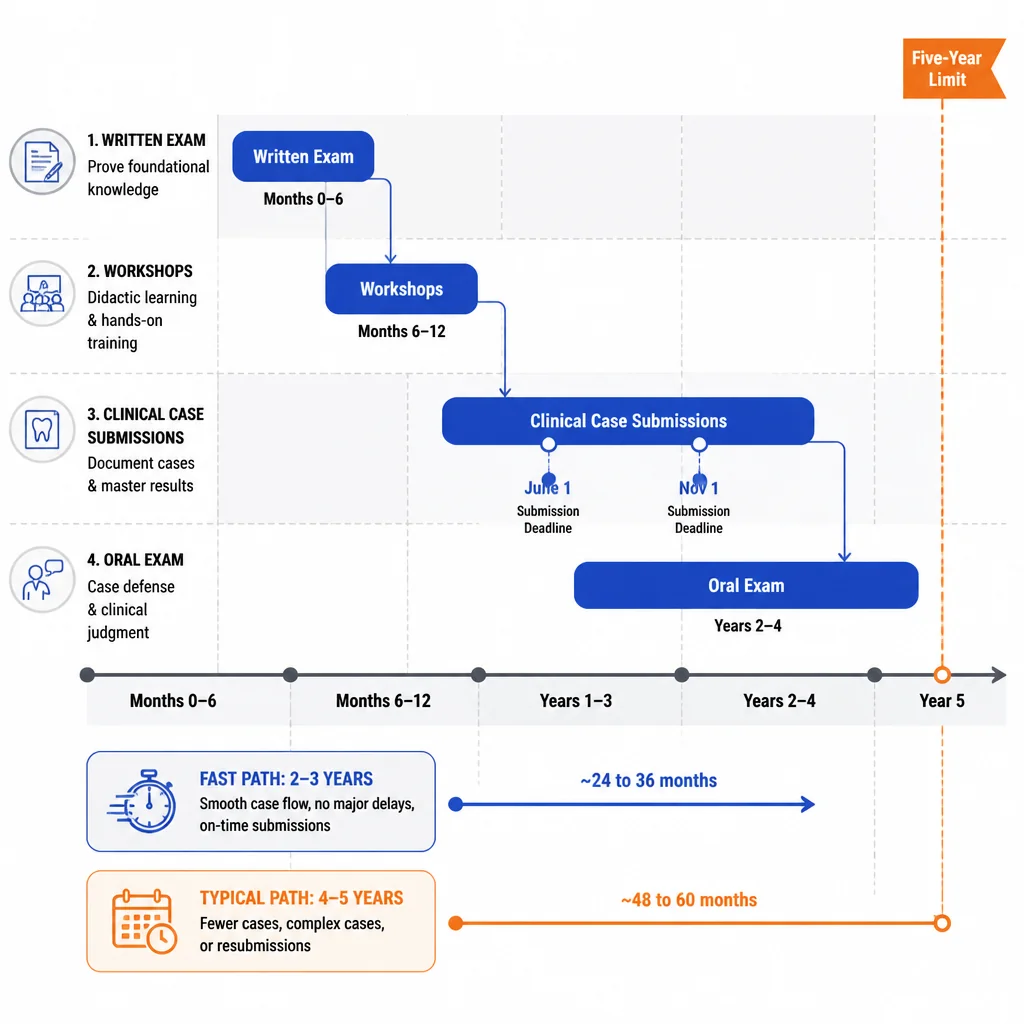
- Months 0–6: Join the AACD, register for the written exam, complete both workshops (online or at the Annual Scientific Session), and study for the written.
- Months 6–12: Sit the written examination at a Meazure center or the annual session. Begin identifying candidate patients for each required case type and start AACD-standard photography.
- Years 1–3: Treat and document cases, submitting in June and November cycles. Most candidates need multiple submission rounds, both because cases take time to complete and because some submissions come back needing rework.
- Years 2–4: Once all cases pass, schedule and sit the oral examination.
The hard constraint is the five-year limit for the entire process (AACD Written Exam). Well-organized candidates with a steady flow of suitable patients can finish in roughly two to three years. Candidates in practices with fewer cosmetic cases, or those who need resubmissions, land closer to four or five. Either path is normal — the AACD welcomed 12 newly Accredited professionals and five new Accredited Fellows in its Class of 2026, which gives you a sense of how selective the annual cohort is (2026 AACD Remote Annual Meeting agenda).
If you're a planning-oriented person, this is a topic where a simple interactive timeline estimator would genuinely help: enter your written exam date, patient volume, and cases remaining, and it projects your earliest realistic oral exam window against the five-year clock. Even a spreadsheet version of that math is worth building before you start.
Preparing for the written exam the right way
Since the written examination is the one stage you can fully control from your desk, it deserves its own strategy notes. The AACD's position is that a clinician knowledgeable in all phases of cosmetic dentistry should pass — so the prep goal is breadth and conceptual clarity, not test-taking tricks (AACD Written Exam).
A study approach that works well for this kind of exam:
- Start from the official scope. Work through the AACD's written exam study materials first so your time goes toward content that can actually appear on the test.
- Diagnose weak domains early. Take a timed practice run before you feel ready. The score matters less than the breakdown — it tells you whether to spend the next month on occlusion, materials, or smile design principles.
- Study explanations, not answers. For every question you miss, work through why the correct option is correct and why each distractor fails. That reasoning habit is the same muscle the oral examination tests years later.
- Simulate test conditions at least twice. Timed, uninterrupted, full-length. Exam anxiety mostly comes from unfamiliar format pressure, and the only reliable cure is exposure to realistic conditions beforehand.
That last point is the entire premise behind ExamJungle's exam simulator: timed practice exams with realistic question formats, detailed explanations for every answer, and an AI tutor (Caesar) that can expand an explanation or generate a harder variant when a concept isn't sticking. If you like drilling with flashcards between patients or running a full simulation on a weekend, the AACD exam prep on ExamJungle is built around exactly that workflow. Candidates preparing for other clinical board-style exams use the same approach — our guides on CCRN practice questions and LMSW exam practice walk through how format-matched practice changes outcomes for high-stakes tests.
Where candidates lose time (and how to avoid it)
After mapping the whole process, a few failure patterns show up repeatedly. None of them are about clinical talent.
Starting the clock before you're ready. The five-year window is a real constraint, and candidates who pass the written exam casually — "I'll see how it goes" — sometimes find themselves in year three with two cases submitted and four to go. Have a patient-flow plan before you sit the written.
Choosing impressive cases over qualifying cases. The criteria are published. Examiners apply them literally. A case that demonstrates the required elements cleanly will always beat a complex showpiece that misses a documentation requirement.
Weak photography. This is the most fixable problem and one of the most common. Standardized, high-quality images are a non-negotiable part of every submission, and the Criteria Workshop teaches exactly what's expected.
Skipping the mentor step. The AACD's accredited alumni consistently recommend working with a mentor (AACD Accreditation). A mentor who's passed the process can look at a case before you submit it and tell you what examiners will see. That feedback loop can save you entire six-month cycles.
Treating the written exam as trivia prep. Candidates who memorize rather than understand often pass the written anyway — then struggle at the oral examination, where defending a treatment plan live is the entire test. Learn the reasoning from the start.
Questions candidates ask about AACD Accreditation
Can a dental lab technician become AACD Accredited? Yes. The Accreditation process is open to both licensed dentists and dental laboratory technicians, with case-type requirements defined for each track, and the oral examination outcome applies to "a dentist/lab technician" equally (AACD Accreditation Process).
How long do I have to finish everything? There is a five-year time limit to complete the entire Accreditation process, beginning with the written examination (AACD Written Exam).
When can I submit my first clinical case? Once you've passed the written examination, completed the two required workshops, and met meeting attendance requirements, you can submit cases immediately after receiving your written exam results (AACD Accreditation FAQs).
What happens if a case fails? You revise and resubmit in a later cycle. Because deadlines fall only on June 1 and November 1 each year, a failed case typically costs about six months of calendar time (AACD Accreditation Process).
Where do I take the written exam? At the Annual AACD Scientific Session each spring, at Meazure Learning Testing Centers nationally and internationally, and at additional dates set by the American Board of Cosmetic Dentistry (AACD Written Exam).
Is Accreditation the same as Fellowship? No. Accreditation is the earned credential; Fellowship is the highest achievement level in the Academy and requires further case work after Accreditation is complete (AACD Accreditation & Fellowship).
Keep building your exam strategy