

Search for hp certification exams today and you land in a strange middle ground. Some results point to legacy HP-branded exams with codes like HP2-H41 that have been around for years, while others lead to HPE0 and HPE7 codes that belong to Hewlett Packard Enterprise's current program. The 2015 split of Hewlett-Packard into HP Inc. and Hewlett Packard Enterprise left two overlapping rosters, and candidates still book (or study for) the wrong one. This comparison walks through both lineups, shows which exams are still alive, and maps each track to the storage, networking, and cloud roles where these credentials actually matter.
The cost of picking wrong is real. Proctored vendor exams are not cheap, a failed attempt means a retake fee, and months spent on a retired syllabus is time you never get back. So treat this as a decision guide: which roster deserves your study plan, and how do you verify that before you spend a dollar?
Why the HP name on an exam code tells you very little
The confusion starts with the brand itself. HP Inc. kept printers and PCs. Hewlett Packard Enterprise took servers, storage, networking, and cloud. Almost every technical IT certification followed the enterprise side, but old codes never fully disappeared from search results, job postings, or third-party study sites. A search engine has no idea that an exam retired; it just indexes the page.
The code prefix is your fastest signal:
- HP2-xxx and HPE2-xxx codes are mostly sales and product knowledge exams. HP2-H41 (Selling Imaging and Printing Fundamentals) is a legacy HP-branded sales exam. HPE2-E70 (Selling the Value of HPE Hybrid IT Solutions) is its enterprise-era cousin, a multiple-choice exam with roughly 80 questions and a 70 percent passing score according to third-party exam records.
- HPE0-xxx codes are the technical proctored exams in the post-split HPE program, such as HPE0-J68 for storage or HPE0-P26 for GreenLake.
- HPE6-xxx and HPE7-xxx codes belong largely to the Aruba networking portfolio, like the HPE7-A02 security professional exam.
- HPE3-xxx codes typically cover web-based or unproctored exams in the HPE system.
The catch is that a legacy code can still appear in an old job description or an archived course page long after the exam retired. So the prefix tells you the era, not whether the exam is bookable today. The only reliable check is the official exam catalog, which HPE maintains on its view all certification exams page. If the code isn't listed there, treat any study material built around it as historical context, not a prep target.
There is a second trap worth naming. Third-party practice sites still sell question banks for retired codes, sometimes updated years after the real exam died. A question bank dated 2026 attached to a code HPE retired in 2021 doesn't mean the exam came back. It means someone kept selling to searchers who didn't verify first.
What the legacy HP-branded exams actually were
Before and shortly after the split, the HP certification program had a wide footprint. It covered imaging and printing sales, HP-UX system administration, ProCurve networking (which later became Aruba under HPE), and the HP ExpertOne program that bundled certifications like Master ASE for server and storage architects.
A few things define this legacy set:
Sales-heavy content. A big share of old HP2 exams tested whether you could position HP products, not whether you could configure them. HP2-H41 is the classic example: it validates knowledge of imaging and printing fundamentals for sales conversations, not engineering skills.
Product lines that changed hands. HP-UX, ProLiant servers, 3PAR storage, and ProCurve networking all moved under the HPE umbrella in 2015. Exams written for those products were either retired, renamed, or replaced with HPE-coded versions over the following years. If you studied 3PAR administration under an HP code a decade ago, the modern equivalent lives in the HPE0-J storage family, with an updated portfolio that now includes Nimble and Alletra.
A shrinking registration path. Legacy exams that HPE still honored were gradually withdrawn from the testing catalog. If a recruiter or a course syllabus references a legacy HP exam in 2026, the practical question is whether Pearson VUE can still schedule it. HPE exams are delivered through Pearson VUE's HPE certification testing program, and retired codes simply stop appearing in its scheduling system.
The honest verdict on the legacy set: these credentials still carry recognition with employers who know the HP ecosystem, and a Master ASE from the ExpertOne era is a real résumé asset if you hold one. But studying for a legacy exam today, as a new candidate, means preparing for a test you may not be able to book. That study time belongs elsewhere.
The current HPE lineup, track by track
The active roster is organized around product families and job roles rather than the old master-level pyramid. HPE separates its certification exams by type, including proctored technical exams, web-based exams, and practical or performance-based assessments. That type distinction matters more than candidates expect: a web-based associate assessment is a different commitment from a proctored professional exam with a testing-center booking, an ID check, and a firm seat time. Here is how the main tracks break down.
Storage and compute
Storage is where the post-split program is strongest. The flagship associate-level option is HPE0-J68, HPE Storage Solutions, which covers Nimble, Alletra, and the broader storage portfolio. Above it sit the design-focused exams: HPE0-J57 (Designing HPE Storage Solutions) and HPE0-J58 (Designing Multi-Site HPE Storage Solutions). On the compute side, composable infrastructure has its own assessment in HPE0-S58, and you can get a feel for its question style in an HPE0-S58 practice exam before committing to the real thing.
These exams fit systems administrators, infrastructure engineers, and pre-sales architects working in HPE-centric data centers. If your employer runs ProLiant servers and HPE storage arrays, this track maps directly to your day job. A reasonable sequence is J68 first for the portfolio breadth, then J57 or J58 once you're doing design work, because the design exams assume you already know the building blocks.
Networking, now under HPE Aruba and Juniper
Networking went through the biggest identity shift. The Aruba certifications (ACSA, ACSP, ACMP, ACMX, and their HPE-coded successors) became the core networking portfolio, with exams like the HPE7-A08 switching exam for campus switching and HPE7-A05 for data center networking. Older mobility exams such as the HPE6-A48 mobility exam remain relevant for wireless specialists.
Then came the Juniper acquisition. As of September 15, 2026, the Juniper Networks Certification Program was renamed the HPE Networking Certification Program, with a Pearson VUE registration blackout from September 12 to 15 and CertMetrics logins moving to hpe.com credentials. If you hold a JNCIA, JNCIS, or JNCIE, your credential now carries the HPE Networking name. That makes the networking track the fastest-changing part of the entire roster, and the one where checking official announcements before booking matters most.
Hybrid cloud and GreenLake
GreenLake, HPE's edge-to-cloud platform, anchors the cloud side of the program. HPE0-P26 (HPE GreenLake Solutions) validates solution-level knowledge of the platform, while HPE0-V25 covers HPE Hybrid Cloud Solutions at the administrator level. For architects, HPE7-V01 (Advanced HPE Edge-to-Cloud Solutions) awards the Master ASE Edge-to-Cloud Architect designation, the program's top tier, with a syllabus spanning six domains from hybrid design through business-case communication.
That last exam deserves a note for senior candidates. Unlike product-focused assessments, HPE7-V01 tests whether you can design end-to-end hybrid infrastructure across on-premises, edge, and cloud delivery models and defend that design to executives. It's the closest thing the modern roster has to the old ExpertOne Master ASE ambition.
Sales and partner certifications
The sales side of the roster refreshed for fiscal year 2026. The two current FY26 options are Compute Solutions and Hybrid Cloud Solutions, delivered through HPE Sales Pro in a mobile-friendly format of roughly five hours total learning. Channel partners need one of the two (plus Business Partner Training) to qualify for Business Partner Membership, with the hybrid cloud certification launching November 3, 2026. These are a different animal from the proctored technical exams: shorter, self-paced, and aimed at partner program requirements rather than deep engineering skill.
Legacy HP vs current HPE: the side-by-side decision
If you're weighing an old exam against a current one, the comparison comes down to four practical questions.
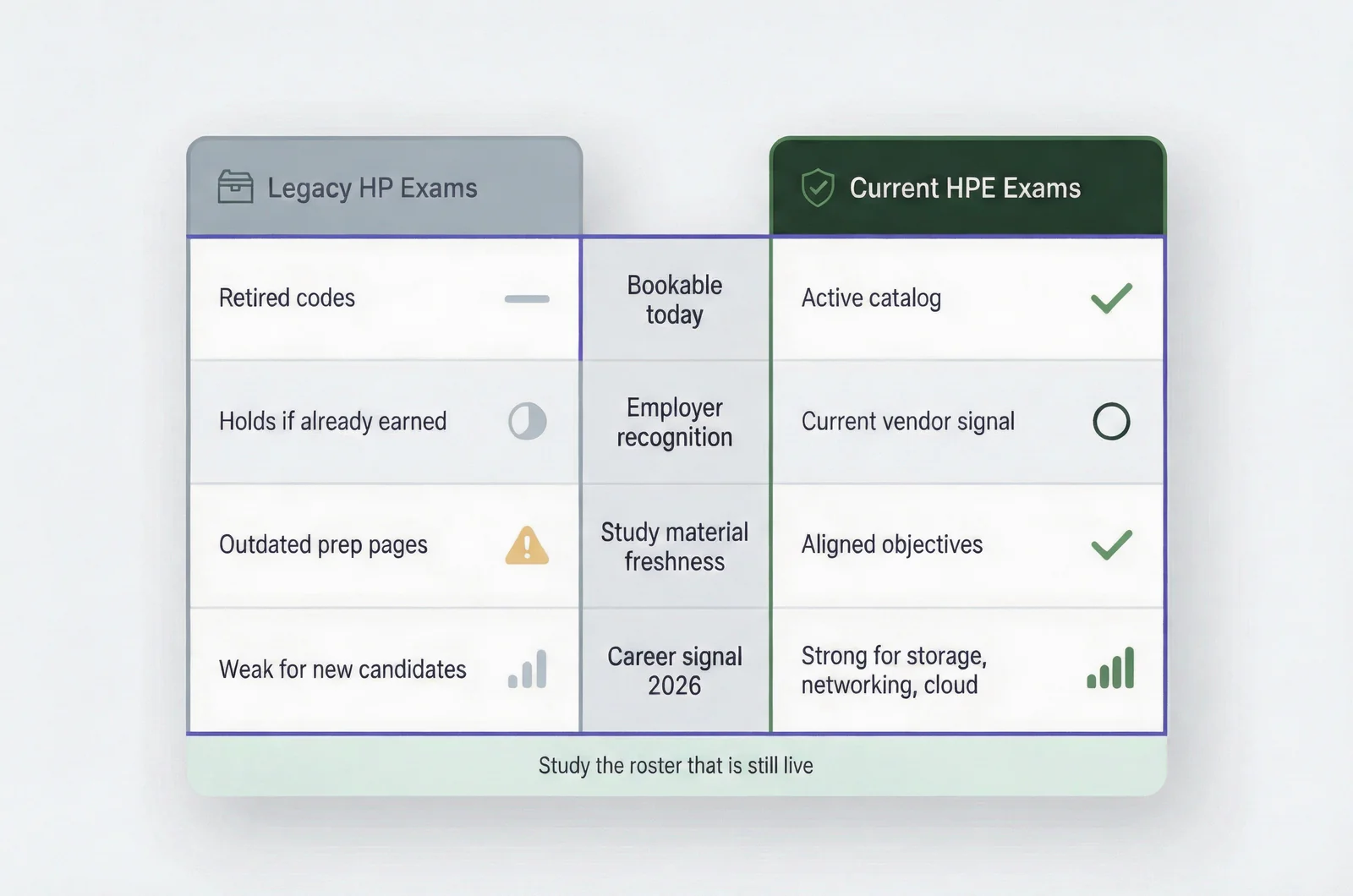
| Decision factor | Legacy HP exams (HP2, HP ExpertOne era) | Current HPE exams (HPE0, HPE6, HPE7) |
|---|---|---|
| Can you still book it? | Mostly no; check the official catalog code by code | Yes, via Pearson VUE or web-based delivery |
| Employer recognition | Strong with veteran HPE shops and partners who know the old program | Current job postings, partner program rules, and new hires reference these codes |
| Study material freshness | Stale; objectives frozen at retirement | Updated as HPE revises objectives each product cycle |
| Career signal | Historical depth, résumé continuity | Active skill validation aligned to GreenLake, Aruba, and storage roadmaps |
The pattern is clear. For anyone starting fresh in 2026, the current HPE-coded roster is the only roster worth a study plan. The legacy exams matter mainly if you already hold them (keep them on your résumé, they don't expire in employers' minds) or if a partner agreement explicitly names an older requirement, which is increasingly rare.
One nuance worth stating: HPE's own training arm acknowledges that course completion alone doesn't confer certification. As HPE Education Services puts it on its certification page, training is designed to prepare learners to pass the exams, and completion of training does not guarantee certification. You still have to sit the proctored assessment. That gap between "finished the course" and "passed the exam" is exactly where candidates get surprised, and where timed practice under exam conditions earns its keep.
How to verify an exam is still live before you study
Given how often this roster shifts, build a three-minute verification habit before buying any course or booking any seat.
- Search the official catalog. Find the exact exam code on HPE's certification and learning portal. If the code returns no result, the exam is retired or renamed.
- Check the datasheet. Live exams have a current datasheet with objectives, question counts, and delivery method. A datasheet dated years ago with no updates is a warning sign.
- Confirm the delivery channel. Technical exams route through Pearson VUE; sales and some associate assessments are web-based inside HPE's own platforms. If a third-party site describes a different delivery path than the official one, trust the official one.
- Check recent program news. The Juniper-to-HPE Networking rename shows how fast branding moves. A credential you read about six months ago may have a new name today even though the underlying exam is unchanged.
Two failure modes show up over and over. The first is studying from a course built for a retired code because the sales page never updated; the objectives look plausible, but none of it maps to the live exam. The second is booking the renamed exam under the old name and panicking when the confirmation email shows a different title. Both are avoidable with the four checks above.
A study plan that matches how these exams are actually written
HPE's technical exams lean on scenario-based questions: you're given a customer environment, a constraint, and a design decision. Memorizing feature lists gets you partway there, but the questions that separate pass from fail ask you to apply the portfolio. A typical storage question won't ask "what is Alletra"; it will describe a mixed workload with a latency requirement and ask which array and replication approach fits.
A plan that works for the current roster:
- Start from the official objectives, not from a generic course outline. HPE publishes self-study materials through HPE Press certification resources, and its course catalog is aligned to the exam datasheets.
- Simulate the timing early. HPE0-level proctored exams run in a fixed window, and scenario questions eat time. Running timed practice under realistic conditions removes the pacing surprises that cause most first-attempt failures. This is where a tool like ExamJungle fits naturally: its simulator mirrors the timed format, and when an explanation doesn't click, the built-in Caesar AI can expand it or generate a harder variant of the same question so you learn the concept rather than the answer.
- Review misses by domain. Every incorrect answer maps back to an objective area. Two or three weak domains concentrated in design or troubleshooting tell you exactly where the next study week goes.
- Use flashcards for the sales-style content. Product codes, positioning statements, and GreenLake consumption-model vocabulary are pure recall. Short drilling sessions beat long rereads for that material.
- Leave a buffer week before the real attempt. Use it for one full-length timed run, a review of every miss, and nothing new. Cramming fresh material in the final days tends to shake confidence more than it adds points.
If you want a quick way to pick your entry point, a small interactive idea would help here: a selector that takes your current role (sysadmin, network engineer, pre-sales) and your employer's HPE footprint, then returns the two or three live exam codes closest to your situation. Until that exists, the track-by-track mapping above does the same job.
Answers to the questions candidates keep asking
Are old HP certifications still valid? Credentials you already earned don't vanish, and employers familiar with the HP ecosystem still respect them. But the exams themselves are largely retired, so you can't newly earn a legacy HP-branded cert. Check the official catalog for your specific code.
What happened to the Juniper certifications? On September 15, 2026, the Juniper Networks Certification Program became the HPE Networking Certification Program. Existing JNCIA, JNCIS, and JNCIE credentials carry over under the new name, with CertMetrics access moving to hpe.com logins.
How much do these exams cost? Third-party guides have historically put HPE technical exams in the roughly $100 to $200 range per attempt, with higher tiers costing more. Confirm the exact fee at booking time through Pearson VUE, since prices change by region and exam level. Budget for a retake too; even well-prepared candidates miss scenario-heavy exams on the first try.
Should a networking candidate choose Aruba-track or Juniper-track exams now? Both sit under the HPE Networking umbrella after the 2026 consolidation. Pick based on the equipment your employer or target employers run: Aruba for campus, wireless, and ClearPass-heavy environments; the former Juniper track for service provider and large data center routing.
Is sales certification worth it if I'm an engineer? Only if your partner program requires it. The FY26 sales certifications take about five hours and exist to satisfy Business Partner Membership rules, not to build engineering depth. Engineers get more career value from the HPE0 technical exams.
How long should I study for an exam like HPE0-J68? That depends on your storage background, but a realistic range for a working admin is four to eight weeks of part-time study, finishing with at least two full timed practice runs before the real attempt. Candidates new to HPE hardware should plan toward the long end.
Keep building on the same theme