

The cpb exam permitted code books list for AAPC’s Certified Professional Biller exam contains three manuals: AMA’s CPT Professional Edition, ICD-10-CM, and HCPCS Level II. AAPC’s instructions identify these references for the CPB exam. AAPC’s CPB reference list
Start with those titles, then check the publisher, edition year, format, and condition of your materials. I’d settle those decisions before buying a bundle or adding notes. Use the questions below to turn the approved list into a purchasing plan, a practice setup, and a final book check.
Which publishers and editions of the three manuals are approved?
AAPC specifies AMA’s CPT Professional Edition only for CPT. For ICD-10-CM and HCPCS Level II, you may choose the publisher. Its instructions allow current-year or previous-year printed books and recommend current-year editions. AAPC’s printed-book requirements
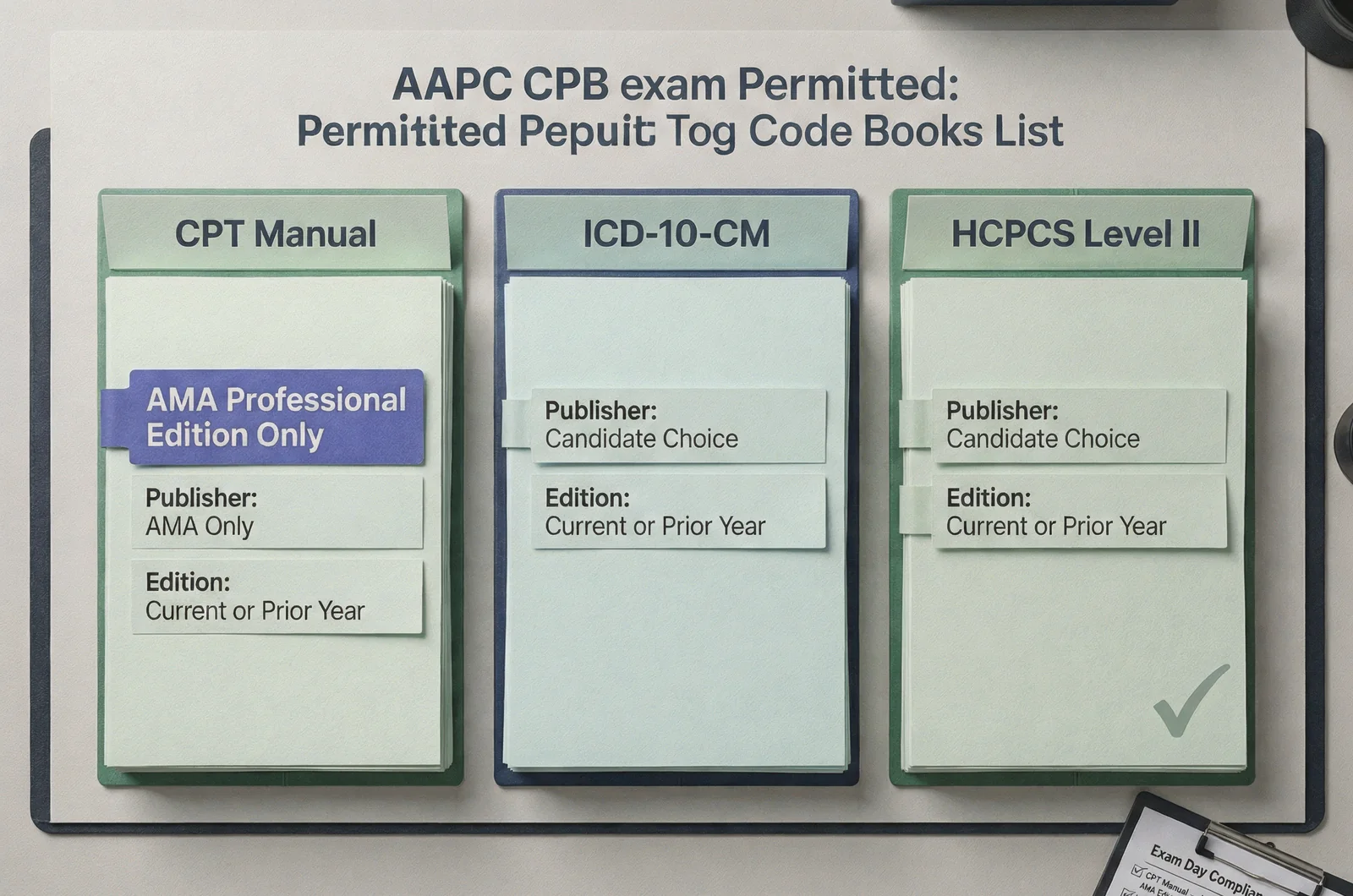
When comparing products, inspect each manual separately. Ask the seller to confirm the full title, publisher, and edition year before paying. Request a photograph of the actual cover if the listing uses a stock image or combines several years in one description.
For CPT, compare the listing against the specified title word for word. Don’t make your purchase decision from an abbreviated product name. For the other manuals, compare layouts only after checking the title and year.
Build a short purchasing record with one line per book. Record the title you intend to buy, its publisher, the year printed on the cover, and any unanswered question. Keep that record in your shopping or study notes.
Suppose a bundle description names all three manuals but omits the CPT publisher. Pause that purchase and request clarification. Suppose another listing shows a newer year in its headline and an older year in its photograph. Ask which physical book you will receive.
Before ordering, resolve every mismatch between the listing, photograph, and your purchasing record.
Which year’s books should I choose for my appointment?
Use your exam year to check printed editions. AAPC permits the current year, the preceding year, or a mixture, with one copy of each manual. Applying that rule to a 2026 appointment means checking for 2026 or 2025 printed editions. AAPC’s book-year guidance
How should I decide whether to replace books I already own?
First, inventory what you have. Write the year beside each title rather than describing the whole set as “last year’s books.” Then compare that inventory with the year of your scheduled appointment.
If you’re considering a replacement, separate your purchase decision from your eligibility check. Confirm whether the existing edition is permitted before weighing the cost of a newer copy. Avoid treating familiarity with a book as proof that its year is acceptable.
For any replacement, reserve study time to examine its organization and practice locating information. Make that appointment with yourself before placing the order.
What if I might postpone the exam?
Choose books against your likely appointment date, then repeat the check after rescheduling. If your plans cross December and January, write both possible exam years in your planning notes.
Ask AAPC which editions apply to the appointment you ultimately book. Give the actual date and the year of each manual in your question.
Finish this check by recording an exam date beside your book inventory. Revisit that record whenever the appointment changes.
Can I bring two versions of the same manual?
AAPC allows one copy of each approved book, including when you mix permitted edition years. Don’t pack duplicate editions as backup references. AAPC’s one-copy book limit
Choose the copy you plan to use and identify it clearly in your study record. If you own several versions, put the selected one in a separate exam-preparation stack. Keep the remaining copies elsewhere while rehearsing.
For example, suppose you own two permitted editions of CPT and prefer different sections in each. Choose one for your rehearsal. When you feel tempted to switch, record what you were trying to find and practice locating it in the selected copy.
Use the same approach if you own ICD-10-CM manuals from different publishers. Pick your exam copy before the final practice sessions. Work through the navigation tasks you expect to perform with that specific manual.
Check borrowed books just as carefully. Ask to inspect the actual copy before agreeing to use it. Review the title, year, loose inserts, and existing markings. Keep a list of anything that needs clarification.
When preparing your materials, place only your selected books in the exam stack. Compare that stack against your inventory one title at a time. If two copies of a manual remain, remove the extra copy before your final rehearsal.
Can I use eBooks instead of printed manuals?
AAPC’s examinee checklist permits printed books or eBooks accessed through a shared library within the exam platform. It states that eBooks are current-year versions and allows changes to the preferred book format up to 48 hours before the exam. AAPC’s book-format instructions
How should I choose between print and digital references?
Choose by rehearsing the work you need to do. For print, practice opening the selected manual, finding a section, reading its instructions, and returning to the question. Keep your practice desk arranged as you intend to use it.
For digital references, review the instructions for the exam’s shared library. Ask how to access any available demonstration or orientation material. Practice the navigation method described for that environment.
Avoid making the decision solely from your preference for reading on paper or a screen. Include reference tasks in your rehearsal: locating a term, checking nearby instructions, and returning to the problem.
Write down where you hesitate. Use that record to choose the format you want to practice further.
What should I confirm when booking?
Check the book-format selection recorded for your CPB appointment. If someone else purchases or schedules the exam for you, ask them to confirm that selection.
For digital references, ask which manuals the appointment supplies and how you will access them. Don’t assume your personal digital library will be part of the testing setup.
After changing a selection, check the confirmation again. Keep a record of the chosen format and repeat the review before the stated change deadline.
What handwritten notes can I leave inside my books?
AAPC allows handwritten code-book notes that concern daily coding activities. Its instructions prohibit long passages on blank pages, questions copied from study guides or practice exams, exam questions, and alterations that replace existing page content with supplemental information. AAPC’s handwritten note rules
Review your annotations before adding more. Read each note and ask what task it supports. If you cannot explain its purpose clearly, flag it for review rather than assuming it belongs in your exam copy.
Keep practice-question analysis in a separate study notebook. There, write the question topic, your reasoning, the explanation you reviewed, and what you want to practice again. Use that notebook during study sessions, then set it aside during exam rehearsals.
Suppose you previously copied a full practice question into a margin. Don’t try to solve that problem by covering the text with another note. Describe the issue to AAPC and ask how to prepare that book appropriately.
For borrowed or secondhand books, inspect annotations throughout the manual. Include the front matter, blank pages, and back sections in your review. Ask about unclear markings before relying on the copy.
I’d keep a separate list of questionable annotations with their page numbers. Send precise questions rather than asking whether “lots of notes” are acceptable. Identify the content and where it appears.
Resolve questionable notes before choosing that manual as your final exam copy.
What kinds of tabs can I add to my manuals?
AAPC permits tabs whose purpose is to mark a page with words or numbers. Tabs must identify locations rather than add supplemental information to the book. AAPC’s code-book tab rules
Choose tab locations from your own navigation practice. Start by recording which sections you repeatedly search for. Review that list before adding markers across the entire manual.
For each proposed tab, write the location you want it to identify. Then check whether the label functions as a page marker. Ask AAPC about any label that goes beyond identifying the destination.
After adding tabs, rehearse with the book closed. Read a practice prompt, decide where you want to look, and use the markers to reach that location. Record any hesitation or wrong turn.
If you repeatedly choose the wrong marker, revise your organization during study time. If several labels look alike, reconsider their wording. Keep the aim specific: find the intended page and read the relevant content.
Suppose you’re tempted to place a full answer explanation on a large tab. Put that explanation in your study notebook instead. Choose a location label for the book marker and request clarification if its wording is uncertain.
Review preinstalled tabs in purchased or borrowed books using the same questions. Before your final rehearsal, read every tab label and resolve any that may contain added reference material.
Can I bring my CPB study guide or another reference book?
Study guides appear on AAPC’s prohibited-resource list. The CPB code-book list also excludes ICD-10-PCS, so don’t add it simply because you have seen it listed for another AAPC credential. AAPC’s exam-specific material rules
Separate your study materials from the references selected for the appointment. Make one space for textbooks, practice notes, and course materials. Make another for the books you intend to use during rehearsal.
Use the wider study collection when reviewing explanations and investigating an error. For an exam rehearsal, follow the materials instructions for your appointment. Record anything you want to consult later rather than reaching for another resource during the session.
For example, suppose a practice explanation leaves you unsure about a billing concept. Write that uncertainty in your review log. After the rehearsal, return to your study guide and work through the topic.
If you’re preparing for more than one credential, label your material lists with the full certification name. Compare each list with its own appointment instructions before packing.
Avoid adding a dictionary, billing textbook, or specialty reference based on another candidate’s packing list. Ask about the exact item if you believe you need it.
Before your final practice session, collect every intended reference in one place. Check each item against the CPB instructions, then move unresolved extras back to your study area.
How should I check loose pages and other added materials?
Treat loose pages, printed guidelines, reference cards, and inserted notes as separate items to verify. Identify each item precisely and ask whether it is permitted for your CPB appointment and delivery format.
Start with a page-by-page inspection of the manuals you intend to use. Look between sections, inside covers, and near heavily used pages. Collect loose items in a separate folder while deciding what to do with them.
For every item, record its title or purpose. Describe whether it is a published document, a course handout, or something you wrote yourself. Include any markings or annotations in your question.
A useful question would be: “For my CPB appointment on this date, may I use this named document separately from my code books?” Add the selected delivery format and explain whether the document has notes.
If you’re considering printed guidelines, ask about that exact document. Request clarification about whether it must be accessed through the testing platform or can accompany your physical books.
Avoid asking only whether “extra paper” is allowed. Give enough detail to distinguish a reference document from a personal study note.
After receiving clarification, update your materials inventory. Keep unresolved items outside the exam stack. Repeat the inspection after your final study session, particularly if you routinely place reminders or practice notes between book pages.
How should I practice with the books I’ve selected?
Rehearse with your chosen references and review your reasoning afterward. Give each session a specific book-navigation goal instead of judging the session only by its score.
What should I record during a lookup exercise?
Try a short sequence:
- Read the practice question and identify the information you need.
- Choose the reference you intend to consult.
- Locate the relevant passage using your selected format.
- Read the surrounding instructions before choosing an answer.
- Explain your choice in your own words during review.
Keep a study log with the topic, the location you consulted, and the reason for any error. Distinguish a navigation problem from a reasoning problem. Decide what to practice next from that record.
For the question side of your rehearsal, use ExamJungle’s CPB question-type guide as a companion to your book work. Choose a question style and identify which information you would need to locate.
How should I review a wrong answer?
First, reconstruct your search. Write down where you looked and what you thought the passage meant. Then compare your reasoning with the explanation you’re reviewing.
If you found the wrong section, repeat the navigation task. If you found the intended passage but misread it, explain the distinction between your answer and the correct choice. Keep that explanation in your study notebook.
If you’re also preparing for CPC, keep a separate session for ExamJungle’s CPC certification practice exams. Label those exercises CPC in your log and maintain separate preparation plans for the two credentials.
End each review by choosing one concrete task: repeat a lookup, reread a passage, or work through another question on the same topic.
What should I check before using these books on exam day?
Run a final materials review against the instructions for your booked CPB appointment. Use your actual books and confirmation details, rather than relying on the shopping list you made earlier.
What belongs in the final review?
Work through the checks in a fixed order:
- Confirm the full exam name and appointment date.
- Review the recorded print or eBook selection.
- Inspect each selected manual’s title, publisher, and year.
- Compare the physical stack with your book inventory.
- Read the annotations and tab labels you flagged.
- Inspect the books for loose or inserted materials.
- Resolve remaining questions with AAPC before the appointment.
Ask anyone helping you prepare to use the same inventory. If you replace or borrow a book after this review, inspect the replacement before putting it in the exam stack.
How could a book-check selector help?
A useful selector would ask for the exam name, appointment year, chosen format, and each manual’s title, publisher, and year. It could generate a review checklist and identify entries needing clarification.
Keep such a tool focused on organizing the check. Use AAPC’s appointment instructions to settle permission questions, especially for annotations and extra documents.
After the final review, leave the selected books together. Keep study handouts and unresolved references in a separate place. Use that prepared setup for one last navigation rehearsal.
Which CPB question styles should I practice with my books?