
CLEP-CHEMISTRY Sample Questions & Answers
Free CLEP Chemistry practice questions with worked answers and explanations. See how the ExamJungle simulator prepares you — then jump into the full test.
Launch the full CLEP-CHEMISTRY simulator →Showing 6 of 12 free samples.
- Question 1Intermediate
Structure of Matter · VSEPR theory and Lewis electron-dot diagrams
According to valence shell electron pair repulsion (VSEPR) theory, what is the molecular geometry and the orbital hybridization of the central sulfur atom in sulfur tetrafluoride (SF4)?
Show answer & explanation
Correct answer: A
SF4 has 4 bonding pairs and 1 equatorial lone pair (steric number 5), yielding a trigonal bipyramidal electron geometry, seesaw shape, and sp3d hybridization.
- Question 2IntermediateSelect 2
Structure of Matter · Sigma and pi bonds
Consider the bonding and molecular structure of acrylonitrile, H2C=CH-C≡N. Which TWO of the following statements correctly describe the covalent bonds and orbital hybridization in this molecule? (Select TWO)
Show answer & explanation
Correct answers: B, D
Counting single and multiple bonds: 3 C-H (σ) + 1 C=C (1σ, 1π) + 1 C-C (σ) + 1 C≡N (1σ, 2π) = 6 sigma and 3 pi bonds.
The nitrogen forms one triple bond and retains one lone pair, yielding a steric number of 2 and linear sp hybridization.
- Question 3Advanced
States of Matter · Phase diagrams of one-component systems
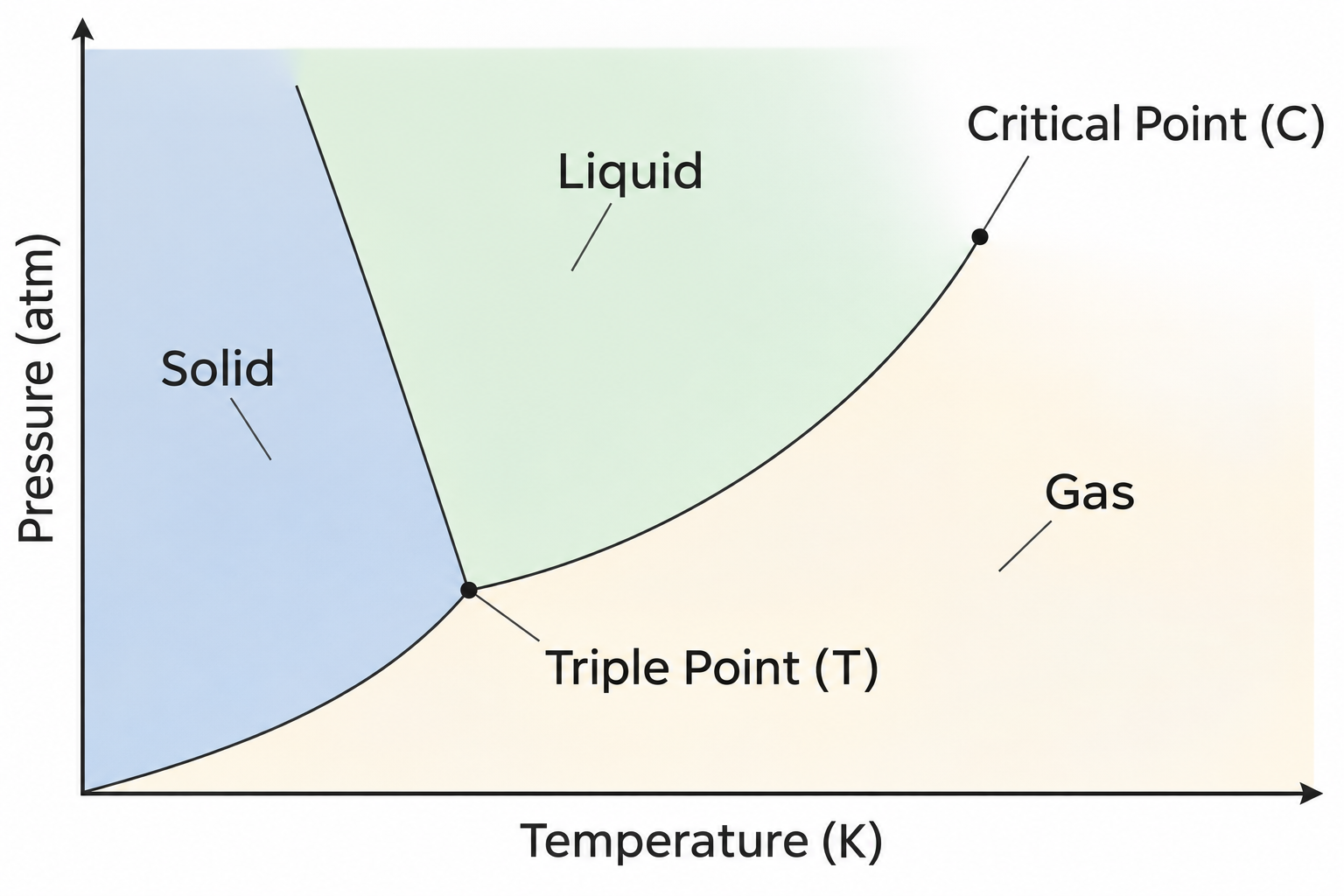
A physical chemistry research group evaluates the one-component phase diagram of Substance X shown in the figure.
Substance X exhibits three stable phases: solid, liquid, and gas. The triple point (T) is located at 0.006 atm and 273 K, and the critical point (C) is located at 218 atm and 647 K. Notably, the solid-liquid coexistence boundary curve extending from the triple point exhibits a distinct negative slope (dP/dT < 0).
A 10.0 g sample of solid Substance X is placed inside a variable-pressure piston chamber at a constant temperature of 272 K and an initial pressure of 0.50 atm. The piston is then compressed isothermally until the pressure reaches 50 atm. Based on the phase diagram in the figure, what phase change occurs during this compression, and what fundamental property of Substance X is revealed by the negative slope of the melting line?
Show answer & explanation
Correct answer: D
Applying pressure at constant temperature below normal freezing drives the system across the negative melting curve into the denser liquid phase.
- Question 4Intermediate
States of Matter · Colligative properties; van 't Hoff factor
Assuming complete electrolyte dissociation and ideal solution behavior, which of the following aqueous solutions has the LOWEST freezing point?
Show answer & explanation
Correct answer: C
Al(NO3)3 produces 4 ions per formula unit (i = 4), yielding an effective particle molality of 4 × 0.050 m = 0.200 m, the largest ΔTf.
- Question 5Beginner
States of Matter · Colligative properties: Raoult's law
At 25 °C, pure liquid water has an equilibrium vapor pressure of 23.8 mmHg. A solution is prepared by dissolving 0.200 mol of a nonvolatile, nonelectrolyte solute in 1.800 mol of pure water. Assuming the solution behaves ideally according to Raoult's law, what is the vapor pressure of water above this solution at 25 °C?
Show answer & explanation
Correct answer: A
By Raoult's law, P = X_solvent · P° = [1.800 / (1.800 + 0.200)] · 23.8 mmHg = (0.900)(23.8 mmHg) = 21.4 mmHg.
- Question 6Beginner
Reaction Types · Acid-base reactions; concepts of Arrhenius, Brønsted-Lowry, and Lewis
In the reaction between gaseous boron trifluoride and gaseous ammonia to produce a solid adduct, BF3(g) + NH3(g) -> F3B-NH3(s), how are the two reactant species classified according to Lewis acid-base theory?
flowchart LR BF3["BF3: Incomplete Octet (Empty 2p Orbital)"] NH3["NH3: Nitrogen Lone Pair"] Adduct["F3B-NH3 Coordinate Covalent Adduct"] NH3 -- "Donates e- pair" --> BF3 BF3 --> Adduct NH3 --> AdductShow answer & explanation
Correct answer: A
Boron in BF3 has an incomplete octet and accepts an electron pair (Lewis acid); nitrogen in NH3 donates its lone pair (Lewis base).
Ready for the real thing?
The full CLEP-CHEMISTRY simulator has every exam-style question, timed mode, and instant scoring.