
MFT Sample Questions & Answers
Free AMFTRB Marital and Family Therapy National Examination practice questions with worked answers and explanations. See how the ExamJungle simulator prepares you — then jump into the full test.
Launch the full MFT simulator →Showing 6 of 12 free samples.
- Question 1Beginner
The Practice of Systemic Therapy · Use a systemic perspective to understand the complexities inherent in therapeutic interactions (e.g., family homeostasis, self of the therapist).
A marriage and family therapist who recently finalized an acrimonious personal divorce finds themselves feeling intense irritation toward a male client who is contemplating separating from his wife. To manage the self of the therapist and uphold systemic competency, what should the clinician do FIRST?
Show answer & explanation
Correct answer: B
Managing self-of-the-therapist requires clinicians to actively identify personal unresolved grief or bias through consultation and supervision, ensuring personal life experiences do not distort systemic neutrality or client care.
- Question 2Intermediate
Assessing, Hypothesizing, and Diagnosing · Assess historic and current self-injurious behavior, suicidal ideation and intent, and/or homicidal ideation and intent.
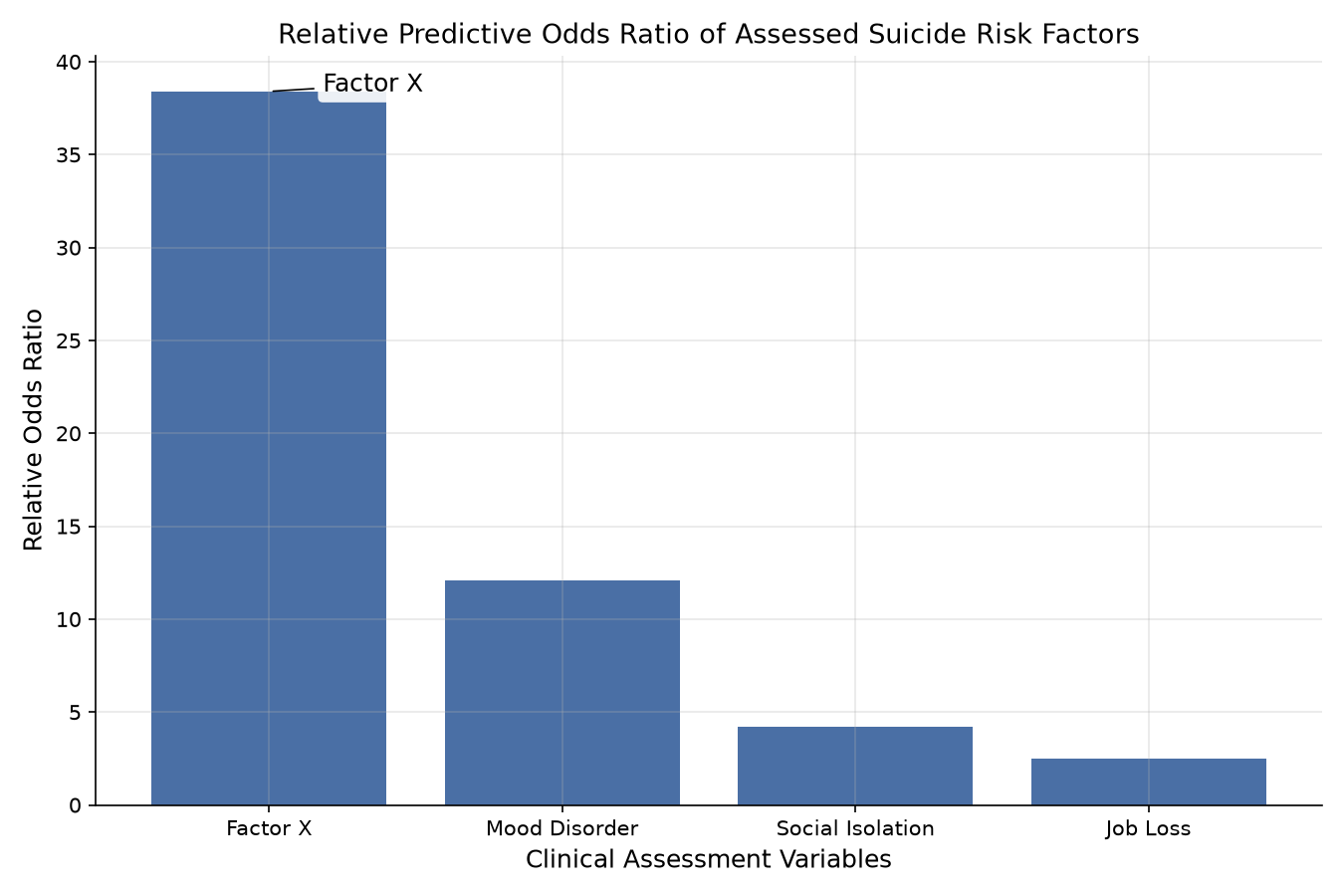
A therapist evaluates an adult client presenting with severe depressive symptoms using SAMHSA's SAFE-T framework. As depicted in the accompanying chart, Factor X demonstrates the highest predictive odds ratio for completed suicide among all clinical assessment variables. Which assessment variable corresponds to Factor X?
Show answer & explanation
Correct answer: A
Prior suicide attempts are empirically documented as one of the single strongest clinical predictors of future suicidal behavior and completed suicide, carrying higher predictive weight than demographic or situational losses alone.
- Question 3IntermediateSelect 2
Assessing, Hypothesizing, and Diagnosing · Assess historic and current self-injurious behavior, suicidal ideation and intent, and/or homicidal ideation and intent.
When conducting a comprehensive suicide inquiry as part of SAMHSA's SAFE-T protocol with a client reporting recent death ideation, which TWO actions must the clinician prioritize? (Select TWO)
Show answer & explanation
Correct answers: C, D
SAFE-T suicide inquiry requires evaluating plan specifics (timing, lethality, means access) and ideation details (frequency, intensity over past 48 hours, month, peak).
Detailed suicide inquiry examines both recent ideation patterns (past 48 hours and month) and worst-ever historical intensity to accurately stratify risk.
- Question 4Intermediate
Assessing, Hypothesizing, and Diagnosing · Assess historic and current self-injurious behavior, suicidal ideation and intent, and/or homicidal ideation and intent.
A 16-year-old client reports making superficial, repetitive cuts on their forearm over the past two months to alleviate intense internal emotional numbness and anxiety, explicitly denying any wish to end their life. How should the systemic therapist clinically differentiate this presentation from suicidal behavior?
Show answer & explanation
Correct answer: B
Non-suicidal self-injury (NSSI) is distinguished by the intent to relieve distress rather than cause death, but it must be carefully assessed and monitored because NSSI significantly correlates with future elevated suicide risk.
- Question 5Beginner
Assessing, Hypothesizing, and Diagnosing · Assess historic and current effects of substance use disorders on the functioning of the client system.
During an intake assessment of a family where an adult member is entering outpatient treatment for alcohol use disorder, the clinician evaluates the family's 'recovery capital.' What does recovery capital specifically assess within a systemic framework?
Show answer & explanation
Correct answer: C
Recovery capital encompasses the internal resources (coping, self-efficacy) and external relational/community assets that individuals and their family systems can mobilize to initiate and sustain long-term addiction recovery.
- Question 6Advanced
Assessing, Hypothesizing, and Diagnosing · Assess historic and current effects of substance use disorders on the functioning of the client system.
A married couple presents to an outpatient clinic seeking conjoint family therapy. The husband completed medical detoxification for severe alcohol dependence three weeks ago. The wife reports feeling emotionally exhausted, hypervigilant, and distrustful after years of covering up his missed work and managing family finances alone. The husband states he wants his wife to stop 'monitoring and interrogating' him so he can focus on his recovery.
During individual pre-screening, the wife discloses that two weeks prior to detoxification, during an argument over his drinking, the husband pushed her against a wall, held her by the shoulders, and threatened severe violence if she disclosed his drinking to his employer. The husband acknowledges this incident, expresses remorse, and claims that alcohol intoxication was entirely responsible for his actions.
The therapist reviews evidence-based screening guidelines for systemic substance use treatment, as diagrammed below:
flowchart TD Screening[Intake Screening of Couple System] --> AssessFactors{Assess Safety & Contraindications} AssessFactors -->|Active Physical Violence / Threats| Separate[Exclude Conjoint Therapy: Safety Planning & Separate Services] AssessFactors -->|Substance Remission & Safety Verified| Conjoint[Initiate Recovery-Oriented Conjoint Therapy]Based on these screening standards, what is the therapist's MOST appropriate clinical action?
Show answer & explanation
Correct answer: D
Conjoint couple/family therapy is contraindicated when there is active intimate partner violence or ongoing physical endangerment, as joint sessions can escalate danger for the victim. Separate care and safety planning are required.
Ready for the real thing?
The full MFT simulator has every exam-style question, timed mode, and instant scoring.