
AGPCNP-BC Sample Questions & Answers
Free Adult-Gerontology Primary Care Nurse Practitioner practice questions with worked answers and explanations. See how the ExamJungle simulator prepares you — then jump into the full test.
Launch the full AGPCNP-BC simulator →Showing 6 of 12 free samples.
- Question 1Advanced
Patient Assessment Process · Cognitive and mental health assessment (eg, screening tools)
An 81-year-old community-dwelling patient accompanied by an adult daughter presents to the primary care clinic for a routine follow-up of hypertension and type 2 diabetes. The daughter privately expresses concern, noting that the patient recently missed utility payments, misplaced essential cardiac medications, and has had increasing difficulty balancing the monthly checkbook. The patient maintains that these are normal lapses of aging and denies any memory decline.
Physical examination reveals blood pressure 138/82 mm Hg, pulse 72 bpm, and no focal neurological deficits. The patient lives alone and independently manages basic self-care activities of daily living such as dressing and bathing.
Which initial clinical action by the nurse practitioner is most appropriate?
Show answer & explanation
Correct answer: D
New deficits in IADLs like handling finances or medications in an older adult are clinical triggers requiring immediate structured cognitive screening rather than reassurance or immediate drugs.
flowchart TD A[Reported IADL Deficit] --> B[Brief Cognitive Screen] B -->|Impaired| C[Diagnostic Workup: Labs, Neuroimaging] B -->|Normal| D[Re-evaluate in 6-12 Months] - Question 2Beginner
Patient Assessment Process · Cognitive and mental health assessment (eg, screening tools)
True or False: In primary care geriatric assessment, a negative initial verbal screen using the two-question Patient Health Questionnaire (PHQ-2) indicates that no further full-length depression inventory (such as the PHQ-9 or Geriatric Depression Scale) is indicated at that visit.
Show answer & explanation
Correct answer: B
The PHQ-2 functions as an efficient initial screening test; if negative, depression is unlikely and longer scales like the PHQ-9 are not indicated at that visit.
- Question 3Intermediate
Patient Assessment Process · Psychosocial assessment (eg, health literacy, lifestyle, nutritional, caregiver/support, cultural, spiritual)
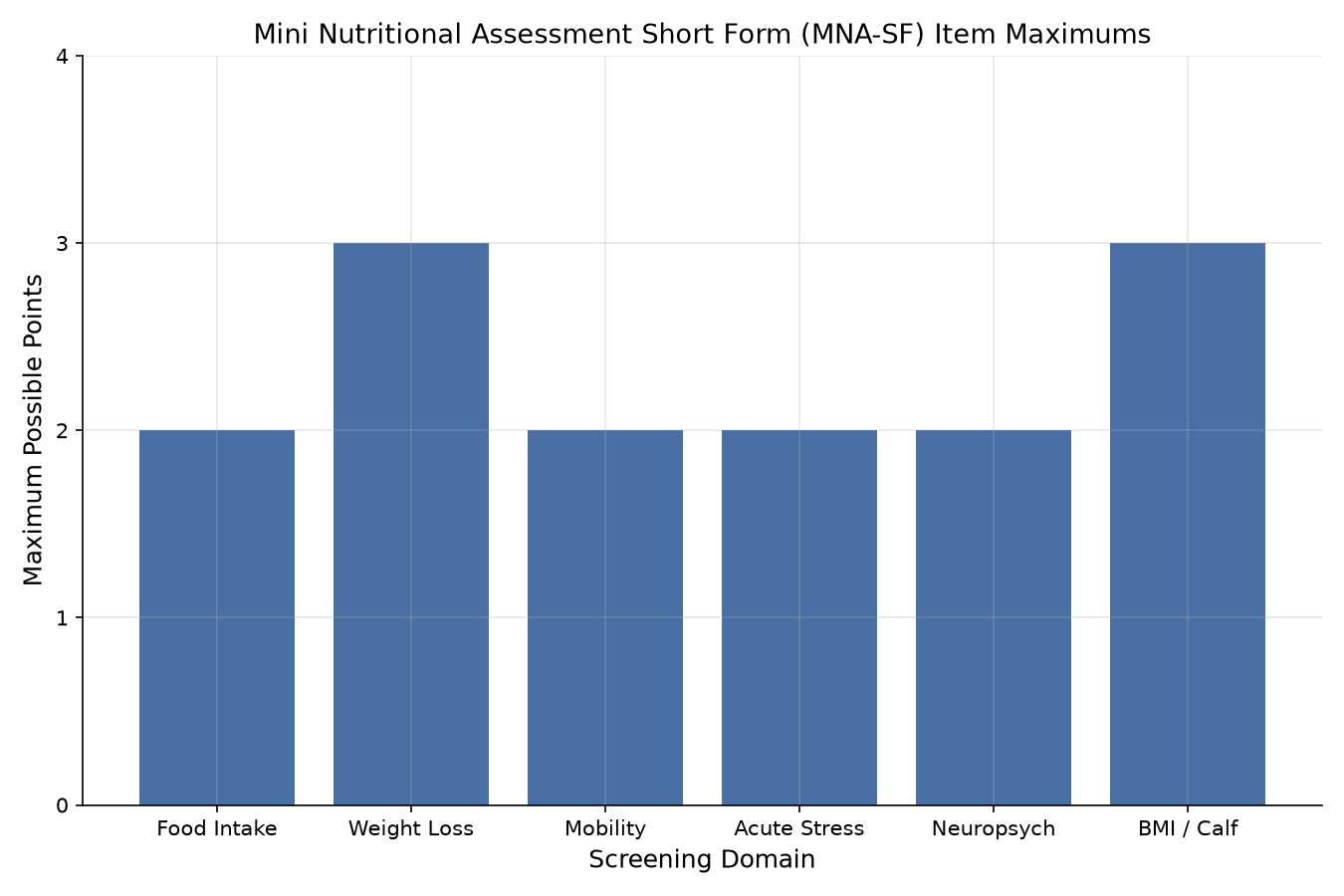
An adult-gerontology primary care nurse practitioner administers the Mini Nutritional Assessment (MNA) short form to an 84-year-old frail older adult during an annual wellness exam. Based on the scoring reference shown in the figure, which total score category places the patient in the 'at risk of malnutrition' stratum?
Show answer & explanation
Correct answer: A
On the validated Mini Nutritional Assessment (MNA), a score of 12-14 reflects normal nutritional status, 8-11 indicates risk of malnutrition, and 0-7 denotes malnutrition.
- Question 4IntermediateSelect 2
Patient Assessment Process · Psychosocial assessment (eg, health literacy, lifestyle, nutritional, caregiver/support, cultural, spiritual)
An adult-gerontology primary care nurse practitioner is performing a comprehensive psychosocial assessment on a newly established 76-year-old patient. Which TWO clinical actions adhere to evidence-based practice standards for psychosocial and family assessment? (Select TWO)
Show answer & explanation
Correct answers: A, E
Patients must designate who may participate in their care, and screening for military service identifies vital VA resources. Surrogates cannot override capable patients.
- Question 5Beginner
Plan of Care · Evidence-based practice and treatment guidelines
A 54-year-old adult presents for routine health maintenance. Laboratory results show a confirmed fasting plasma glucose (FPG) of 132 mg/dL on two separate visits. According to American Diabetes Association (ADA) Standards of Care, which set of criteria definitively establishes the diagnosis of diabetes mellitus?
Show answer & explanation
Correct answer: A
The ADA defines diabetes by fasting plasma glucose >= 126 mg/dL, HbA1c >= 6.5%, 2-hr OGTT >= 200 mg/dL, or random plasma glucose >= 200 mg/dL with classic symptoms.
- Question 6Intermediate
Plan of Care · Evidence-based practice and treatment guidelines
An adult-gerontology primary care nurse practitioner evaluates a 79-year-old resident of an assisted living facility with longstanding type 2 diabetes, moderate vascular dementia, stage 3b chronic kidney disease, and frequent nighttime hypoglycemic episodes. According to clinical practice guidelines, what is the most appropriate individualized glycemic target for this patient?
Show answer & explanation
Correct answer: C
In older adults with complex health, cognitive impairment, and multiple comorbidities, glycemic targets are relaxed to HbA1c < 8.0-8.5% to prioritize hypoglycemia avoidance.
flowchart TD A[Older Adult with T2D] --> B{Health Status?} B -->|Intact/Healthy| C[HbA1c < 7.0 - 7.5%] B -->|Complex/Comorbid| D[HbA1c < 8.0%] B -->|Poor Health/End-Stage| E[Avoid Hypoglycemia / Relax Targets]
Ready for the real thing?
The full AGPCNP-BC simulator has every exam-style question, timed mode, and instant scoring.