
RADIOGRAPHY Sample Questions & Answers
Free ARRT Radiography Examination practice questions with worked answers and explanations. See how the ExamJungle simulator prepares you — then jump into the full test.
Launch the full RADIOGRAPHY simulator →Showing 6 of 12 free samples.
- Question 1Beginner
Patient Care · Pharmacology
Approximately three minutes after an intravenous injection of non-ionic iodinated contrast media, a patient suddenly complains of widespread itching and develops localized urticaria and mild facial erythema. The patient's blood pressure is 124/78 mmHg, pulse is 76 bpm, and respiration is 16 breaths per minute with uncompromised breathing. How is this adverse event categorized, and what is the primary radiographer action?
Show answer & explanation
Correct answer: C
Urticaria, pruritus, and erythema without airway compromise or hypotension represent a mild systemic reaction. Moderate reactions include bronchospasm or extensive vomiting.
- Question 2Intermediate
Patient Care · Infection Control
A hospitalized inpatient with confirmed active cavitary pulmonary tuberculosis requires transport to the imaging suite for chest radiography. According to CDC Transmission-Based Precautions guidelines, what environmental control and personal protective equipment protocols are required?
Show answer & explanation
Correct answer: A
TB requires Airborne Precautions, including an AIIR with negative pressure, 6-12 air exchanges/hour, and HEPA filtration or direct outside exhaust.
flowchart LR Source[Active TB Patient] -->|Airborne Droplet Nuclei| Air[AIIR 6-12 ACH Negative Pressure] Air --> Filter[HEPA Filter / Direct Exhaust] Staff[Radiographer] -->|Wears| N95[Fit-Tested N95 Respirator] - Question 3Intermediate
Safety · Principles of Radiation Physics
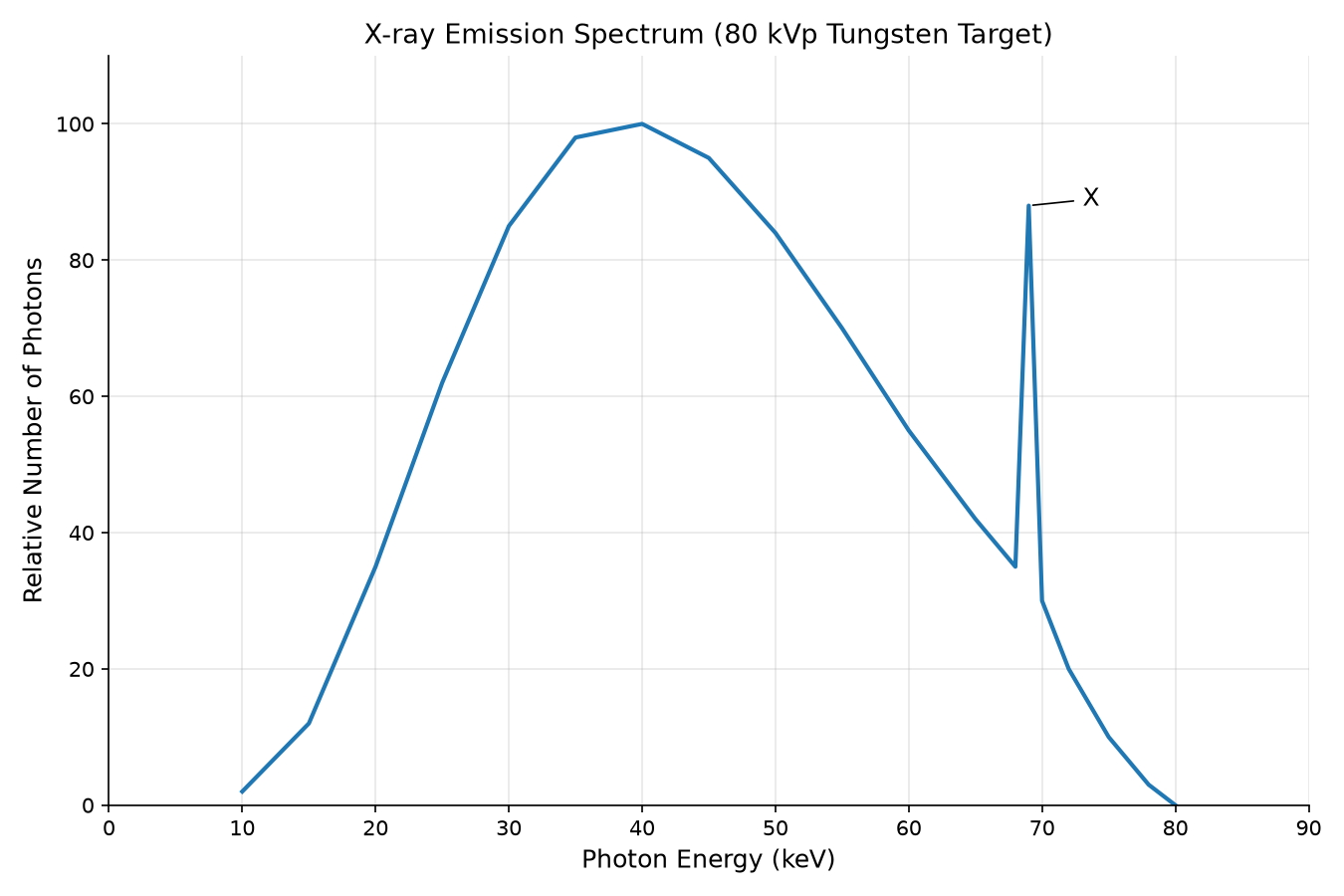
Based on the X-ray emission spectrum shown in the figure for a tungsten target operated at 80 kVp, which physical mechanism accounts for the broad continuous spectrum of photon energies below label X?
Show answer & explanation
Correct answer: B
Bremsstrahlung produces 85-90% of the beam at 80 kVp as electrons decelerate near tungsten nuclei. Characteristic x-rays produce discrete peaks.
- Question 4Intermediate
Safety · Principles of Radiation Physics
During diagnostic radiography within the clinical energy range of 70 to 120 kVp, which physical mechanism characterizes a Compton scattering interaction in soft tissue?
Show answer & explanation
Correct answer: D
Compton scattering ionizes an outer-shell electron; the scattered photon retains most energy and exits with longer wavelength and changed path.
- Question 5Beginner
Safety · Biological Effects of Radiation
Under NCRP Report #184 guidelines and SI radiation measurement conventions used on the ARRT examination, which SI unit is designated for reporting both absorbed dose in tissue and air kerma in diagnostic beams?
Show answer & explanation
Correct answer: A
Gray (Gy) is the SI unit for absorbed dose and air kerma (1 Gy = 1 J/kg). Sievert (Sv) measures equivalent/effective dose; C/kg measures exposure.
- Question 6Advanced
Safety · Biological Effects of Radiation
An industrial worker accidentally sustains an acute, uniform whole-body radiation exposure of 8 Gy (800 rad). Following an initial prodromal episode of severe nausea and vomiting, the individual experiences a brief latent period followed by intractable diarrhea, electrolyte imbalance, dehydration, and destruction of the intestinal mucosal crypt cells, resulting in death within 8 days. Which acute radiation syndrome does this describe?
Show answer & explanation
Correct answer: D
Doses of 6 to 10 Gy destroy intestinal crypt cells, producing GI syndrome (severe dehydration, diarrhea, mucosal denudation, and death in 4-10 days).
Ready for the real thing?
The full RADIOGRAPHY simulator has every exam-style question, timed mode, and instant scoring.