
EPPP Sample Questions & Answers
Free Examination for Professional Practice in Psychology (EPPP) practice questions with worked answers and explanations. See how the ExamJungle simulator prepares you — then jump into the full test.
Launch the full EPPP simulator →Showing 6 of 12 free samples.
- Question 1Beginner
Scientific Orientation to Practice · 1.B.2. Data analysis methods (e.g., quantitative, qualitative, mixed) and statistical interpretation (e.g., power, effect size, causation vs. association, clinical vs. statistical significance)
A psychologist analyzing outcome data from a large youth anxiety intervention computes both statistical significance and effect size metrics. In a sample of 2,000 adolescents, a post-treatment symptom reduction of 1.2 points on a 100-point rating scale yields p < .001 with an observed Cohen's d of 0.06. How should the psychologist interpret these statistical findings?
Show answer & explanation
Correct answer: D
In large samples (N=2,000), even trivial score differences achieve statistical significance. An effect size of d = 0.06 is negligible, demonstrating that statistical significance does not imply meaningful clinical improvement.
- Question 2Advanced
Assessment · 2.A.1. Psychometric principles (e.g., knowledge of item and test characteristics, test construction principles, standardization procedures, reliability, validity, sensitivity, specificity, test fairne
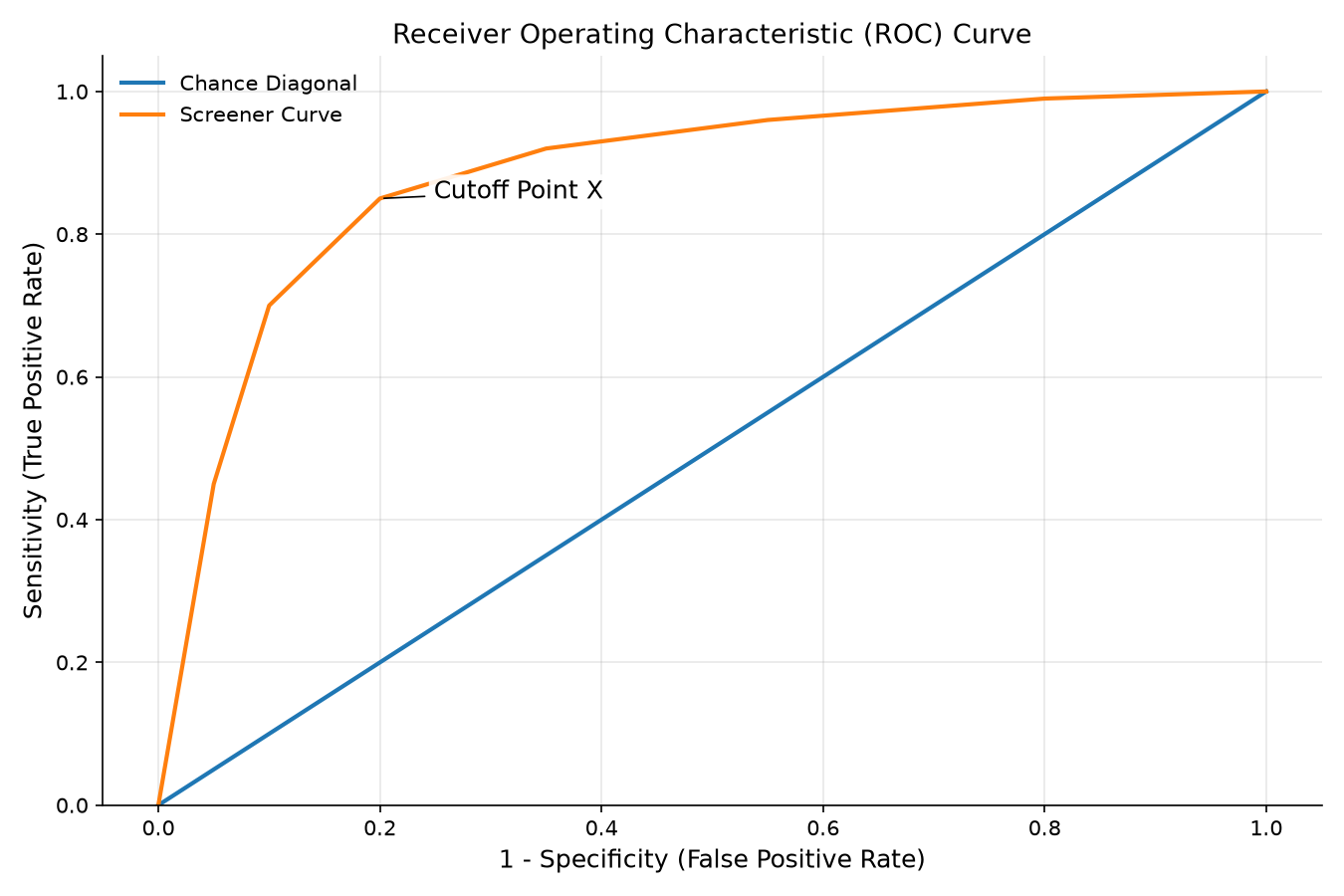
A psychologist is evaluating the diagnostic accuracy of a rapid neurocognitive screening instrument. Based on the Receiver Operating Characteristic (ROC) curve shown in the figure, Cutoff Point X corresponds to a False Positive Rate (1 - Specificity) of 0.20 and a True Positive Rate (Sensitivity) of 0.85. If the psychologist shifts the diagnostic decision threshold to a more stringent cutoff that lowers the False Positive Rate to 0.05, what is the inevitable psychometric consequence?
Show answer & explanation
Correct answer: C
Shifting the diagnostic cutoff to lower the false positive rate (higher specificity) inevitably reduces sensitivity (true positive rate), causing more true cases to be missed and increasing false negatives.
- Question 3Intermediate
Assessment · 2.A.1. Psychometric principles (e.g., knowledge of item and test characteristics, test construction principles, standardization procedures, reliability, validity, sensitivity, specificity, test fairne
A psychologist in an outpatient pediatric assessment center evaluates an 8-year-old child referred for suspected specific learning disorder. The psychologist administers an individually administered, standardized test of general cognitive ability and an academic achievement battery. The cognitive instrument has a published normative mean of 100 and a standard deviation of 15, with an established test-retest reliability coefficient of 0.96, resulting in a Standard Error of Measurement (SEM) of 3.0 points.
The child obtains an observed Full Scale standard score of 92. In the written evaluation report, the psychologist provides a 95% confidence interval for this score, reporting that the child's true cognitive ability is estimated to fall between standard scores of 86 and 98.
During feedback, the child's guardian asks why the evaluation provides a range of scores rather than stating a single, definitive number. In formulating an explanation based on classical test theory, what foundational measurement principle must the psychologist articulate?
Show answer & explanation
Correct answer: D
Classical test theory establishes that an observed score reflects true ability plus random measurement error. The standard error of measurement (SEM) generates confidence intervals that bracket this true score.
- Question 4Intermediate
Assessment · 2.A.1. Psychometric principles (e.g., knowledge of item and test characteristics, test construction principles, standardization procedures, reliability, validity, sensitivity, specificity, test fairne
An assessment psychologist is evaluating a newly developed computerized situational judgment test intended for promotional screening of transit supervisors. During validation analyses, the psychologist discovers that several items require reading intricate, colloquial English idioms under strict time limits, which disproportionately lowers the scores of bilingual candidates who perform exceptionally well on behavioral role-play simulations. Under the Standards for Educational and Psychological Testing, which source of invalidity is introduced by this testing condition?
Show answer & explanation
Correct answer: B
Construct-irrelevant variance occurs when extraneous demands (such as unnecessary colloquial linguistic complexity) artificially lower scores for certain examinees, confounding the measurement of targeted skills.
- Question 5Beginner
Assessment · 2.A.4. Commonly used instruments for the measurement of characteristics and behaviors of individuals, groups, or organizations and their appropriate use
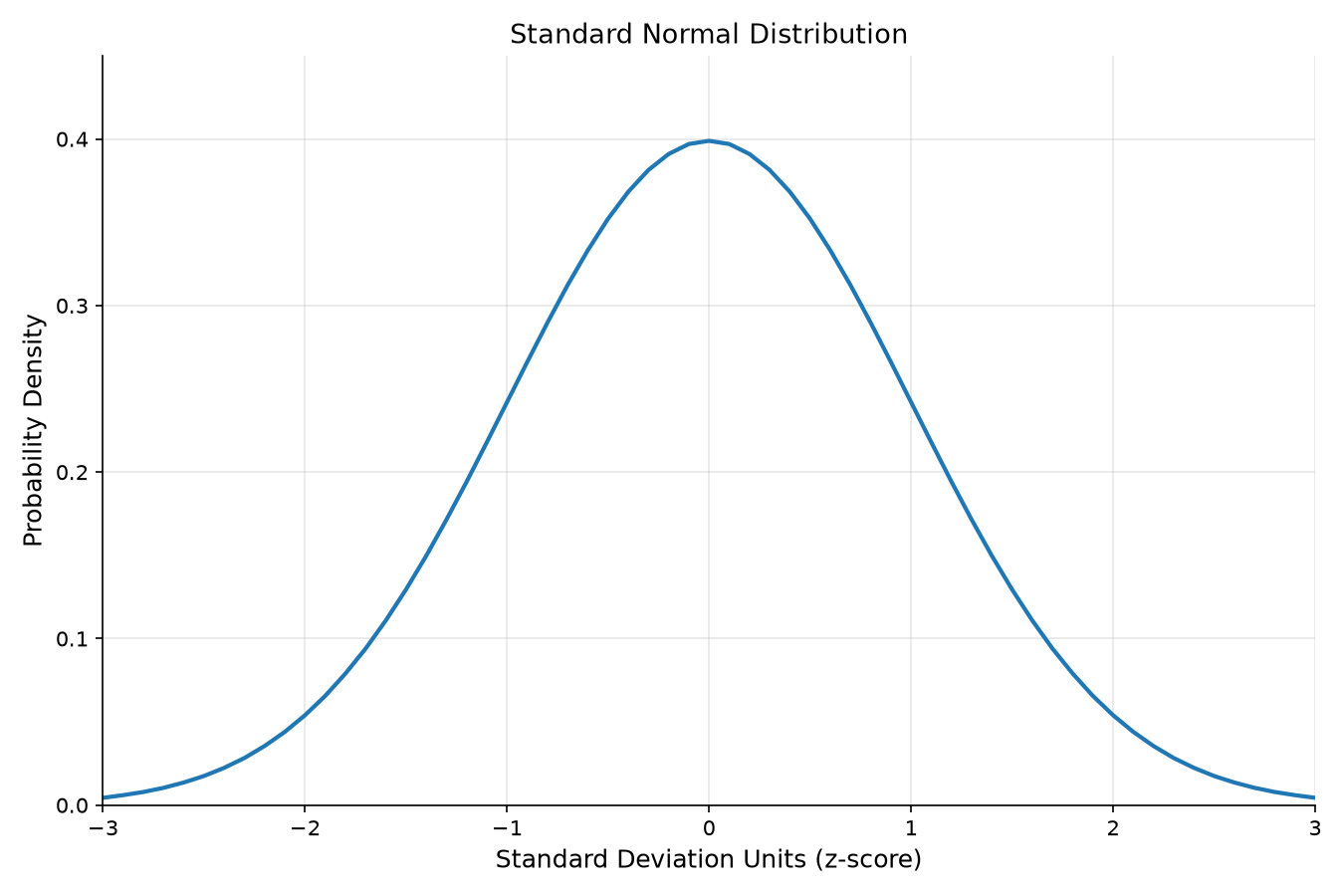
A psychologist reviews standardized test results across different assessment batteries. On an intellectual ability battery with a population mean of 100 and a standard deviation of 15, a client achieves a Full Scale standard score of 115. On a standardized personality inventory utilizing linear T-scores with a mean of 50 and a standard deviation of 10, as shown in the standard distribution curve in the figure, which T-score corresponds to the identical relative normative standing?
Show answer & explanation
Correct answer: A
A score of 115 on a Wechsler scale (mean=100, SD=15) is +1.0 SD above the mean (z = +1.0). On a T-score metric with a mean of 50 and SD of 10, +1.0 SD corresponds to a score of 60.
- Question 6IntermediateSelect 2
Assessment · 2.A.4. Commonly used instruments for the measurement of characteristics and behaviors of individuals, groups, or organizations and their appropriate use
A school psychologist is evaluating a 7-year-old child referred by teachers for persistent motor restlessness, difficulty sustaining attention on structured classroom tasks, and frequent peer interruptions. To conduct a comprehensive, evidence-based multimodal assessment for suspected Attention-Deficit/Hyperactivity Disorder (ADHD), which TWO assessment methods are essential to incorporate? (Select TWO)
Show answer & explanation
Correct answers: A, E
Standardized rating scales from both parents and teachers provide cross-situational behavioral data required to verify symptoms across settings.
Direct observation provides objective, real-time contextual evidence of attention deficits and motor restlessness in natural learning environments.
Ready for the real thing?
The full EPPP simulator has every exam-style question, timed mode, and instant scoring.