
RBT Sample Questions & Answers
Teaching through discrete trials and building up reinforcement carry the biggest share, ahead of reducing problem behavior with antecedent interventions, recording and graphing data, professional ethics, documentation and reporting, and preference and skill assessments.
Launch the full RBT simulator →Showing 6 of 12 free samples.
- Question 1Beginner
Data Collection and Graphing · A.2 Implement discontinuous measurement procedures (e.g., partial & whole interval, momentary time sampling).
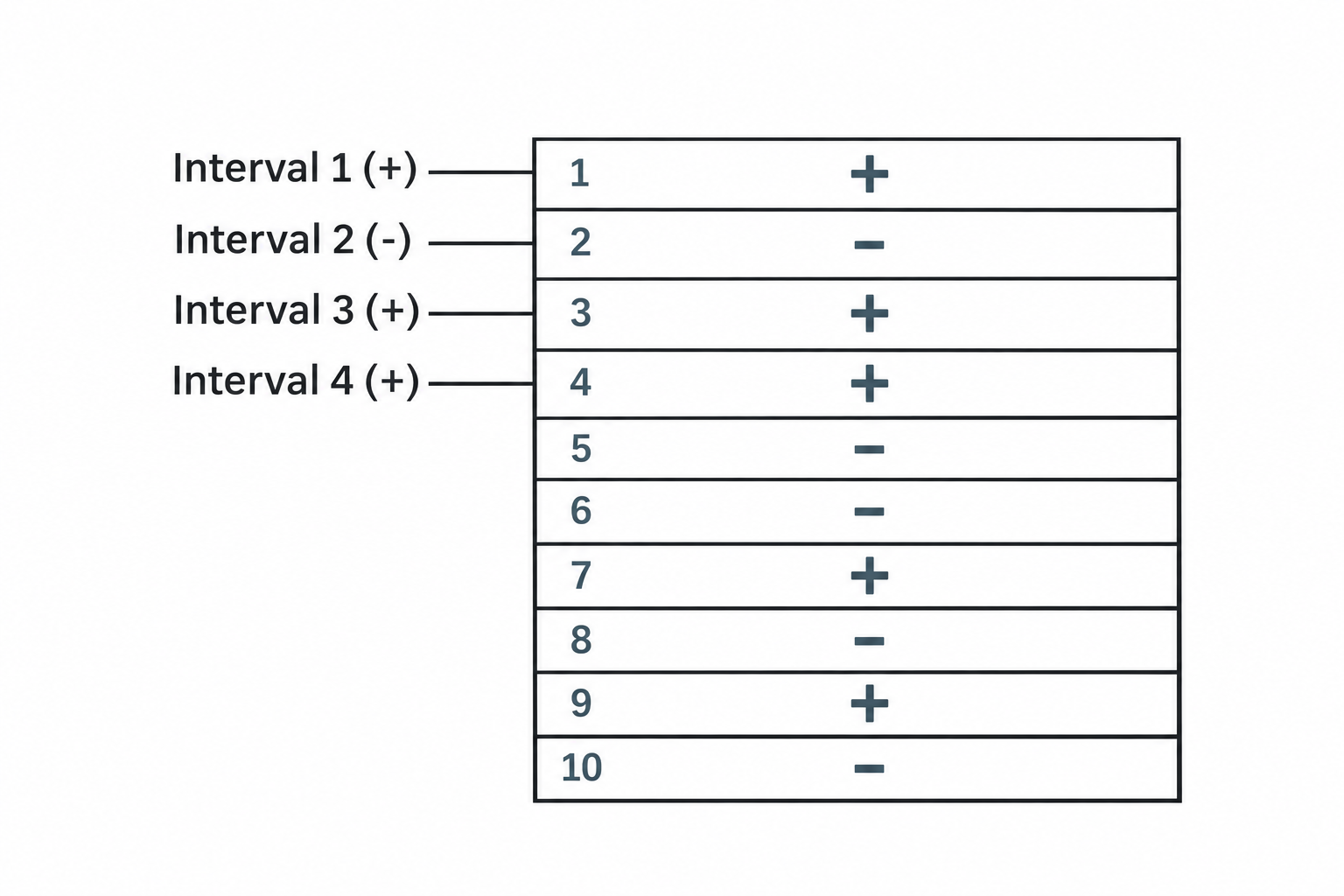
An RBT tracks out-of-seat behavior across ten consecutive 1-minute intervals. If the student stands up or leaves their seat at any second during a 1-minute interval, the technician scores that interval as an occurrence (+). Which discontinuous measurement procedure does this protocol describe?
Show answer & explanation
Correct answer: B
Partial-interval recording scores an interval as an occurrence if the behavior happens at any point during the interval, which tends to overestimate overall duration.
- Question 2Intermediate
Data Collection and Graphing · A.2 Implement discontinuous measurement procedures (e.g., partial & whole interval, momentary time sampling).
While facilitating a small reading group in an inclusive classroom, a technician sets an auditory timer to vibrate every 2 minutes. When the device vibrates, the technician immediately glances up and records whether the target student is looking at the book materials at that exact second.
flowchart LR A[Timer vibrates at end of 2-minute interval] --> B{Is student looking at book right now?} B -->|Yes| C[Score interval as occurrence +] B -->|No| D[Score interval as non-occurrence -]Show answer & explanation
Correct answer: B
Momentary time sampling records whether the target behavior is occurring at the exact end of the specified interval, allowing technicians to track behavior without continuous observation.
- Question 3Beginner
Data Collection and Graphing · A.7 Identify trends in graphed data.
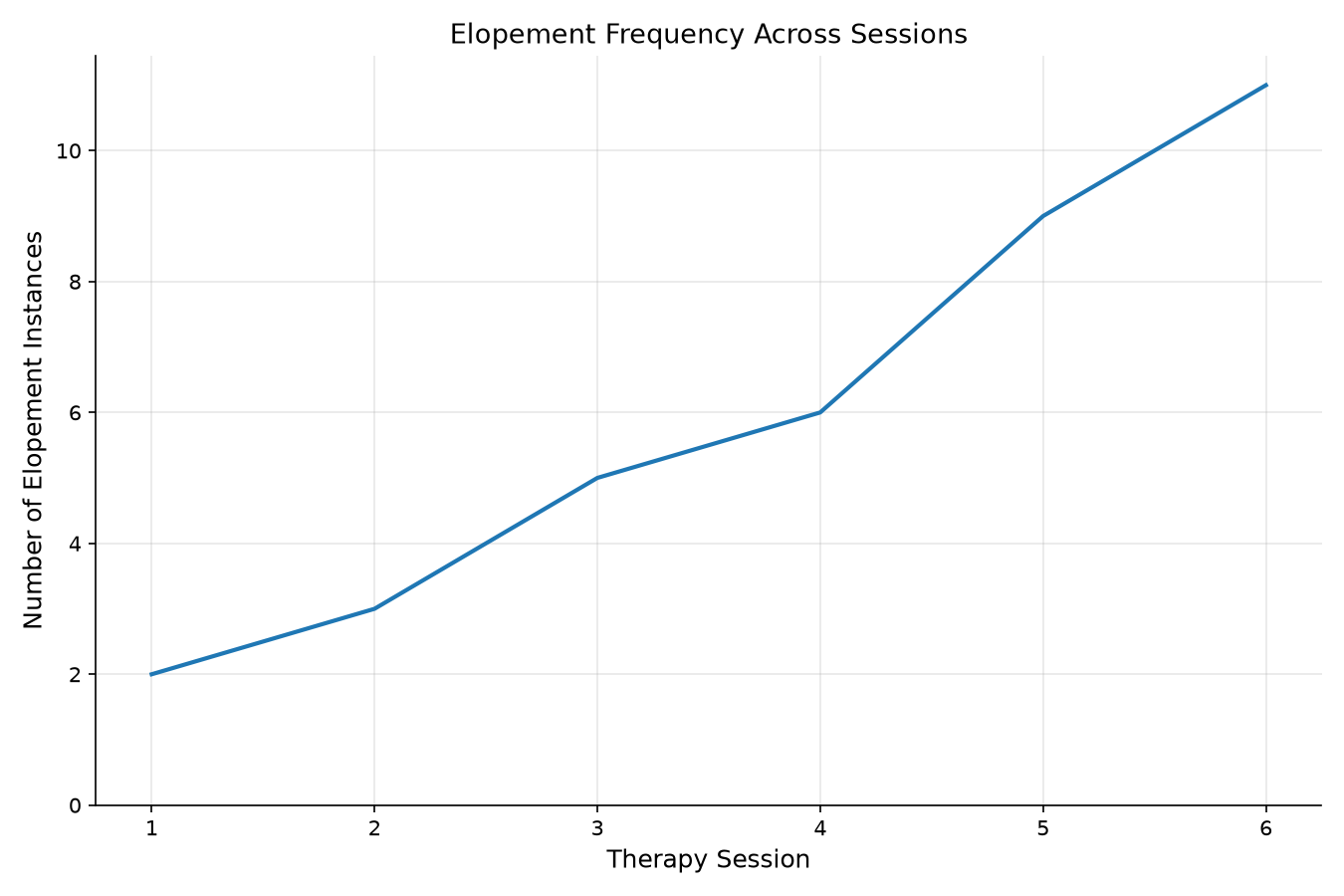
A behavior technician enters session data into the clinic's electronic graphing system. Based on the line graph displaying the frequency of elopement across six consecutive therapy sessions, what data pattern or trend is depicted?
Show answer & explanation
Correct answer: C
Trend describes the overall direction of the data path. A consistent rise across consecutive data points indicates an increasing or upward trend.
- Question 4Intermediate
Data Collection and Graphing · A.7 Identify trends in graphed data.
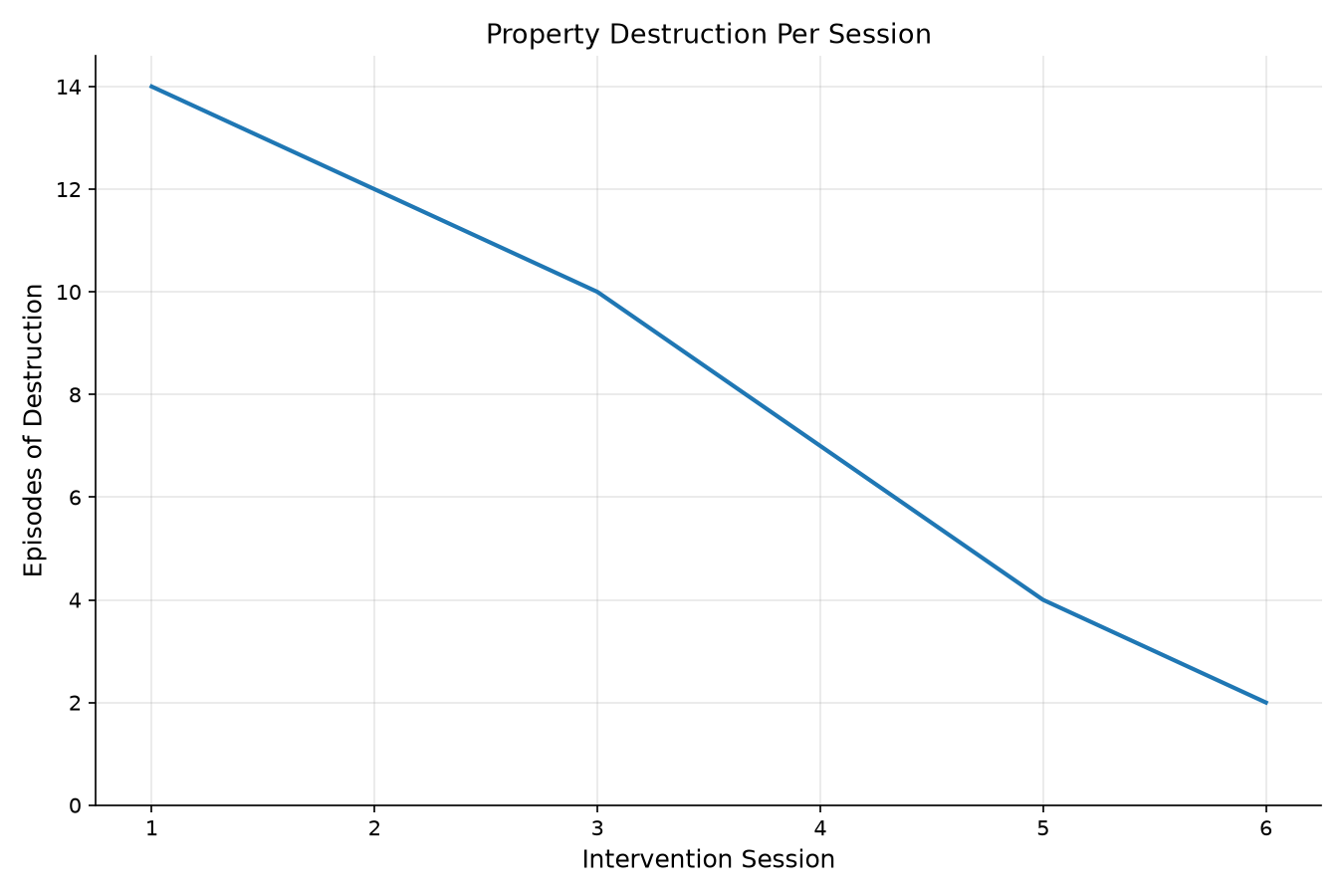
A behavior technician reviews the progress monitoring chart for a client's property destruction intervention. Looking at the data path across Sessions 1 through 6, what trend does the graphed behavior display?
Show answer & explanation
Correct answer: D
The data path demonstrates a consistent decline in frequency over successive sessions, which represents a downward trend and indicates therapeutic progress.
- Question 5Intermediate
Data Collection and Graphing · A.7 Identify trends in graphed data.
When inspecting a graphed baseline data series prior to starting an intervention, an RBT observes that the data points fluctuate only between 4 and 5 instances across seven sessions. How should the technician describe the trend of this baseline data to the supervisor?
Show answer & explanation
Correct answer: B
Data that demonstrate minimal fluctuation without a distinct upward or downward slant reflect a stable baseline with zero trend, ideal for introducing intervention.
- Question 6Intermediate
Data Collection and Graphing · A.8 Describe the risks associated with unreliable data collection and poor procedural fidelity.
What is the primary clinical risk if an RBT collects inaccurate or unreliable behavioral data during daily sessions?
Show answer & explanation
Correct answer: D
Behavior analysts rely directly on technician data to make treatment decisions; inaccurate data lead to misinterpreting client progress and implementing inappropriate plan changes.
Ready for the real thing?
The full RBT simulator has every exam-style question, timed mode, and instant scoring.