
ASP Sample Questions & Answers
Free Associate Safety Professional® (ASP®) practice questions with worked answers and explanations. See how the ExamJungle simulator prepares you — then jump into the full test.
Launch the full ASP simulator →Showing 6 of 12 free samples.
- Question 1Intermediate
Safety Programs and Concepts · Apply the hierarchy of hazard controls
An aerospace maintenance hangar uses trichloroethylene (TCE), a chlorinated solvent, in manual parts-degreasing tanks. Air monitoring shows airborne concentrations approaching regulatory exposure thresholds. The safety committee evaluates multiple corrective proposals. According to the hierarchy of controls, which action represents the highest level of hazard control?
graph TD A[Elimination: Physically remove hazard] --> B[Substitution: Replace hazard] B --> C[Engineering Controls: Isolate people from hazard] C --> D[Administrative Controls: Change work practices] D --> E[PPE: Protect worker with personal gear]Show answer & explanation
Correct answer: C
Replacing hazardous TCE with a non-toxic aqueous wash substitutes the chemical with a safer alternative, which outranks engineering hoods, administrative rotations, and PPE.
- Question 2Beginner
Safety Programs and Concepts · Apply the hierarchy of hazard controls
True or False: Under the NIOSH Total Worker Health® (TWH) hierarchy of controls, the "Redesign" strategy is prioritized above the "Educate" and "Encourage" strategies to protect and advance worker well-being.
Show answer & explanation
Correct answer: B
True. In the NIOSH Total Worker Health framework, redesigning the work environment sits in the middle tier, outranking individual-focused educate and encourage strategies.
- Question 3IntermediateSelect 2
Safety Programs and Concepts · Implement hazardous energy control programs (e.g., electrical, hydraulic, thermal, kinetic, mechanical, magnetic)
While auditing a manufacturing plant's hazardous energy control program, a safety specialist inspects energy-isolation hardware across several stamping presses. Which TWO of the following items qualify as energy-isolating devices under OSHA 29 CFR 1910.147? (Select TWO)
flowchart TD Start[Energy Source Isolation] --> Check{Device Type?} Check -->|Manual Disconnect Switch| Isolating[Energy-Isolating Device: Lockable] Check -->|Mechanical Line Valve| Isolating Check -->|Push Button / E-Stop| Control[Control Circuit Device: Non-Isolating] Check -->|Selector / Interlock| ControlShow answer & explanation
Correct answers: C, E
Manually operated disconnect switches physically break power circuits, qualifying as energy-isolating devices under 1910.147.
Mechanical line valves physically isolate fluid or gas lines and can be locked, meeting energy-isolating device criteria.
- Question 4Intermediate
Safety Programs and Concepts · Implement hazardous energy control programs (e.g., electrical, hydraulic, thermal, kinetic, mechanical, magnetic)
At the conclusion of a maintenance shift, an authorized millwright inadvertently leaves their personal lockout padlock on a pneumatic distribution manifold disconnect and departs the facility. Production must resume immediately. Under OSHA 29 CFR 1910.147, which sequence of mandatory steps must the employer execute before another designated employee may remove the lock?
Show answer & explanation
Correct answer: C
OSHA allows employer lock removal only after confirming the worker is absent, making documented efforts to contact them, and informing them prior to resuming work.
- Question 5Intermediate
Safety Programs and Concepts · Understand the key safety fundamentals of: Trenching and excavations
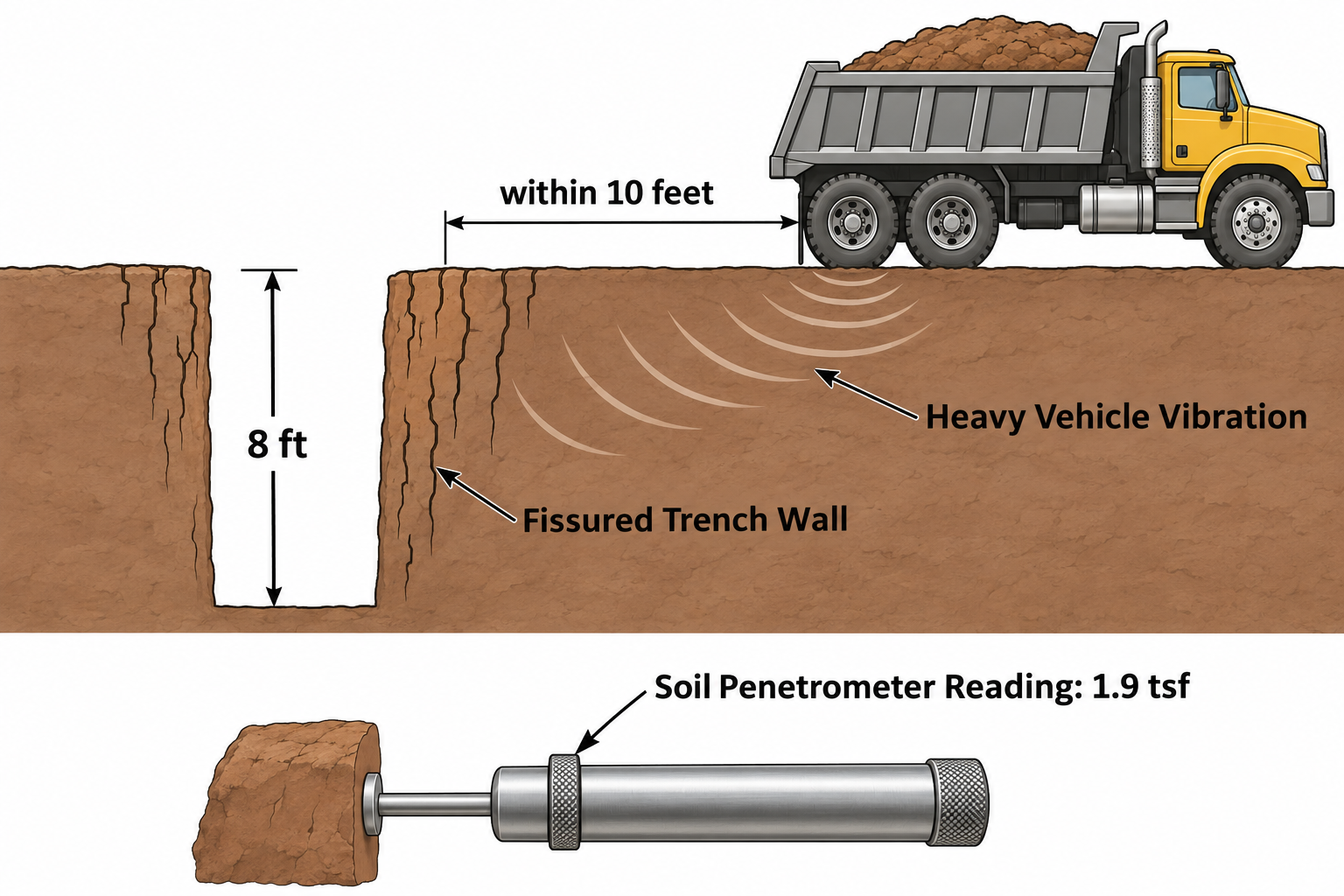
A competent person performs soil testing on an 8-foot-deep utility excavation. Initial pocket penetrometer tests indicate cohesive clay soil with an unconfined compressive strength of 1.9 tons per square foot (tsf). However, heavy dump trucks operate within 10 feet of the excavation crest, and distinct vertical tension cracks are visible along the trench walls. Under OSHA 29 CFR 1926 Subpart P, how must this soil be classified?
Show answer & explanation
Correct answer: D
Cohesive soil with strength over 1.5 tsf cannot be classified as Type A if it is fissured or subject to vibration from traffic; OSHA requires downgrading it to Type B.
- Question 6Advanced
Safety Programs and Concepts · Understand the key safety fundamentals of: Trenching and excavations
A civil utility contractor is excavating an 8-foot-deep, 5-foot-wide linear trench spanning 100 feet in cohesive Type B soil to install a municipal sewer lateral. Workers must enter the trench bottom to grade aggregate and assemble pipe couplings.
During an unannounced safety inspection, the safety professional observes that excavated spoil piles are deposited 14 inches from the trench lip, and a single extension ladder is positioned at the far eastern terminus of the 100-foot trench run. No trench boxes, shoring struts, or sloping benches are in place because the foreman claims the soil is stiff and dry.
The safety professional immediately stops all work within the trench. To achieve full regulatory compliance under OSHA 29 CFR 1926 Subpart P before employees re-enter, which set of corrective actions must the contractor implement?
flowchart TD A[Excavation Depth >= 5 ft] --> B[Competent Person Soil Analysis] B --> C{Soil Classification} C -->|Type B Soil| D[Install Protective System: Trench Box or Sloping 1:1] D --> E[Set Spoil Piles Back >= 2 ft] E --> F[Provide Egress Ladder Every 25 ft Lateral Travel]Show answer & explanation
Correct answer: B
OSHA 1926 Subpart P requires protective systems for trenches 5 feet or deeper, spoil setbacks of at least 2 feet, and lateral egress ladder spacing within 25 feet.
Ready for the real thing?
The full ASP simulator has every exam-style question, timed mode, and instant scoring.