
CPCE Sample Questions & Answers
Free Counselor Preparation Comprehensive Examination practice questions with worked answers and explanations. See how the ExamJungle simulator prepares you — then jump into the full test.
Launch the full CPCE simulator →Showing 6 of 12 free samples.
- Question 1IntermediateSelect 2
Professional Counseling Orientation and Ethical Practice · Ethical standards of professional counseling organizations and credentialing bodies, and applications of ethical and legal considerations in professional counseling
A mental health counselor conducts an intake assessment with a 13-year-old adolescent who is experiencing social withdrawal. The adolescent's legal guardians have accompanied the client to the clinic. Which TWO ethical actions are mandatory regarding the consent and assent process? (Select TWO)
Show answer & explanation
Correct answers: A, D
Minors must be included in the decision-making process through developmentally appropriate assent.
Minors cannot legally consent; legal consent must be granted by the parent or legal guardian.
- Question 2Beginner
Social and Cultural Diversity · The impact of heritage, attitudes, beliefs, understandings, and acculturative experiences on an individual’s views of others
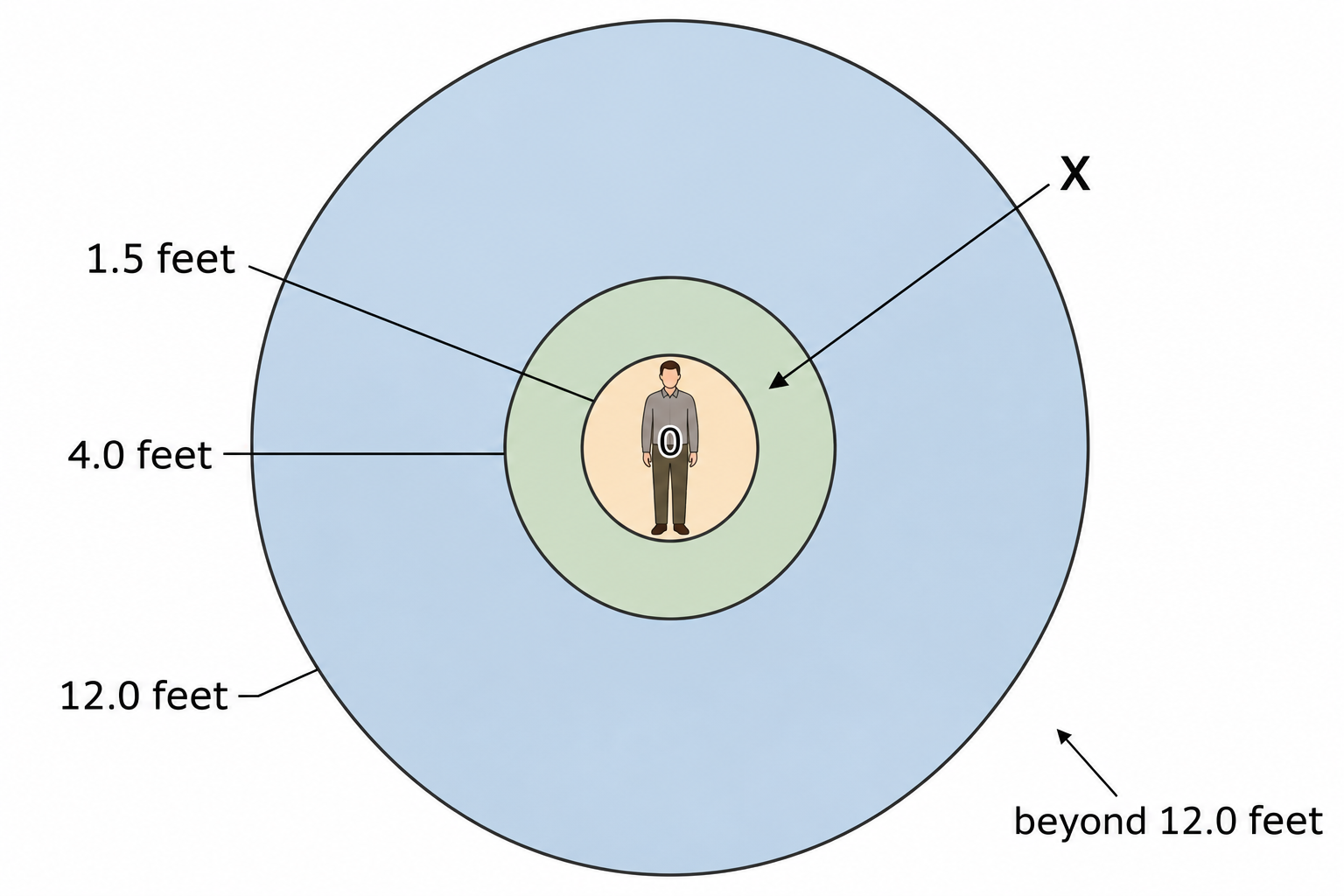
While conducting cross-cultural assessments, a clinical counselor analyzes physical boundaries and interpersonal space in the consulting room. The figure illustrates the concentric spatial distances described in cross-cultural anthropology. Which term denotes the study of how cultural groups regulate physical interpersonal space, and which spatial zone corresponds to label X spanning 1.5 to 4 feet?
Show answer & explanation
Correct answer: B
Proxemics studies human use of space. Edward T. Hall defined personal distance as 1.5 to 4 feet (labelled X). Kinesics refers to body motion, paralanguage to vocal cues, and haptics to touch.
- Question 3Intermediate
Social and Cultural Diversity · Theories and models of multicultural counseling, cultural identity development, and social justice and advocacy
A second-generation client expresses profound resentment toward dominant societal institutions, actively rejects Eurocentric values, and exclusively consumes cultural media from their heritage group. The client explains that historical oppression explains all personal adversity. The diagram outlines the Racial/Cultural Identity Development (R/CID) model:
flowchart TD A[Conformity] --> B[Dissonance] B --> C[Resistance and Immersion] C --> D[Introspection] D --> E[Integrative Awareness]Which stage of the R/CID model is this client demonstrating?
Show answer & explanation
Correct answer: D
In the Resistance and Immersion stage of R/CID, individuals reject dominant cultural values, hold uncritical allegiance toward their minority group, and experience guilt or anger regarding past complicity with oppression.
- Question 4Advanced
Social and Cultural Diversity · The effects of power and privilege for counselors and clients
A licensed professional counselor at a community clinic conducts an intake with an undocumented immigrant client who reports severe insomnia, panic attacks, and pervasive fear following local immigration raids. The client fears deportation and the forced separation of her young children, who are natural-born citizens.
During the consultation, the counselor tells the client: "Anxiety is primarily cognitive and completely under your internal control. If you practice deep progressive relaxation and stop worrying about external legal issues that you cannot change today, your panic will resolve." The counselor also suggests that the client simply hire an immigration attorney, overlooking that the client works for minimum wage and lacks legal documentation pathways.
The client becomes silent, gives monosyllabic answers, and fails to attend subsequent scheduled appointments.
From the framework of multicultural and social justice counseling competencies, what primary conceptual error did the counselor commit?
Show answer & explanation
Correct answer: C
Culturally competent practice requires recognizing external systemic oppression. Locating chronic environmental distress solely within intrapsychic control invalidates sociopolitical trauma and damages therapeutic alliance.
- Question 5Beginner
Social and Cultural Diversity · Multicultural counseling competencies
True or False: Under the Multicultural and Social Justice Counseling Competencies (MSJCC), multiculturally competent counselors must integrate self-awareness, client worldview knowledge, culturally responsive interventions, and advocacy across interpersonal, institutional, and systemic levels.
Show answer & explanation
Correct answer: B
The MSJCC framework requires counselors to intervene across internal and systemic domains, combining cultural self-awareness, client knowledge, and social justice actions at interpersonal, institutional, and global levels.
- Question 6Intermediate
Human Growth and Development · Theories of individual and family development across the lifespan
In Jean Piaget's theory of cognitive development, a 5-month-old infant accidentally kicks a crib mobile, causing it to spin and chime. Captivated by this environmental effect, the infant deliberately repeats the leg-kicking motion multiple times to reproduce the external sound. In which sensorimotor substage is this behavior classified?
Show answer & explanation
Correct answer: B
Secondary circular reactions (4-8 months) involve repeating actions that produce interesting effects in the external environment. Primary circular reactions focus strictly on the infant's own body (e.g., thumb sucking).
Ready for the real thing?
The full CPCE simulator has every exam-style question, timed mode, and instant scoring.