
Atlassian's ACA-930 exam format is short, fixed, and unforgiving of guesswork: 30 questions, 60 minutes, and a 68% passing score. That works out to roughly two minutes per question and about 21 correct answers to clear the bar. For a $100 USD exam, that's a fair trade — but only if you walk in knowing what the test actually asks.
The problem is that official detail on Loom Essentials is thin. Atlassian's associate-level Loom credential is newer than the Jira and Confluence tracks, so most of what circulates online is either recycled marketing copy or material that misrepresents what you'll see on test day. This breakdown sticks to what's verifiable: the confirmed format, the domains the exam draws from, how the question types behave, and where candidates tend to lose points they didn't need to lose.
If you're deciding whether to register, or you've already booked a slot and want to know what you're walking into, the sections below cover the shape of the test first and the study implications second.
The confirmed ACA-930 format at a glance
Start with the numbers, because they drive every other decision you'll make about preparation. The format is published and stable enough to plan around.
| Attribute | Detail |
|---|---|
| Exam code | ACA-930 |
| Full name | Atlassian Certified Associate – Loom Essentials |
| Level | Associate |
| Questions | 30 |
| Time limit | 60 minutes |
| Passing score | 68% |
| Approximate correct answers needed | 21 of 30 |
| Cost | $100 USD |
| Question types | Multiple choice and multiple response (select all that apply) |
| Delivery | Online proctored via Certmetrics, or at a physical testing center |
The ACA 930 exam page confirms the duration, question count, passing threshold, and price, and notes that the credential validates foundational Loom skills: creating and editing videos, sharing and collaborating with teammates, and managing Loom content and workspace settings.
Two things about that table deserve emphasis. First, 68% is not a generous threshold when you only have 30 questions. Each question is worth about 3.3 percentage points, so missing three more than you planned can be the difference between a pass and a retake fee. Second, the 60-minute window sounds comfortable until you hit a multi-select question that requires you to evaluate five options instead of four. Those eat time.
The exam is also described as beginner-friendly, with candidates who have hands-on Loom experience and complete the official 40-minute prep course reporting first-attempt passes. That's a useful signal about the intended audience, but "beginner-friendly" is not the same as "no preparation required." The people passing on the first try are the ones who have actually recorded, edited, and shared Loom videos, not the ones who read about it.
What the Loom Essentials domains actually test
The exam covers three functional areas, and they map cleanly onto how Loom works in practice. Understanding the weighting matters more than memorizing feature names, because the questions are scenario-based rather than definition-based.
Recording and editing video
This is the largest practical area and the one most candidates underestimate. Expect questions about capture modes — screen only, camera only, screen and camera together — and about when each makes sense. A question might describe a support engineer who needs to walk a customer through a dashboard while maintaining eye contact, and ask which capture configuration fits.
Editing questions tend to focus on trimming, cutting sections out of a recording, and stitching clips together. You should know how to remove a false start without re-recording the whole video, and how to add a title or a call-to-action at the end. These are the tasks that separate people who have used Loom from people who have watched a demo of it.
Sharing and collaboration
Sharing questions test whether you understand the difference between a link that anyone can view and a link restricted to specific people or a workspace. You'll see scenarios about sending a video to an external client versus posting it to an internal channel, and the correct answer usually hinges on the access setting rather than the sharing method.
Comments and reactions matter here too. Loom lets viewers leave timestamped comments, which means feedback lands at the exact moment in the video it refers to. Questions in this domain often ask how to direct a teammate to a specific point in a recording, or how to respond to feedback without re-recording.
Content and workspace management
This is the smallest domain by question count but the one where careless candidates drop points. It covers organizing videos into folders, managing workspace settings, controlling who can create and share within a workspace, and handling retention or deletion of content.
The trap here is assuming that workspace-level settings and video-level settings do the same thing. They don't. A workspace admin can restrict sharing defaults across the team, but an individual video can still carry its own permissions. Questions that blend the two layers are where people second-guess themselves.
If you want a concrete way to test whether you actually know these three areas rather than just recognize them, an ACA-930 practice test that mirrors the real domain weighting will surface the gaps faster than re-reading documentation.
How the question types behave under a 60-minute clock
Question format is where exam anxiety usually starts, and it's worth being specific about what you'll face.
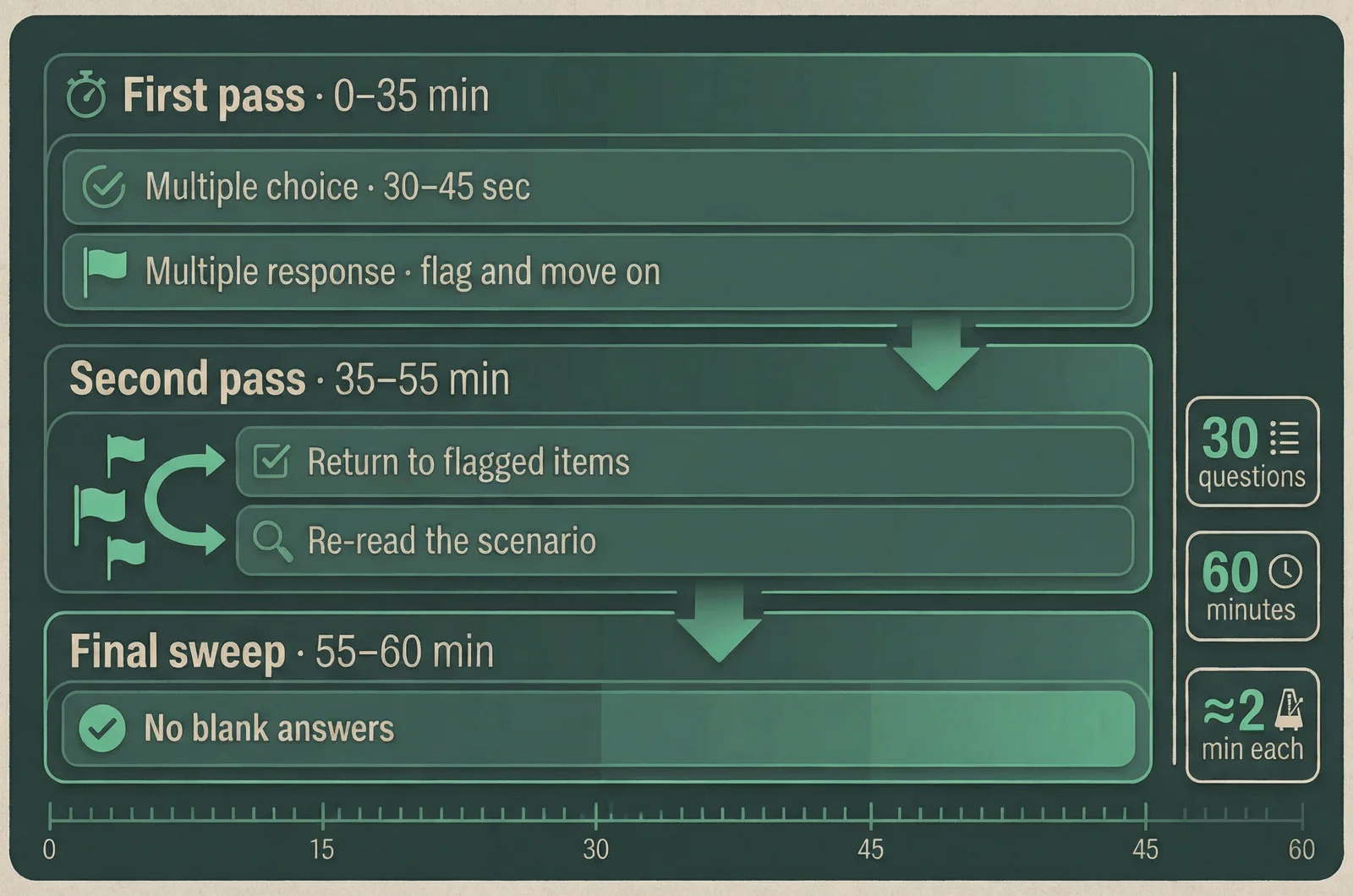
Multiple choice questions give you four options and one correct answer. These are the fast questions. If you know the material, you'll spend 30 to 45 seconds on each. If you don't, you'll spend three minutes and probably still guess wrong.
Multiple response questions — the "select all that apply" variety — are the ones that change your pacing. They typically present five options and ask for two or three correct selections. There's no partial credit in most certification formats, so a question where you're confident about two of three answers is still a question you might miss entirely.
Here's the practical implication: if the exam has, say, eight multi-select questions and you average three minutes on each, that's 24 minutes gone before you've touched the other 22 questions. You have 36 minutes left for those, which is about 1.6 minutes each. That's tight but workable — provided you don't get stuck.
A pacing approach that holds up:
- First pass: answer every question you're confident about, flag anything uncertain, and move on. Don't let a multi-select question hold you hostage on the first pass.
- Second pass: return to flagged questions with whatever time remains. You'll often find that a later question jogged your memory about an earlier one.
- Last five minutes: make sure nothing is blank. An unanswered question is a guaranteed zero; a reasoned guess is not.
The ACP-220 exam format breakdown shows how Atlassian structures timing and question types across its certification line, which is useful context if you're planning to stack multiple Atlassian credentials.
Where candidates lose points they didn't need to lose
Most ACA-930 failures aren't knowledge failures. They're format failures — candidates who knew the material but misread what the question was asking.
The most common pattern is confusing "how do I do this" with "what's the best way to do this." Loom often supports several routes to the same outcome, and the exam asks which one fits the scenario. Recording a quick screen capture and sharing it via a public link works. But if the scenario involves a customer-facing walkthrough of an unreleased feature, the public link is the wrong answer even though it technically functions.
A second pattern is missing the workspace-versus-video distinction described earlier. If a question mentions a workspace admin, the answer almost always involves a workspace-level control. If it mentions a video owner, the answer lives at the video level. Reading for the actor in the scenario is often enough to eliminate two options immediately.
The third pattern is over-preparing on features that aren't tested. Loom has integrations, analytics, and enterprise controls that sit outside the associate-level scope. Spending a week on admin console configuration when the exam asks about trimming a video is a poor use of study time — and it's exactly the kind of wasted effort that makes certification prep feel longer than it needs to be.
That's the case for practicing under real conditions rather than reading indefinitely. A timed simulator forces you to answer at exam speed, with exam-style distractors, and shows you whether your problem is knowledge or pacing. ExamJungle's simulator pairs each question with an explanation of why the correct answer is correct and why the others aren't, and Caesar AI can expand an explanation or generate harder variants when a topic still isn't clicking. Understanding the reasoning is what makes the knowledge stick past test day.
What to watch as Atlassian's Loom certification matures
This is where confirmed fact ends and analysis begins, and it's worth labeling clearly.
Confirmed: the exam is 30 questions, 60 minutes, 68% to pass, $100 USD, delivered through Certmetrics or a testing center, and built around recording/editing, sharing/collaboration, and content/workspace management. That's the format as published.
Analysis: newer associate-level certifications tend to stabilize their domain weighting over the first year or two as candidate data accumulates. Atlassian has a track record of publishing objective updates for its ACA exams, so anyone planning to sit ACA-930 more than a few months out should check the official objectives page before booking rather than relying on a study plan built today.
What to watch specifically:
- Objective revisions. If Atlassian adds a domain or shifts weighting, practice material built on the old blueprint drifts out of alignment. Re-verify against the current objectives before your exam date.
- Question-type mix. The published format lists multiple choice and multiple response. If early candidate reports describe a different mix, treat that as a signal to practice both formats heavily rather than assuming one dominates.
- Retake policy and pricing. A $100 exam with a retake fee changes the math on how much preparation is worth. Confirm current pricing and retake terms at registration, since vendor policies shift.
For candidates weighing Loom Essentials against other Atlassian associate credentials, the sibling exams follow similar formats. The Confluence Essentials practice exam and the Jira Essentials practice exam sit at the same associate tier, so if you've prepared for one, the pacing and question style will feel familiar. The ACA-915 practice test covers Cloud Foundations, which is a reasonable starting point if you're building toward the Loom credential and want the broader Atlassian context first.
Building a study plan around the real format
Since the exam is 30 questions and 60 minutes, your preparation should mirror that ratio. Long reading sessions don't build the reflex you need; timed question sets do.
A workable two-week structure for someone with basic Loom familiarity:
Days 1–3: Hands-on coverage. Record at least five videos using different capture modes. Trim one, cut a section out of another, add a CTA to a third. Share one internally and one externally, and note the access settings you used. This is the fastest way to make the domain questions feel obvious rather than abstract.
Days 4–7: Domain-targeted drilling. Work question sets organized by domain so you can see which of the three areas is weakest. If workspace management is your soft spot, that's where the extra reps go.
Days 8–11: Full timed simulations. Take complete 30-question, 60-minute sets under exam conditions. No pausing, no looking things up. Track your score and, more importantly, track where your time went.
Days 12–14: Error review. Go back through every missed question and write down why you missed it — didn't know the feature, misread the scenario, or ran out of time. The category matters, because each one has a different fix.
If you're preparing a team rather than yourself, the same structure works with a shared scoreboard. Managers sponsoring certification for direct reports get more value from tracking domain-level scores than from tracking hours studied, because domain scores tell you where the actual risk sits.
One tool idea worth building into your routine: a readiness estimator that takes your last three timed scores, weights them by recency, and flags any domain below 70%. It's a simple calculation, but it turns "I think I'm ready" into a number you can act on.
Questions candidates ask before booking
How many questions do I need to get right to pass ACA-930?
Twenty-one out of 30, based on the 68% passing score. That leaves room for nine misses, which sounds generous until you account for multi-select questions where a partial answer still counts as wrong.
Is ACA-930 hard?
It's an associate-level exam with a beginner-friendly reputation. Candidates with hands-on Loom experience and the official prep course behind them report passing on the first attempt. The difficulty comes from format unfamiliarity, not from the underlying material.
Can I take it from home?
Yes. The exam is available online with proctoring through Certmetrics, and it can also be taken at a physical testing center if you prefer a controlled environment.
How long should I study?
Two weeks of focused preparation is realistic for someone who already uses Loom. If you've never recorded or edited a video in the tool, add a week for hands-on practice before you start timed drilling.
What happens if I fail?
You pay a retake fee, which is why the 68% threshold deserves respect. Confirm current retake pricing and any waiting period at registration, since vendor policies change.
Does the certification expire?
Check Atlassian's current certification terms at the time you register. Maintenance requirements for Atlassian credentials have shifted over time, and the answer that was accurate a year ago may not be today.
Atlassian associate exams worth knowing about
ACA-930 sits inside a broader associate tier, and knowing the neighbors helps you plan a certification path rather than a single exam. The Jira Service Management exam targets service desk agents, the ITSM with Jira exam covers service management foundations, and the Atlassian Cloud Admin exam moves up to the professional tier for administrators. Each follows a similar short-format structure, so the pacing skills you build for Loom Essentials transfer directly.
For Loom specifically, the format is settled enough to plan around: 30 questions, 60 minutes, 68% to pass, three domains, two question types. What isn't settled is how well you perform under that clock, and that's the part practice actually fixes.
References
aca Standards — ACA - Standards ... The Standards and Accreditation Department is dedicated to the field of corrections. The standards created and refined by the American Correctional
Standards at Glance — Standards at a Glance | American Camp Association ... Disclaimer: The American Camping Association ... ACA), Inc. provides guidelines, but cannot and does not specifically monitor