
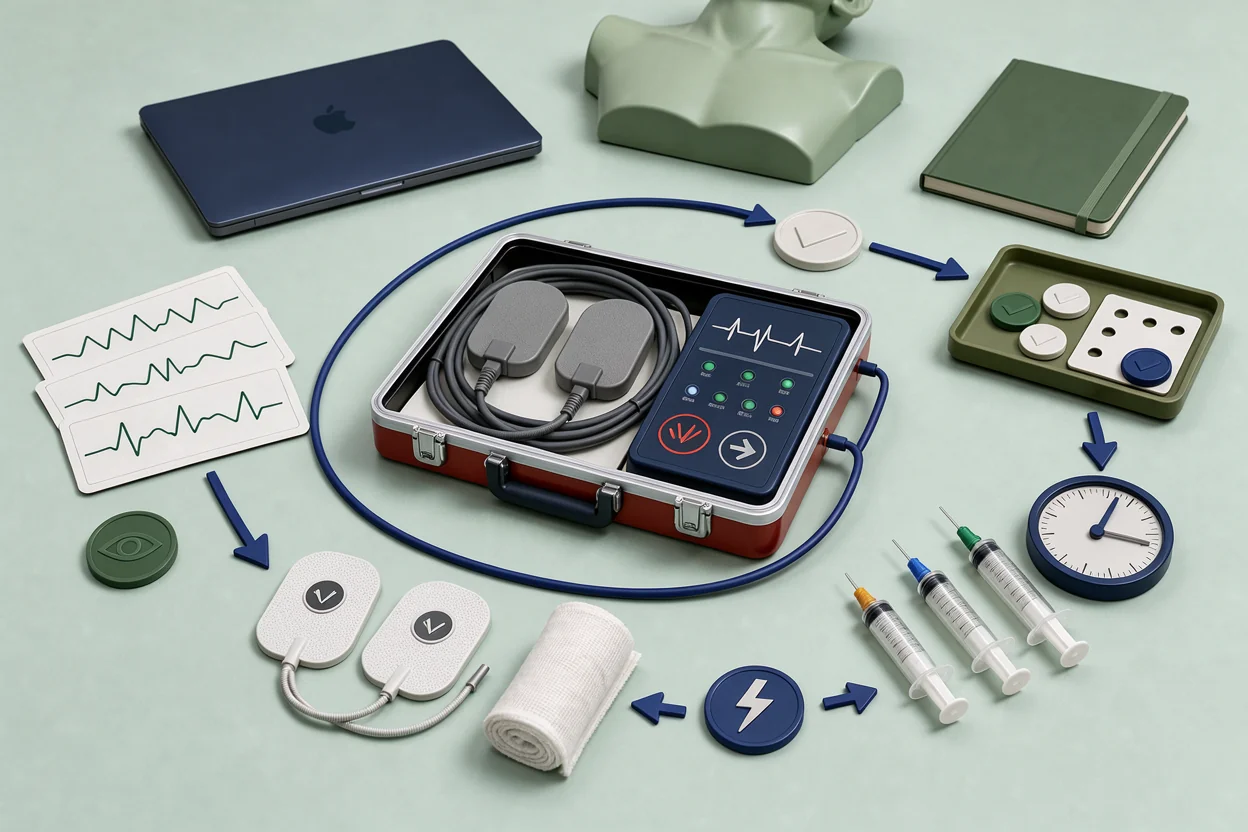
Use your ACLS megacode testing scenario flow chart to rehearse each decision aloud, then check your reasoning against the adult algorithms and assessment materials assigned by your course. Work through initial assessment, rhythm selection, branch-specific actions, medication checks, reassessment, and the transition to ROSC care.
I’d keep those materials open during the first pass. Fill treatment details directly from them, including indications, doses, intervals, and device settings. Then ask your instructor to review any uncertain connections. The goal of this checklist is a concrete study record: what you can explain, what you can demonstrate in rehearsal, and what still needs correction.
Build a scenario map you can check against your course materials
Start your megacode checklist by identifying the exact materials you will use to check it. Write the course name, assigned algorithm edition, assessment-sheet title, and instructor’s clarification date at the top.
Keep a narrow margin beside your map for source locations. Whenever you add a clinical instruction, record the page, algorithm box, or assessment item that supports it. Leave uncertain details visibly unfinished until you check them.
Give every arrow a reason
Sketch a study map around this reading order:
Initial findings → branch selection → branch actions → reassessment → the next supported pathway.
Treat that line as a worksheet structure. Copy the actual clinical sequence from your assigned algorithm.
At each arrow, write the finding or criterion that permits the transition. Avoid an unexplained arrow labeled “continue.” Specify what information you must review and which box you would select afterward.
Make room for a return arrow as well. For every repeat sequence in your materials, identify where you reenter it and what you must reassess first.
Keep treatment details attached to their source
Place exact treatment values beside the action they belong to. Record any qualifying instructions in the same space.
Ask a partner to point at an unfamiliar box and request your explanation. Locate its source before answering from memory.
Consider the map ready for rehearsal when every clinical instruction has a traceable source and every transition has an explicit reason.
Verify the initial assessment before tracing treatment
For the opening assessment, prepare a short record of the findings you must obtain or receive under your course’s scenario instructions.
Separate what the scenario states from what you are expected to assess. If a written prompt supplies a finding, copy it accurately. If the exercise expects an assessment, identify how you will demonstrate or verbalize it.
Use three spaces on your worksheet: information received, assessment performed, and findings reported. Keep interpretation in a separate space.
Review these items against your assessment sheet:
- Identify the starting patient condition and the information still needed.
- Locate the criteria that direct you into the assigned pathway.
- Record the help, equipment, and team actions specified by your materials.
- Prepare a concise statement of your initial findings and intended direction.
Rehearse that statement without adding findings the scenario never supplied.
For example, in a fictional practice exercise, ask a partner to withhold one finding. Explain what information you need before choosing the next box. Have the partner check your response against the assigned materials.
Keep a correction note whenever you assume a finding, skip an assessment item, or give a treatment instruction before explaining its basis.
Finish this check by delivering the opening assessment aloud while a partner follows the corresponding items on your course sheet.
Make rhythm and pulse findings explicit at each decision
At the rhythm decision, write down the information you used to select the pathway. Include separate entries for rhythm findings and pulse findings wherever your assigned materials require them.
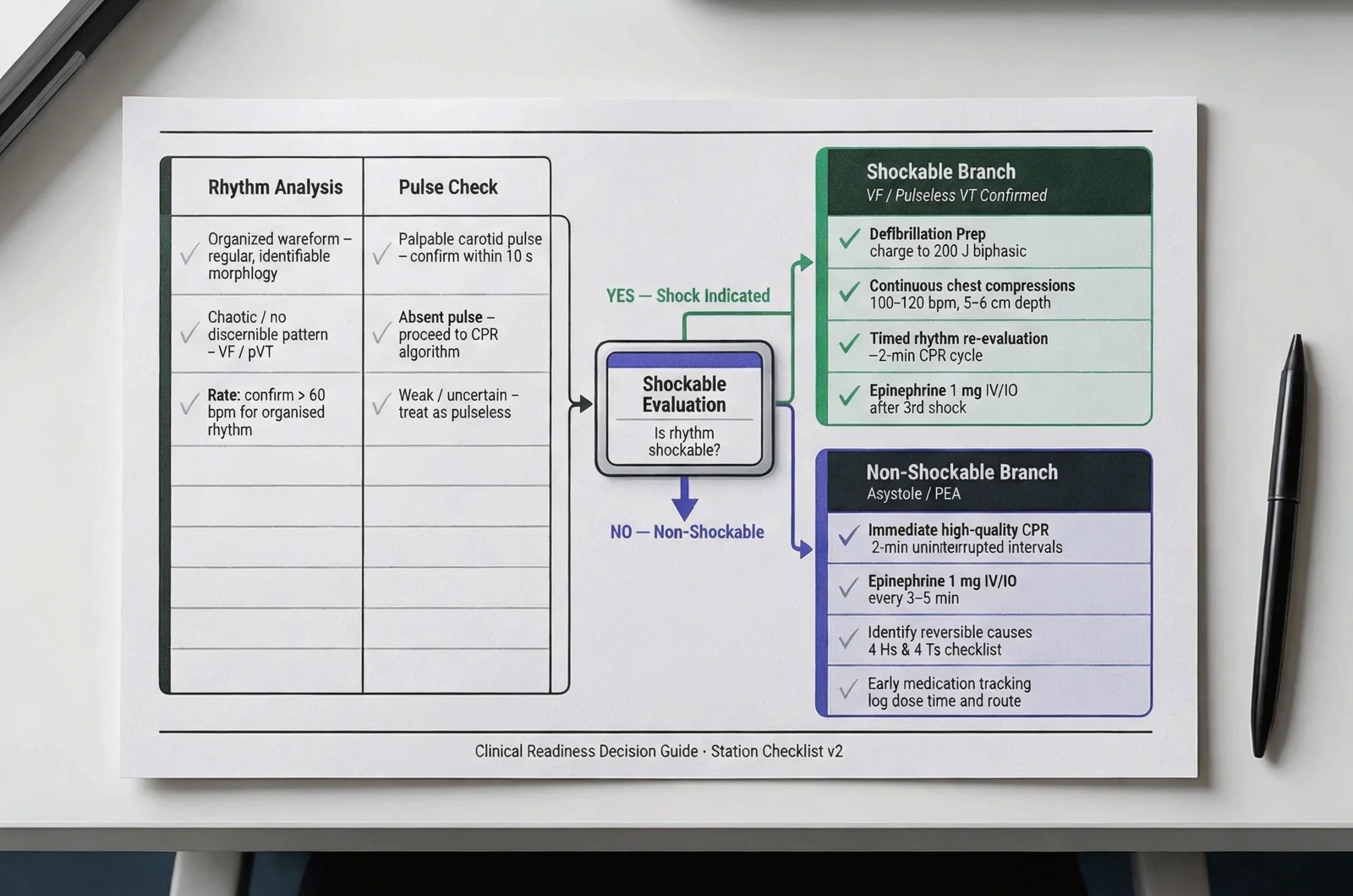
Copy the rhythm categories and their corresponding branches from the course algorithm. Beside each category, add the recognition criteria you are expected to know.
Use your course’s rhythm examples for this check. Cover the label, describe the visible features, and compare your interpretation with the supplied explanation.
Explain the branch before naming its actions
For each example, complete this sentence in your own words: “These findings place the scenario in this branch because…”
Then point to the supporting algorithm box. If you cannot identify the connection, put that example in your review queue.
Avoid accepting a correct branch selection with an unfinished explanation. Record exactly which finding you overlooked or misinterpreted.
If you use ExamJungle’s ACLS practice questions, keep a brief note beside each uncertain answer: the finding you used, the branch you selected, and the course reference you need to check.
Recheck the decision after a change
Ask your rehearsal partner to introduce a change using instructor-approved scenario material. Reevaluate the findings before choosing the next route.
Mark this section complete when you can explain both your first branch selection and a later change without relying on the order of a memorized practice script.
Trace the shockable branch from entry to reassessment
For the shockable portion of your map, copy the entry criteria and action sequence from your assigned algorithm. Keep the branch label visible throughout the exercise.
Record the defibrillation instructions, device-specific directions, accompanying actions, and reassessment points exactly as your materials describe them. Ask your instructor to resolve any disagreement between your notes and the equipment used in class.
During a supervised equipment rehearsal, identify the controls and safety checks you are expected to demonstrate. Have your partner compare your spoken instructions with the assessment sheet.
Check the sequence using these prompts:
- What finding places this scenario in the branch?
- Which action comes next in the assigned algorithm?
- What instructions accompany that action?
- Where does the algorithm direct the team afterward?
- What finding would justify leaving this branch?
Keep medication references beside the correct point in the sequence. Verify their placement separately during the medication review below.
For a fictional rehearsal, ask your partner to pause after any action and request the next algorithm box. Point to that box and explain the transition before continuing.
If you lose your place, mark the exact arrow where the uncertainty began. Rehearse that connection again with the source open.
Complete this check when you can trace the branch from entry through its specified reassessment and identify each possible exit shown in your materials.
Trace the nonshockable branch on its own terms
Give the nonshockable pathway a separate rehearsal. Copy its entry criteria, treatment sequence, reassessment instructions, and exit conditions from the assigned algorithm.
Study it with the neighboring branch covered initially. Explain each action using the instructions within this pathway.
Then uncover both branches and compare their decision points. Mark which actions belong to each route, where any shared instructions appear, and what findings support a transition between them.
Write down any confusion in precise terms. Replace “I mix up the branches” with a specific note such as “I selected an action from the adjacent pathway after the second scenario update.” Use your own rehearsal findings rather than that example if it does not apply.
Ask a partner to challenge each branch change:
“What new information supports that move?”
Answer from the current findings and your assigned algorithm. If the scenario has not supplied enough information, identify what you still need.
Add the reversible-cause review specified by your materials. Copy the required causes and connect each one to the assessment or investigation described in your course.
Avoid inserting a cause simply to complete a remembered list. In rehearsal, explain what scenario information you would examine and where you would check the corresponding response.
Finish by tracing the nonshockable pathway aloud, including its reassessment loop and any supported transition to another pathway.
Attach medication checks to the correct decision
For every medication on your megacode map, prepare a source-checked entry beside its location in the algorithm. Copy the exact name, indication, dose, route, repeat instructions, and any qualifying notes from your assigned materials.
Leave uncertain entries blank until an instructor or the designated course reference resolves them.
Check the instruction and its placement separately
First, verify the medication details. Compare each field with the source and correct transcription errors.
Next, check its placement in the scenario. Point to the finding and algorithm position that support the instruction.
Ask your partner to select a medication entry and request both explanations. Record whether you missed the treatment detail, the branch placement, or both.
Use separate notes for initial administration and subsequent administration when your materials distinguish them. Copy the conditions attached to each.
Reconcile the medication record aloud
Prepare a rehearsal log with spaces for the instruction, confirmation, administration report, recorded time, and the next applicable check.
Use the timing method specified by your course. Ask your instructor how the station expects you to track and communicate repeat instructions.
In a fictional practice run, have your partner report that a medication was administered earlier in the scenario. Review that report before deciding what the assigned algorithm calls for now.
Keep calculation practice, preparation instructions, and equipment questions on a separate review list where needed.
Mark medication preparation complete when every entry matches its source and you can locate its place in the scenario without guessing from memory.
Rehearse reassessment and the transition to ROSC care
At each reassessment point, pause your study narration and identify the new findings. Then locate the next supported pathway in your materials.
Write the required reassessment items beside the relevant return arrow. Include the timing and conditions exactly as assigned.
Make the findings determine the next route
Ask your partner to supply an instructor-approved scenario update. Restate the update accurately before interpreting it.
Point to the box that now applies. Explain whether you would continue within the present branch, change branches, or follow the assigned ROSC pathway.
If you select the same branch again, explain the finding that supports staying there. Record any repeated action only after checking the relevant algorithm instruction.
Use a different color for corrections made during debrief. Preserve the original mistake long enough to identify the decision that needs another rehearsal.
Prepare the ROSC handoff from your assigned materials
Write out the meaning of ROSC from your course reference. Copy the criteria used in the assigned scenario to recognize it.
Create a separate space for the post-arrest actions and targets specified by those materials. Keep exact values and qualifying instructions together.
Prepare a brief handoff using the fields your course expects. Include the scenario findings, actions reported, timing information, current condition, and outstanding concerns where required.
Rehearse the transition aloud with a partner who checks the post-arrest assessment items.
Complete this section when you can explain why the scenario has entered the ROSC pathway and identify the first actions assigned to that phase.
Give the team instructions someone can verify
For the team portion of your megacode rehearsal, check how you assign work, confirm understanding, receive reports, and respond to updated information.
Use the communication expectations on your course assessment sheet. Write down the behaviors you are expected to demonstrate, then have a partner observe them during rehearsal.
Practice giving an instruction to an identified person. Ask that person to repeat the instruction and report completion in the manner your course teaches.
For each exchange, record whether the instruction, acknowledgment, and completion report were clear. Keep a separate note for interruptions or conflicting reports.
In a fictional exercise, ask a teammate to request clarification about an unclear instruction. Restate it precisely and have the observer check it against the scenario materials.
Rehearse a change of responsibility using the information your course expects in a handoff. Make the transfer explicit enough for the receiving person to repeat their assignment.
Keep rhythm interpretation and treatment decisions connected to the team’s reported findings. When a report changes, identify which part of your map needs another review.
Choose one communication problem for the next attempt. Examples might include an unnamed recipient, an incomplete completion report, or an unclear transfer of responsibility.
Repeat the exchange until your observer can record the assigned behavior as demonstrated.
Run a complete rehearsal and record the first uncertainty
For a full megacode rehearsal, use the scenario and assessment materials your instructor has approved. Agree on who will lead, who will supply findings, and who will record observations.
Keep the observer’s record focused on specific decisions and actions. Ask for the first point of uncertainty, the finding involved, and the source needed to resolve it.
Use this short sequence:
- Read the starting information and identify the assigned pathway.
- Narrate the assessment and branch selection.
- Follow the scenario updates through the supported actions.
- Complete the assigned ending or transition.
- Review uncertain decisions against the course materials.
During the initial pass, allow pauses for source checking. Record every pause rather than hiding it.
Correct the connection that failed
Afterward, select one uncertainty to repair. Find the relevant algorithm box, rewrite the unclear connection, and explain it aloud.
Ask your partner to repeat that portion with a different starting point. Use an instructor-approved variation so the clinical details remain anchored to the course.
If an ExamJungle practice question leaves you unsure about a branch decision, add the question to this review record. Check the unresolved point against your assigned materials before bringing it into scenario rehearsal.
Keep a visible readiness record
Use personal study labels such as “source checked,” “explained aloud,” “rehearsed,” and “needs instructor review.” Define those labels in your notebook.
A useful digital version of this checklist would let you attach a course reference to each decision arrow and flag missing references. Include fields for instructor corrections and the date you rehearsed the corrected sequence.
Keep course assessment results separate from these personal study labels. Bring the unresolved entries to your next instructor review.
Resolve the questions still blocking your station preparation
Use the questions below to finish your megacode study record. Write the answer from your assigned materials or mark it for instructor clarification.
Which flow chart should I rehearse?
Use the algorithm identified for your course and station. Confirm its title and edition with your instructor.
If you have several saved versions, label the assigned version clearly. Ask about any differences before combining notes from them.
Keep the confirmed document name at the top of your rehearsal worksheet.
What should I memorize, and what should I check?
Ask your instructor which details you must recall unaided and which reference materials, if any, are permitted during assessment.
Build two study lists from that answer. Put recall items on one and permitted-reference navigation tasks on the other.
Rehearse each list under the conditions your instructor specifies.
What if I choose the right action but cannot explain it?
Record the finding, the selected action, and the missing explanation. Locate the relevant connection in your assigned algorithm.
Explain that connection aloud, then ask a partner to present another approved example.
Keep the item open until you can identify the supporting finding and source.
How should I use practice questions alongside scenario rehearsal?
Keep question review and scenario rehearsal as separate entries in your study log. For each unresolved question, record the clinical point you need to verify.
During the next approved rehearsal, ask your instructor how that point applies to the scenario.
Finish your preparation record with a specific unresolved question, its source location, and the person you will ask to check it.
Question practice for ACLS and emergency care