

If your ACLS card expires in the next few months, you've probably already Googled your way into a wall of conflicting claims: "100% online," "AHA-approved," "instant card," "no skills test needed." Some of those claims are true in narrow circumstances, and some will leave you with a card your employer won't accept. This guide walks through the real ACLS recertification exam options available in 2026, what the written exam actually looks like, how the skills-check rules work, and how to verify a course before you hand over your credit card. The short answer up front: online recertification is accepted when it ends with a recognized provider card, but "online" covers three very different formats, and only some of them include a hands-on component most hospitals still expect. By the end, you'll know which format fits your employer's policy, what the exam will ask of you, and how to prepare for the written portion without wasting hours on content that won't show up.
Is online ACLS recertification actually accepted by employers?
Yes, with a big asterisk. Acceptance depends on two things: which organization issued the card and what your employer's credentialing policy says. The American Heart Association lists several ACLS course options, including instructor-led classroom courses and blended formats where the cognitive portion happens online. A card issued through one of those official pathways is the gold standard most hospitals, clinics, and staffing agencies recognize without question.
The asterisk applies to fully online providers that aren't part of the AHA network. Companies like eMedCert's online ACLS recertification course and the ACLS Certification Association's experienced provider renewal offer 100% online recertification with no in-person skills check, and plenty of employers do accept these cards, especially for experienced clinicians renewing rather than certifying for the first time. Others don't. Some hospital systems write "AHA only" directly into their credentialing requirements, and no amount of arguing with HR changes that.
In practice, acceptance tends to split along setting lines. Large academic medical centers and hospital systems with formal credentialing committees are the most likely to require AHA cards. Urgent care clinics, private practices, dental surgery centers, telehealth companies, and some staffing agencies are more flexible, because their policies say "current ACLS from an accredited provider" rather than naming an issuer. If you work across several sites through an agency, check each facility's policy, because the strictest one effectively becomes your rule.
So the honest answer is: online recertification counts when the card matches what your employer's policy names. Before you pay anyone, send a two-line email to your credentialing office or nurse manager with the provider's name and ask if the card is accepted. That one email is the difference between a smooth renewal and paying for the same exam twice.
What are the main ACLS recertification exam options in 2026?
Three formats dominate the market right now, and they differ on price, time, and whether your hands ever touch a manikin.
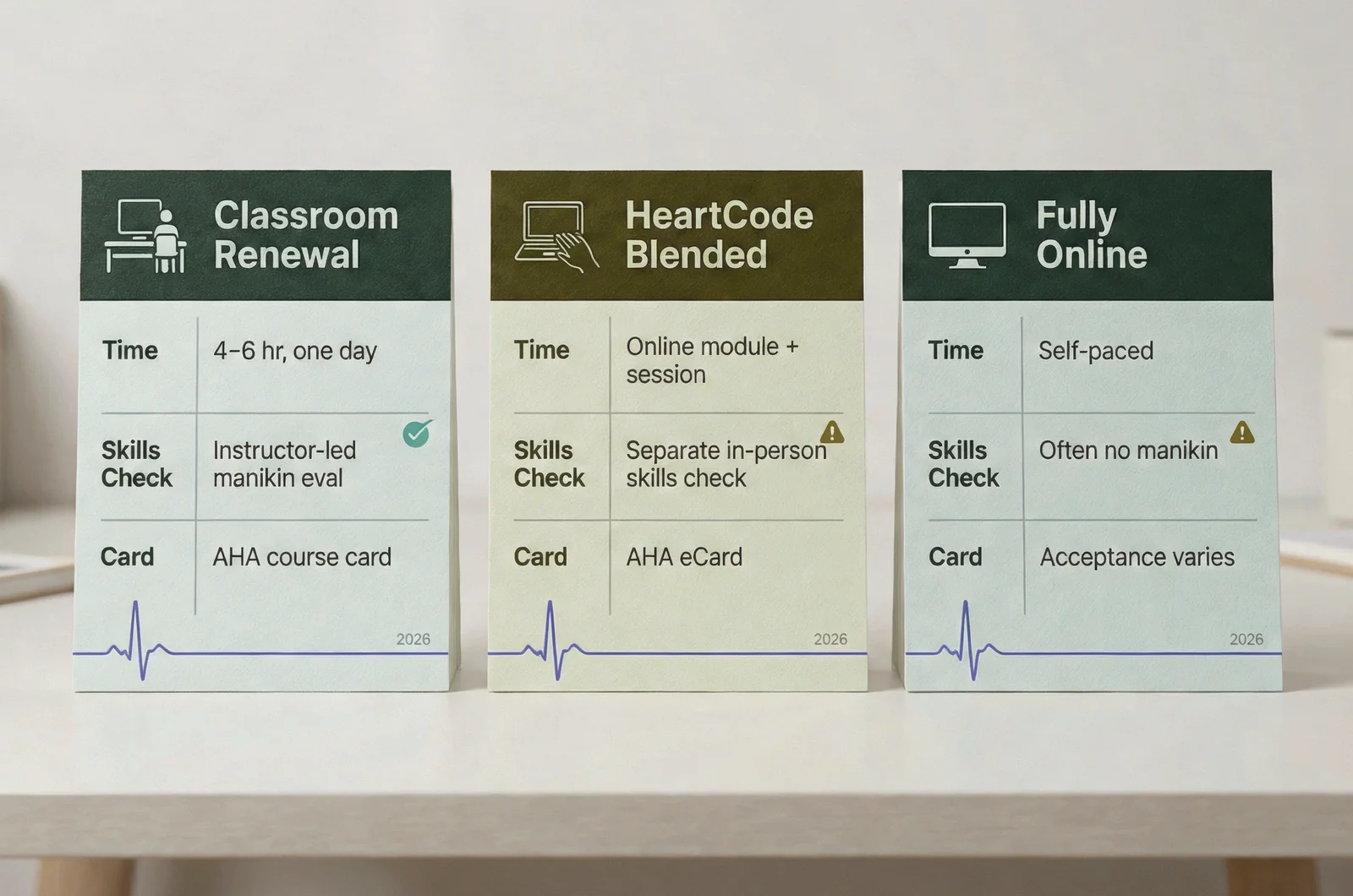
Traditional in-person renewal courses
The classic route: a one-day class at a training center, typically running four to six hours for recertification (shorter than the initial provider course, which often stretches across two days). You review algorithms, run megacode scenarios with a team, take the written exam, and complete a hands-on skills evaluation with an instructor watching. The AHA's ACLS course page describes the instructor-led format alongside its blended alternatives, and both paths end with the same AHA eCard.
This option costs more in time than money. You'll usually pay somewhere in the $150 to $250 range depending on the training center, plus a day away from your schedule. The upside is that acceptance is never in question, and if your last megacode was two years ago, the hands-on reps genuinely help. There's also a subtler benefit: running team dynamics with other clinicians surfaces habits you can't test online, like closed-loop communication and role switching mid-code.
Blended learning: HeartCode ACLS
HeartCode is the AHA's own blended format, and it's the most common "online" answer that's automatically safe with employers. You complete a self-paced online cognitive portion (adaptive lessons, patient scenarios, and the written exam), then schedule a separate in-person skills session with an instructor or a voice-assisted manikin station. The HeartCode ACLS Online product is sold through the AHA's shop, and completing both parts earns the identical eCard a classroom course produces.
For busy clinicians, this is often the sweet spot. You knock out the cognitive work at 10 p.m. on your couch, then book a 30-to-60-minute skills check at a time that fits your shift pattern. Your employer sees an AHA eCard and asks no further questions. One scheduling caveat: the skills session is the bottleneck. Training centers in smaller markets may only offer skills slots a few times a month, so book yours before you finish the online portion rather than after.
Fully online recertification providers
The third category skips the in-person skills check entirely. Providers like AMRI's ACLS recertification program (operating since 1983) and ACLS.com's online renewal deliver the entire course and exam online, issue a digital card immediately after you pass, and market heavily on speed and convenience. Some advertise completion in as little as one to two hours for experienced providers.
These courses are accredited by bodies other than the AHA and are accepted by many employers, particularly for renewals. They work well for clinicians in private practice, telehealth, or settings whose credentialing language doesn't specify AHA. They work poorly if your hospital's policy names the AHA explicitly, which is why the pre-purchase verification step matters so much. Price-wise, fully online renewals often land between $120 and $200, so they're not always the cheapest route once you factor in the risk of a rejected card.
How does the ACLS recertification written exam work?
Whichever format you choose, there's a cognitive exam, and it trips up more people than you'd expect. The AHA's written exam is 50 multiple-choice questions covering algorithms, pharmacology, rhythm recognition, airway management, and team dynamics, with a passing score of 84% in most current administrations. Questions are case-based: you'll get an ECG strip or a patient scenario and have to decide the next intervention, which rewards applied reasoning over memorized lists.
Fully online providers run their own versions. Most use 25 to 50 questions, require scores in the 80% range, and allow free retakes if you miss the cutoff the first time. The ACLS Certification Association's renewal exam and similar programs are untimed and open-resource in some cases, which lowers the stress but also means employers who want a proctored standard may look past them.
Two things catch renewing clinicians off guard on the written side:
- Guideline drift. The AHA updates its guidelines on a rolling basis, and recent focused updates touched defibrillation strategy for refractory VF, antiarrhythmic dosing language, and post-arrest care. If you last studied two cycles ago, expect questions on content that didn't exist when you first certified.
- Pharmacology specifics. Epinephrine timing and dosing, amiodarone versus lidocaine, and adenosine administration for stable versus unstable tachycardia show up constantly. These are exactly the items people "sort of" remember and get wrong under pressure.
A third failure mode is pacing. Clinicians who haven't sat a timed multiple-choice exam in years often burn ten minutes on the first rhythm strip and rush the pharmacology block at the end. Practicing under a clock before test day fixes this faster than any amount of rereading.
If the written exam is the part that worries you, that's fixable with targeted practice. Running through realistic ACLS practice questions before your renewal exam lets you rehearse the case-based format, and the per-question explanations show you why the correct intervention beats the plausible distractor, which is what the real exam is actually testing. If a rhythm question's explanation doesn't click, ExamJungle's Caesar AI can expand it or generate a harder variant on the spot, so you're reasoning through megacode logic rather than memorizing answer letters.
Do I still need an in-person skills check?
It depends entirely on which of the three formats you pick, and this is where most confusion lives.
A traditional classroom renewal always includes a skills evaluation: CPR quality, airway management, and a megacode scenario where you either lead or participate as a team member. HeartCode ACLS requires the hands-on session too, just scheduled separately from the online portion. The AHA built its blended model on the idea that cognitive knowledge and psychomotor skill are different things, and its course structure keeps both. Fully online providers skip the manikin entirely and validate you through the written exam alone.
From your employer's perspective, the skills check is often the sticking point. Credentialing offices that require AHA cards are implicitly requiring a validated hands-on component, because every AHA pathway includes one. Employers that accept alternative providers have usually decided the written exam plus your daily clinical practice is enough for a renewal.
One newer wrinkle worth knowing: some health systems now use RQI (Resuscitation Quality Improvement), a subscription model where staff complete short skills sessions on a manikin cart on their own unit each quarter instead of a single big renewal every two years. If your hospital runs RQI, your "recertification exam" is really a rolling series of low-stakes sessions, and the cognitive portion happens online inside that program. Ask your education department whether you're enrolled before paying for an external course. Clinicians in RQI systems sometimes buy an outside renewal out of habit, only to learn their employer already covers the whole process.
How do I verify an online ACLS course before paying?
Five minutes of checking saves you from buying a card nobody accepts. Here's the sequence I'd follow:
- Read your employer's policy first. Find the exact wording. "AHA ACLS" means HeartCode or classroom only. "Current ACLS certification from an accredited provider" opens the door to online alternatives.
- Confirm with credentialing in writing. A quick email creates a record. If the answer is yes and someone disputes it later, you have the reply.
- Check who accredits the provider. Legitimate online providers state their accrediting body and their acceptance policy openly. AMRI, for example, describes its accreditation and history on its ACLS online certification page. Vague claims with no named accreditor are a red flag.
- Look for a money-back acceptance policy. Several established online providers, including ACLS.com, advertise refunds if your employer rejects the card. That's a meaningful signal the provider tracks acceptance rates.
- Check the card format. Employers increasingly verify eCards online. Make sure what you receive has a verifiable card number and a lookup portal, not just a PDF you could have made yourself.
If any step produces a vague answer, default to the AHA route. HeartCode costs a bit more in effort, but it's never the wrong choice.
What happens if my ACLS card already expired?
The moment the expiration date passes, your card is invalid, even by one day. The practical consequence: most AHA training centers won't let you into a recertification course with an expired card. You have to take the full initial provider course instead, which runs roughly twice as long (often 12 to 16 hours) and costs more. Some training centers allow a short grace window at their discretion, and some hospital systems give 30 to 60 days of administrative leeway for scheduling, but the card itself is technically expired during that time, which can affect scheduling, on-call privileges, and any certification pay differential.
Fully online providers are often more lenient here. Because their renewal courses cover the full algorithm set anyway, several accept recently expired cards into the recertification track rather than forcing a full initial course. Check the provider's policy page before assuming, and treat "recently expired" as weeks, not years. A card that lapsed three years ago puts you in initial-course territory almost everywhere.
The clean fix is boring but effective: set calendar reminders at 60, 30, and 7 days before your expiration date, and book your renewal no later than three weeks out. That leaves room for a failed exam attempt, a rescheduled skills check, or a slow card delivery without ever going dark on your credential.
How should I study for the recertification written exam?
The good news: as an experienced provider, you don't need to relearn ACLS from scratch. You need to refresh the parts that changed and drill the parts you don't touch in daily practice. A focused week usually beats a panicked weekend.
Start with a diagnostic. Take a timed practice exam cold, before reviewing anything. Your wrong answers tell you exactly which algorithms have faded, and your right answers tell you what you can safely skim. This is where a realistic simulator pays for itself: on ExamJungle you can run an ACLS timed practice exam under exam-like conditions, so the real test's pacing and case-based format feel familiar rather than foreign.
Prioritize by exam weight. Rhythm recognition and the tachycardia/bradycardia algorithms carry the most questions. Pharmacology dosing comes next. If you're strong on rhythms but shaky on drug doses, flip your study time accordingly instead of rereading cover to cover.
Study the "why," not the letter. Case-based questions present scenarios where two answers look defensible. The exam rewards knowing why epinephrine comes early in cardiac arrest or why synchronized cardioversion differs from defibrillation. Read explanations for every question you get right by guessing, because guessing right today means guessing wrong on the real thing.
Drill weak spots in short bursts. Flashcard-style review for doses and algorithm branches works well in 10-minute gaps between shifts. Revisit your missed questions two or three days later; if you nail them cold, they've moved into durable memory.
One practical tool idea if you're planning your timeline: a simple renewal-countdown calculator that takes your expiration date and works backward, slotting in the course booking, the skills session, and a buffer week, would take the mental math out of scheduling. Until someone builds it, the 60/30/7-day reminder stack does the same job.
Book the exam when practice scores stabilize. When you're consistently scoring above the pass threshold on timed practice runs, schedule the real thing within a week. Waiting longer just lets the material fade again.
Keep your renewal momentum going