

If you’re weighing the ACT digital test vs paper format, I’d start with two questions: which options can you actually book, and which one holds up during timed practice? Use your reading habits, math workflow, and review routine to guide the choice. Treat availability, section timing, permitted materials, accommodations, and score delivery as details to confirm for your specific administration.
Below, I compare the formats through practical selection criteria. The aim is to help you make a defensible choice without relying on an assumed score advantage. Start with your registration requirements, then use a rehearsal to decide which format deserves your preparation time.
Confirm the choices for your ACT administration
Make your ACT format decision around a specific administration, rather than a general preference for screens or paper.
Before comparing comfort, establish exactly what you’re considering. Write down the test date, location, administration type, and format you intend to register for. Leave anything unconfirmed visibly marked as unresolved.
Use this short list to guide your checks:
- Confirm which format is available for your intended date and location.
- Identify the section configuration and timing instructions that apply.
- Check the equipment and materials you must bring.
- Review any accommodation requirements relevant to you.
- Establish the registration and change deadlines.
For each answer, save the relevant ACT instructions or registration confirmation. Include the date you checked them. If two pieces of information appear inconsistent, resolve the difference before building your study schedule around either one.
I’d also distinguish a preference from a requirement. Wanting to annotate by hand is a preference to test. Needing a particular approved accommodation is a condition to resolve before comparing convenience.
Keep a backup plan beside your preferred option. Specify what you would do if the desired date, location, or format were unavailable. For example, decide whether you would reconsider the format or investigate another date first.
Finish this check with one clearly identified administration and a list of any questions still awaiting confirmation.
Match each format to habits you can demonstrate
For ACT preparation, I’d shortlist digital and paper according to repeatable study behavior. Use the profiles below as recommendations to test against your own practice.
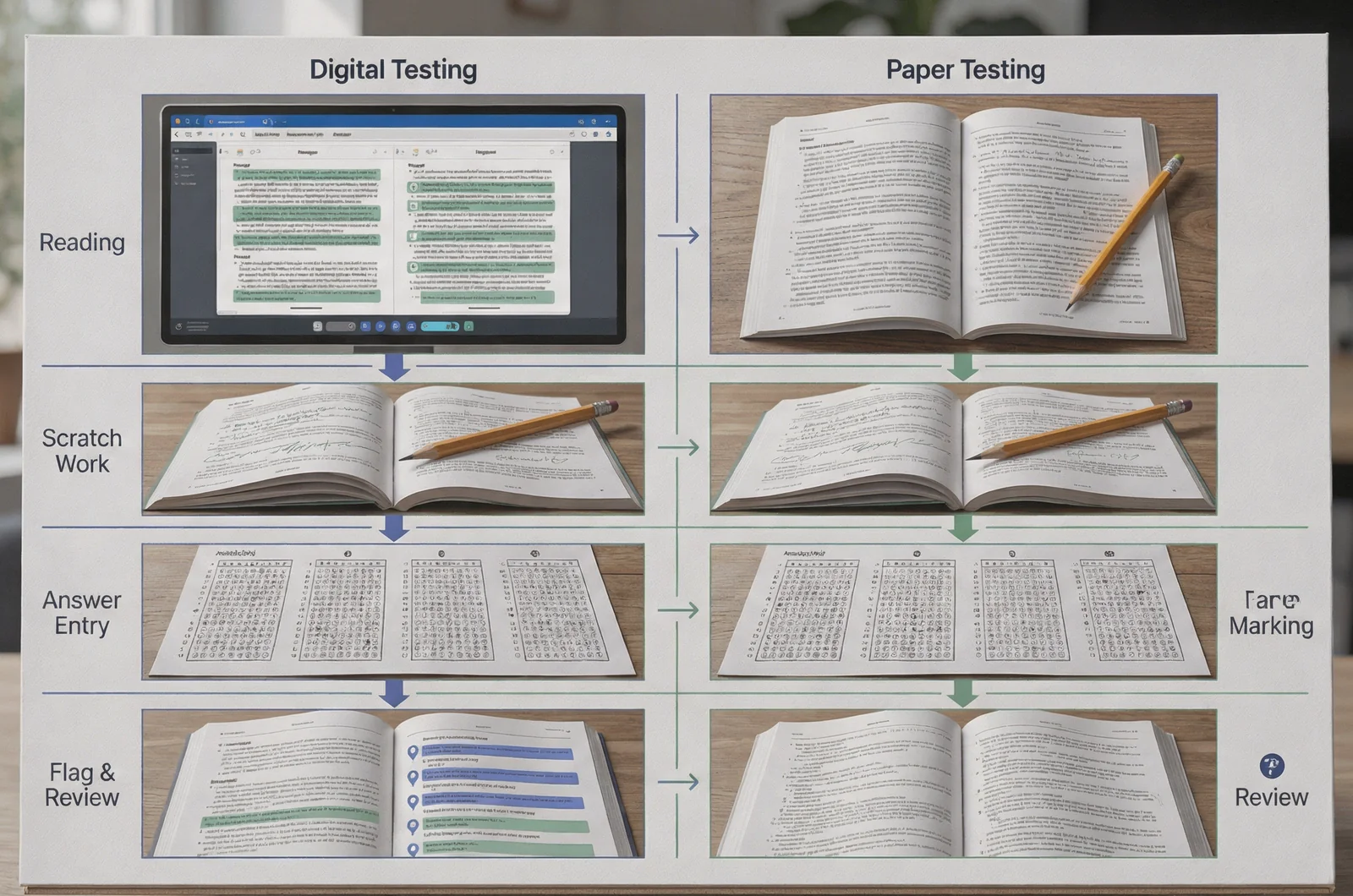
Consider digital if your screen-based routine holds up
I’d put digital first on your shortlist if a realistic screen-based rehearsal shows accurate reading, deliberate answer selection, and a review routine you can repeat.
During practice, pay attention to the complete interaction. Read the question, locate the relevant information, work through the answer, record your choice, and return to anything you intended to review. Use the available controls according to the practice instructions.
Look for specific evidence in your notes. Did you select the answer you intended? Could you find an unfinished question again? Did you spend time adjusting the display or figuring out a control?
The limitation I’d watch for is dependence on an assumed interface. Avoid making your choice around a timer, annotation tool, navigation control, or calculator until you’ve confirmed it applies to your administration.
My recommendation: favor digital when the relevant practice interface supports a workflow you can use consistently under time pressure. Record any control you still need to learn.
Consider paper if your handwritten routine holds up
I’d put paper first on your shortlist if your timed rehearsal supports your preference for handwritten working, physical page navigation, and the applicable answer-recording process.
Evaluate the whole routine. If your practice materials require separate answer recording, include that step within the allotted time. Check question numbering, changed answers, and the legibility of any working you need to revisit.
Keep your annotations purposeful. Try brief marks for evidence, uncertainty, or a calculation you need to check. Then assess whether you actually use those marks during review.
The limitation I’d watch for is treating familiarity as sufficient evidence. Test your preferred method with the same care you would apply to an unfamiliar one.
My recommendation: favor paper when your rehearsal demonstrates accurate answer recording and usable handwritten work. Identify the exact habit that supports your preference.
Judge pacing by errors, pauses, and unfinished work
Compare ACT pacing through a complete timed section, using the instructions that apply to the materials and administration you’re evaluating.
I’d avoid choosing a format from a single completion time. Record what happened within that time so your decision has a clearer basis.
Separate content work from format friction
After each rehearsal, classify the questions that caused difficulty:
- You needed more subject knowledge.
- You understood the task but spent too long solving it.
- You lost your place or had trouble recording your answer.
- You intended to return but didn’t complete the review.
Use these categories as your own review framework. Keep them consistent across both formats.
For example, suppose you miss a math question after overlooking a condition. Review the reading error separately from any difficulty entering the answer. Don’t automatically assign both problems to the format.
For questions left unfinished, write down where you stopped. Distinguish an unsolved problem from a solved problem whose answer you hadn’t recorded.
Evaluate the last part of the section
Review your final questions with particular care. Check for unanswered items, accidental selections, numbering errors, and rushed changes.
Then ask whether your planned review routine was practical. If you reserved time to revisit uncertain answers, record whether you reached them and what you did when you returned.
Use the next rehearsal to test one adjustment. You might change how you mark uncertainty or when you check answer recording.
Keep the section timing consistent with the applicable instructions, and write down the adjustment before starting.
Rehearse scratch work and calculator use together
For ACT math preparation, I’d evaluate the format through your full working process: reading, calculating, recording, and checking.
Confirm the applicable calculator and scratch-material rules before designing that rehearsal. Treat each unverified detail as an open question.
Make scratch work easy to revisit
Begin by checking what materials are permitted, who supplies them, and how they must be handled. Verify whether your planned annotation method is allowed.
Then choose a simple organization method for practice. Consider labeling each piece of working with its question number and leaving enough space to distinguish a correction from your original calculation.
Use a few tasks to examine the routine:
- A problem with several calculation steps.
- A diagram that requires careful labeling.
- A question you deliberately leave and revisit.
- A calculation where you change your approach.
Check whether you can reconnect the working to the right question. If you can’t, revise the organization before drawing conclusions about the format.
For screen-based practice, rehearse the movement between the displayed question and your permitted working area. For paper practice, rehearse using the allowed space while keeping the question readable.
Test the calculator you intend to use
Confirm the calculator policy for your administration. If an onscreen calculator is available, verify its functions and practice with the relevant version before relying on it.
If you intend to use a permitted handheld calculator, include it in your rehearsal. Check the sequence from reading the expression to entering it and recording the result.
I’d compare accuracy before judging convenience. Review signs, parentheses, decimal placement, and any copied values. Record whether an error came from the mathematical approach, calculator entry, or answer recording.
If your preferred calculator method requires extra practice, schedule that practice explicitly. Repeat the same kind of task until you can assess the routine without stopping to learn a control.
Compare reading comfort through a complete passage
For ACT passage work, I’d choose according to what you can read and revisit accurately within the applicable time.
Start with a realistic passage task. Read the material, answer its questions, and return to the text whenever your normal approach requires it. Avoid judging the format from a brief look at the page or screen.
Afterward, review how you located evidence. Identify the passage details you revisited, any place you lost your position, and any annotations you actually used.
For screen-based practice, check the display and navigation options that are confirmed for your administration. For paper practice, assess whether your markings remain useful when you return to the passage.
Keep the interpretation narrow. If you struggled with unfamiliar vocabulary, assign that to content review. If you repeatedly searched the wrong paragraph, examine your reading and navigation routine.
I’d also note your comfort at the beginning and end of the session. Describe the experience specifically rather than assigning a vague label such as better.
Write an observation you can act on: you reread a paragraph, overlooked a reference, or couldn’t relocate supporting evidence. Choose one reading habit to adjust in the next rehearsal.
Treat score delivery and logistics as separate checks
For the ACT format decision, I’d keep score timing, travel, and registration costs beside your performance comparison.
Avoid awarding either format an advantage based on an unverified promise about results. Instead, confirm the score-release guidance for your intended administration and the requirements of each institution receiving your scores.
Build your planning notes around these questions:
- What score deadline are you trying to meet?
- What does the institution require by that date?
- What score-release guidance applies to your administration?
- What would your alternative plan be if the timing didn’t work?
Record confirmed information separately from estimates. Use a planning buffer that fits your circumstances, and investigate uncertainty before committing to a tight schedule.
Apply the same approach to location and travel. Estimate your own journey, identify any overnight arrangements you would need, and compare those demands with your preparation schedule.
For financial planning, consider the questions raised in the ACT fee waiver guide. Check current eligibility and registration instructions before making a budget.
I’d treat unresolved accessibility requirements as a reason to seek clarification before choosing. Specify the support you need, then confirm how it applies to the administration under consideration.
Keep those answers alongside your registration details so you can review the entire plan together.
Run a rehearsal that can change your mind
Before selecting an ACT format, I’d run a comparison with enough structure to challenge your initial preference.
Use appropriate practice materials and their applicable instructions. Keep a written record so you can distinguish what you expected from what happened.
Set up a comparison you can interpret
Choose a manageable practice plan before starting. If you compare the formats across separate sessions, aim for similar working conditions.
Use these steps:
- Identify the practice materials and confirm their section instructions.
- Set the permitted materials and calculator within reach.
- Complete the section with its stated timing.
- Record unanswered questions and answer-entry mistakes immediately afterward.
- Review content errors separately from problems with the format.
I’d avoid assigning a format advantage from one isolated result. Where the choice remains uncertain, schedule another comparable rehearsal and reverse the order of the formats.
Treat results cautiously if the practice sets differ substantially in familiarity or difficulty. Write down those differences rather than hiding them inside a single score.
Before each session, state what you’re testing. You might investigate whether you can revisit a passage efficiently or keep scratch work organized.
Review the answers and the routine
After practice, explain why each missed answer was wrong and what would support the correct choice. Give content gaps their own study tasks.
Next, review the physical actions. Check whether you recorded your intended answer, found the right question during review, and followed the applicable navigation instructions.
If you already use ExamJungle, keep the same distinction in your study notes: material to understand and actions to rehearse. Use administration-specific instructions to guide the format rehearsal.
Finish with one concrete change for the next session. Choose something observable, such as labeling scratch work or checking question numbers before recording answers.
Write the change beside the result. During your next rehearsal, assess whether you followed it and whether the original difficulty recurred.
Choose from your notes rather than a universal ranking
For your ACT format choice, I’d give confirmed requirements priority, then compare the routines you demonstrated in practice.
Review your notes in a consistent order. First, remove options that don’t fit your confirmed administration or essential requirements. Next, compare answer accuracy, completion, reading comfort, and the quality of your review.
Consider digital if your screen-based rehearsal supports accurate reading and deliberate answer selection, and you can use the confirmed interface without unresolved difficulty.
Consider paper if your handwritten rehearsal supports clear working, accurate answer recording, and a review process you can complete within the applicable time.
If the result is close, compare the preparation each option still requires. Write down the remaining tasks and decide which plan fits the time you have available.
A useful format selector would ask for confirmed availability, accommodation needs, rehearsal errors, unfinished questions, and reading comfort. Its output should identify unresolved checks and a provisional preference.
You can use that approach without a separate tool. Write a short decision statement:
I prefer this format because my rehearsal showed these specific strengths. Before registering, I still need to confirm these details.
Keep the statement modest. Base it on your observations and requirements, then resolve the remaining checks before committing to the choice.
Questions to settle before ACT registration
For remaining ACT format questions, I’d use the same standard: confirm official requirements and test personal preferences through practice.
Should I assume one format is easier?
I wouldn’t use that assumption to choose. Compare your own accuracy, unfinished work, and answer-recording errors under the applicable practice instructions.
If someone recommends a format because of easier questions or a scoring advantage, ask for current official support before using that claim. Keep your decision tied to evidence you can assess.
What if my preferred format is unavailable?
Review the alternatives you’re actually considering. Compare another date or location with preparing for the available format.
I’d work backward from your score requirements and essential accommodations. Then estimate the preparation each alternative would require. Record the tradeoff explicitly before changing your plan.
Can I rely on a calculator or review tool I’ve seen elsewhere?
Confirm that the tool applies to your intended administration. Practice with the relevant version and follow its instructions.
Until you’ve confirmed access and permitted use, keep an alternative working method in your preparation plan. Rehearse the method you’ll be allowed to use.
How should I divide my remaining study time?
Use your rehearsal notes to assign the work. Schedule subject review for misunderstood answers and focused practice for recurring interaction problems.
I’d make each task specific enough to check afterward. Replace a broad goal such as improve digital practice with a concrete one, such as complete a passage and revisit every marked question within its stated time.
Before registering, return to your administration details and resolve any remaining uncertainty about format, materials, accommodations, or score timing.
Place your ACT choice in your college testing plan