

When checking for unapproved notes in AAPC exam code books, examine both the information you added and how you added it. I recommend reviewing handwritten reminders, loose sheets, printed inserts, and taped guidelines separately. For each item, establish whether the applicable AAPC instructions expressly permit its content and format.
No example below is presented as officially approved or prohibited. This comparison helps you describe your annotations, identify unresolved questions, and prepare your books around an authoritative answer. Keep clearly permitted material within the stated limits, exclude expressly prohibited material, and seek clarification about anything uncertain.
Compare the note’s content and physical format
Start your book review by recording exactly what each addition contains and where it sits. Avoid assigning an approval status from its appearance alone.
Describe what the annotation actually contains
Classify each addition as a definition, navigation reminder, guideline summary, worked example, or practice question and answer. Then record its wording.
For example, imagine two handwritten additions. One points you toward another section. The other reproduces a complete practice question with its answer explanation. Describe those items separately when requesting a policy decision. A question about handwritten notes generally would leave their different contents unexplained.
For a longer addition, include its approximate length and origin. Identify whether you composed the wording yourself, copied it from study material, or received it already written in the book. Present those details without assuming that any particular origin establishes permission.
Compare formats without inventing an approval list
The following examples are hypothetical. Use the final column to frame a question about your actual book.
| Annotation format | Illustrative content | Question to resolve |
|---|---|---|
| Handwriting on an original page | A short definition beside an entry | Is this content permitted directly on the page? |
| Handwritten cross-reference | A reminder to consult another section | Does the applicable instruction permit this navigation note? |
| Loose handwritten sheet | A longer explanation kept between pages | May a separate sheet accompany the book? |
| Printed insert | A typed summary added after purchase | Are this added page and its contents permitted? |
| Taped guideline extract | Printed wording attached to an existing page | Are the attachment and reproduced wording permitted? |
| Copied practice material | A question, answer, or worked explanation | Is this category of content permitted in any format? |
Treat each row as a distinct review item. Permission for one example should support your decision only within the scope of the answer you receive.
Record any conditions alongside the decision. If an instruction addresses placement, content, length, or attachment, preserve those qualifications in your preparation notes.
Handwritten reminders versus separate study sheets
Compare handwriting on an original page with handwriting on added paper by asking about both placement and purpose. Keep your study preference separate from your exam-material decision.
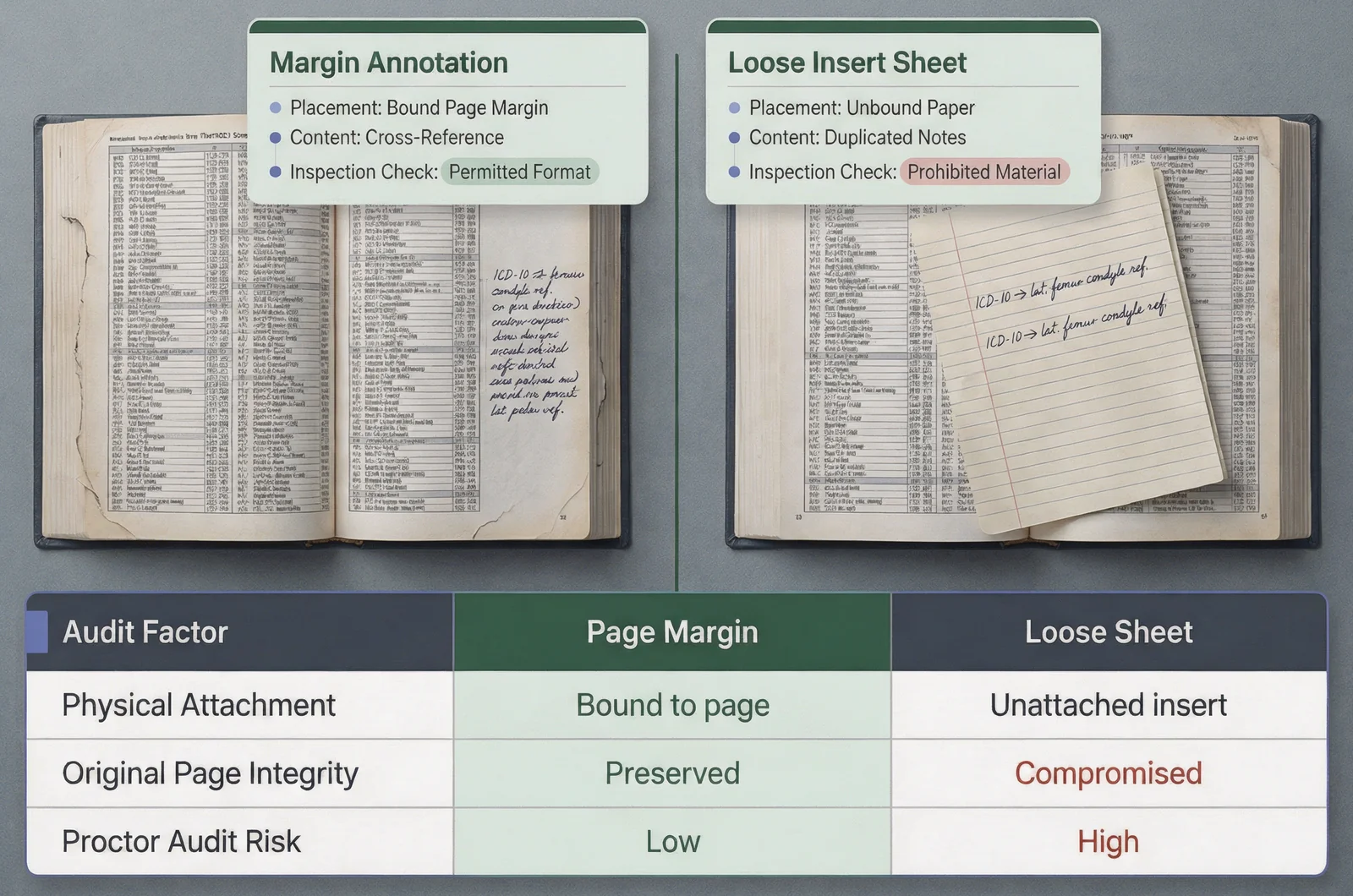
Review handwriting where it appears in the book
Suppose you have written a short anatomical definition beside a relevant entry. For that hypothetical annotation, I would prepare a question that includes the exact definition and a description of its placement.
Ask whether the applicable instruction addresses that kind of wording. If you receive clarification about a brief definition, retain the limits of that clarification. Avoid extending it to a full worked scenario or copied answer explanation without checking those examples separately.
Use the same approach for abbreviations, cross-references, and personal reminders. Describe the actual annotation instead of relying on a broad label such as study notes.
For your own review, ask:
- What does the note say?
- Where is it written?
- Does it reproduce a question or answer?
- Which instruction or clarification supports keeping it?
Keep the supporting instruction with your preparation records. Avoid adding administrative correspondence to the exam book unless its presence is also expressly permitted.
Review separate sheets as separate items
Now imagine the same definition written on a loose page between the book’s original pages. Submit that format as its own question.
Describe whether the sheet is loose, folded, clipped, or otherwise attached. Include any writing on its reverse side. If you are asking about several sheets, explain the complete arrangement instead of showing only the simplest example.
For studying, I would use separate pages for longer explanations and exercises that I want to revise freely. That is an organizational preference, not a statement about exam permission.
For the exam copy, follow the applicable answer about added material. If the instruction excludes the sheet, leave it with your study resources. If its status remains unclear, resolve the question before building your exam preparation around access to it.
Do not copy an unresolved sheet into the margins merely to change its format. Ask whether both the content and the proposed placement are permitted.
Printed inserts versus taped guideline extracts
Review printed additions by describing what was added, what it reproduces, and how it is attached. Keep those details visible throughout the permission request.
Identify the added printed material precisely
Imagine a typed page summarizing a topic you find difficult. Before considering it for your exam materials, record its title, length, origin, and contents.
Distinguish publisher-printed pages from material added after purchase when describing your book. If you are uncertain about an insert’s origin, say so. Avoid presenting an unknown addition as part of the original publication.
For a purchased or borrowed annotated book, ask the previous owner about unfamiliar additions where practical. Then evaluate the actual material against the applicable instructions. Treat another person’s description as background for your question.
A useful request would identify whether the insert contains general explanations, reference extracts, worked examples, or practice answers. Include representative wording where needed to make the question precise.
If you receive an answer about a specific insert, apply it to that insert and its stated conditions. Seek clarification before treating it as permission for other printed additions.
Describe taped material without changing its category
For a hypothetical guideline extract taped to a page, explain both the reproduced text and the attachment.
Ask whether that exact combination is permitted. Include any text on the back, folded sections, or additional material concealed beneath the attachment when describing the arrangement.
Avoid treating attachment strength as an approval test. Instead, ask about the wording, the added material, and the way it sits in the book.
Use equally precise language for glued pages, adhesive labels, and pasted summaries if your book contains them. Describe the physical arrangement without calling the item a margin note.
If an instruction prohibits the addition, follow the stated direction for preparing the book. Before making a permanent alteration, establish whether removing the added material is sufficient or whether further clarification is needed.
Keep unrelated permitted annotations outside that decision. Review each disputed addition on its own terms.
Ask AAPC about the exact annotation
Prepare a request that lets AAPC address the material you intend to use. Replace a broad question about notes with a concrete description of your exam, book, and annotation.
Include enough detail for a specific answer
Identify your booked examination and scheduled date. Include the book’s title, publisher, and edition as printed in your copy. Describe the delivery arrangement shown in your booking information.
Then provide the annotation details:
- The exact wording, or a representative extract for a longer addition.
- Whether it is handwritten, printed, or mixed.
- Its location on an original page or added material.
- Its attachment method, if applicable.
- Whether it includes questions, answers, or worked explanations.
If photographs are accepted through the contact route you use, ask whether a clear image would help. Show the surrounding page and attachment rather than only a cropped line of text.
Keep the request focused on permission. Explain what is present without arguing that the annotation deserves an exception.
Separate examples that need separate decisions
For illustration, a request about handwriting could read:
For my scheduled CPC exam, I would like clarification about a short handwritten definition on an original page of my code book. The note contains a definition and a cross-reference, with no practice question or answer. Does the applicable annotation policy permit this content and placement?
A request about attached material should describe that different arrangement:
I also have a printed guideline summary taped onto an original page. Please clarify whether this added material is permitted and whether removing the attachment would resolve the issue if it is prohibited.
These are sample questions, not statements about AAPC’s answer.
If you have several examples, number them and request a response to each. Ask follow-up questions where an answer leaves an important condition unresolved.
Record the response date, the exam context, and the scope of the answer. If your booking or materials later change, check whether the earlier clarification still addresses your actual circumstances.
Prepare your exam copy around confirmed decisions
Use three working categories while reviewing your books: confirmed permitted, confirmed prohibited, and unresolved. These are personal review categories, not official approval labels.
Match every decision to its supporting instruction
For a confirmed permitted item, record the instruction or clarification that addresses it. Include any restrictions stated with that permission.
For a confirmed prohibited item, follow the applicable direction before your exam preparation reaches its final rehearsal. Keep useful explanations in a separate study notebook where appropriate.
For an unresolved item, write down the remaining question. It might concern the wording, the added page, the attachment, or the relevance of an earlier answer to your booked exam.
Keep uncertainty visible. Avoid changing an item’s status simply because you have already spent time creating it.
A practical review record could contain the book title, page location, annotation description, supporting instruction, decision, and required action. Use a separate preparation document for that record unless its inclusion among exam materials is expressly permitted.
Make changes deliberately
Before erasing, detaching, or replacing anything, establish the action needed for the specific issue. Ask for clarification where the instruction leaves the remedy uncertain.
If you have borrowed a book, discuss permanent changes with its owner. If the copy contains unfamiliar writing, inspect those annotations as well as your own.
After preparing the book, compare it with your record. Check whether every disputed addition has a settled decision and whether the physical copy matches the description used to obtain that decision.
A useful interactive checklist would let you record each annotation, attach the applicable instruction, and assign one of the three review categories. It should display unresolved items clearly and leave permission decisions to the relevant AAPC instruction or clarification.
Complete the review before settling on the materials for your final practice sessions.
Rehearse with the book setup you intend to use
Once you have resolved the annotation questions, practice with that specific setup. Keep additional study resources separate during the rehearsal, then consult them afterward.
Observe what you reach for
Choose a practice session and record which pages or references you consult. When you reach for something outside the settled setup, note what you wanted to find.
Review those moments after the session. Decide whether you need more subject study, more familiarity with the book, or clarification about a particular annotation.
For a separate rehearsal, you could use ExamJungle’s CPC practice test. Set your own study timer and use the book arrangement you have confirmed for your circumstances.
Treat any practice question or explanation as study material. Check its status separately before copying it into an exam book. Keep your preparation decisions tied to the applicable material rules.
Review the reasoning outside the timed session
After practice, revisit any answer you could not explain. Work through the reasoning in a study notebook, then attempt another suitable exercise without relying on the written answer.
For a hypothetical example, suppose you keep reaching for a full worked solution while deciding between answers. Use that observation to plan another study session on the underlying distinction. Avoid responding automatically by adding the solution to your book.
If a brief reference reminder seems useful, describe the proposed note and establish whether it is permitted before adding it to the exam copy.
Keep a separate list of study gaps and annotation questions. Address the study gaps through further practice and explanation. Resolve the material questions through the relevant instructions or direct clarification.
End your final rehearsal with a specific list of anything still needing attention.
Questions to settle about annotated code books
Use these questions to check the remaining uncertainty in your own materials. Apply each answer to the actual annotation and booked exam.
Can I assume my own handwriting is permitted?
I would check the content and placement before making that decision. Describe whether your writing is a definition, cross-reference, summary, question, or answer explanation.
Look for an applicable instruction that addresses the example. If the wording is unclear, request clarification about the actual note.
Keep the answer’s limits intact. Permission addressing one kind of handwritten reminder should guide your decision about that reminder within the stated conditions.
What if an instructor recommended the annotation?
Include the instructor’s recommendation as background when asking about the note. Then seek an answer that addresses the applicable exam instructions.
For example, describe exactly what the instructor suggested writing and where. If the recommendation involved an attachment, include that detail.
Avoid relying on a general statement that a study method is acceptable. Ask about the specific content and format you intend to bring.
Should I remove every note to avoid uncertainty?
Review the individual annotations first. Identify which ones have clear support, which are expressly prohibited, and which still need clarification.
Before making permanent changes, ask what action would address the unresolved item. Keep the scope of that decision specific.
For a borrowed book, obtain the owner’s agreement before altering it. Preserve useful study explanations separately where appropriate, and check the prepared copy against your review record.
What should I ask about book inspection?
Request the current instructions for presenting your books and handling a disputed annotation. Ask what information you should have ready and how to raise a materials question before the session.
Avoid predicting an inspection outcome from another candidate’s account. Describe your own books, annotations, and booking circumstances.
If an instruction requires a particular action, record that action alongside the relevant item. Prepare the physical copy accordingly.
Could a disputed note affect my exam result?
Confirm any potential consequence directly with AAPC. Ask which instruction governs the situation and what action you should take before the exam.
Keep questions about permission, inspection, and consequences distinct. Request clarification on each point that remains uncertain.
Before exam day, check your books against the decisions you recorded and complete any required changes.
CPC practice and CPB study planning