

CEH vs OSCP: Exam Format, Cost, and Career Fit 2026
Last spring, Jenna bought a CEH voucher, read through a 900‑page textbook, and booked her exam six weeks later. She knew the material — but she had never sat inside a timed, 125‑question simulation that matched the real 312‑50 interface. She failed by two questions, lost the $400 retake fee, and pushed her job search back another three months. The CEH vs OSCP 2026 decision often starts as a salary debate, but the question that actually keeps your money in your pocket is which exam structure fits how you study and test.
The Certified Ethical Hacker (now CEH v13 AI) from EC‑Council tests 125 multiple‑choice questions in four hours. The Offensive Security Certified Professional (OSCP+) from OffSec is a 24‑hour hands‑on practical where you compromise a lab network and submit a penetration test report. Both sit on job boards for analyst, pentest, and incident‑response roles, but they prove two very different things to a hiring manager. This guide pulls the current exam formats, costs, eligibility rules, and career trajectories into one place — using 2025‑2026 data from EC‑Council, OffSec, and independent comparison sources — so you can choose the cert that actually moves your career forward instead of burning time on the wrong one.
What the CEH Exam Actually Demands in 2026
EC‑Council released CEH v13 AI to fold large‑language models, AI‑driven attacks, and AI defense techniques into the ethical hacking curriculum. The knowledge exam is still 312‑50: 125 multiple‑choice questions inside a 240‑minute window. That works out to roughly a minute and 55 seconds per question, and the passing score lands somewhere between 60 and 85 percent depending on the exam form you draw. Because EC‑Council doesn’t publish a single fixed cut score for every version, candidates who practice to 85 percent or higher on realistic timed sets walk in with a comfortable cushion.
The curriculum covers 20 modules and more than 550 attack techniques, with 221 hands‑on labs built into the official courseware. That lab count matters — a common criticism that CEH is pure theory no longer holds up. The v13 update added AI‑assisted phishing simulations, adversarial prompt engineering, and automated vulnerability enumeration, so the domain coverage now touches modern tradecraft alongside the classic footprinting, scanning, enumeration, and web‑application attack vectors.
Eligibility calls for at least two years of information security experience, but you can meet the requirement by completing an EC‑Council‑approved training program. The exam voucher runs $1,199 through EC‑Council’s official page, though prices shift slightly when purchased via authorized training partners or bundled with an iLabs subscription. After you pass, the credential stays active for three years and requires 120 continuing education credits to renew.
For anyone who wants practical proof beyond the multiple‑choice test, EC‑Council also offers the CEH Practical — a separate six‑hour, scenario‑driven challenge that tests real exploitation skills. Pass both the knowledge and practical exams and you earn the CEH Master designation, which closes much of the credibility gap that OSCP‑focused teams sometimes point out.
“Structured across 20 learning modules and covering more than 550 attack techniques, CEH AI gives you the core knowledge you need to succeed as a cybersecurity professional.” — CEH Certification page
Because the exam hinges on rapid, accurate recall under a clock, the single best investment most candidates miss is timed practice testing. When a domain like web‑application attack vectors keeps showing up in your wrong‑answer queue, drilling flashcards and re‑reading the relevant module until the pattern clicks is far more efficient than restudying the entire syllabus. The same goes for the CEH Practical: running through lab scenarios that demand specific tool flags under time pressure builds the muscle memory that classroom videos alone cannot deliver.
What the OSCP Exam Actually Demands
OffSec delivers the OSCP+ (the current variant for new exam attempts) as a proctored 24‑hour practical exam. You receive a VPN connection to a lab network containing a mix of Windows and Linux machines. Your job is to identify vulnerabilities, exploit them, escalate privileges, and chain steps until you capture enough proof files to reach 70 out of 100 points. After the hacking window closes, you have another 24 hours to submit a structured report — and the report is graded, not optional.
The OSCP+ Exam Guide confirms that all OSCP+ exams are proctored through a screen‑sharing tool and that automated exploitation frameworks like Metasploit are restricted on some targets. Any use of unauthorized practice materials or third‑party consulting during the exam triggers immediate disqualification. The PEN‑200 course is the intended preparation path. OffSec’s Learn One subscription — which includes the PEN‑200 course, a year of lab access, and two exam attempts — cost $2,749 at last check. A standalone exam attempt is priced at $1,699, and the PEN‑200 bundle (course plus one exam retake) runs $1,749.
OSCP has no formal prerequisites, which surprises people who have been told they need years of penetration testing experience. In reality, walking into the exam without six to eight months of hands‑on lab reps and a solid grasp of Active Directory enumeration, privilege escalation chains, and Linux command‑line tooling will almost certainly result in a retake. The exam doesn’t care about your resume; it cares about what you can do on a live target while a clock ticks down.
Consider Marcus, a SOC analyst who spent three months working through PEN‑200 evenings and weekends. On his first OSCP attempt, he ran out of time on the final Active Directory set and finished with 60 points — ten short of passing. Because he’d purchased the bundle, his retake cost nothing extra. He spent the next five weeks drilling domain privilege escalation chains and passed on his second try. Marcus’s path is typical: most first‑time candidates don’t pass, and the bundle is less a convenience than a practical insurance policy.
Side‑by‑Side: Exam Formats and Pricing in 2026
| CEH v13 (312‑50) | OSCP+ (PEN‑200) | |
|---|---|---|
| Issuing body | EC‑Council | Offensive Security (OffSec) |
| Exam format | 125 multiple‑choice, 4 hours | 24‑hour hands‑on practical plus report |
| Prerequisites | 2 years infosec experience or approved training | None formally; real‑world lab prep expected |
| Core access cost | $1,199 (voucher, self‑paced course) | $1,749 (PEN‑200 bundle with retake) |
| Standalone exam | $1,199 (voucher) | $1,699 |
| Full subscription | iLabs add‑on (varies) | $2,749 (Learn One, 1‑year lab, 2 attempts) |
| Renewal | 3 years, 120 ECE credits | OSCP: lifetime; OSCP+: 3 years, credit‑based |
| Passing threshold | ~60–85% (depends on exam form) | 70 out of 100 points |
| Hands‑on requirement | 221 labs in course; optional add‑ons | Mandatory; the exam itself is entirely practical |
At first glance, the base cost for either path sits around $1,200 to $1,750. The real‑world expense shifts once you factor in retakes. A CEH retake voucher typically costs $399 to $499, while an OSCP retake without a bundle adds $249 for a short lab extension plus the exam fee. If you need two attempts to clear OSCP, the total can easily push past $2,000 without a Learn One subscription. For CEH, the total cost tends to stay lower unless you add the CEH Practical and lab time. The “cheaper on paper” comparison only works if you assume a first‑attempt pass — and for OSCP, that’s not the norm.
Career Paths: Where Each Certification Leads
CEH shows up on a huge number of job postings because it maps directly to the U.S. Department of Defense 8570 directive, which lists CEH as an approved credential for Information Assurance Technical Level II and III positions. Government contractors, SOC analysts, and compliance‑focused security roles frequently list CEH in the required or nice‑to‑have column. That creates broad, sustained demand that isn’t tied to whether the technical team personally respects the cert.
OSCP doesn’t hold a DoD 8570 designation, but it has built a reputation that often matters more in technical hiring pipelines. Penetration testing firms, red‑team consultancies, and any org that runs a hands‑on technical interview view an active OSCP as evidence that you can work a terminal — not just answer multiple‑choice questions about what a SYN scan looks like. One hiring manager quoted in the SecurityElites comparison put it bluntly: technical interviewers rarely question OSCP. With CEH, they sometimes add a practical screening step.
“The global cybersecurity workforce gap stands at 3.4 million positions, yet employers consistently prioritize candidates with validated offensive security skills.” — oscp vs ceh comparison comparison, January 2026
Salary data aggregated from job boards and Glassdoor reports in 2026 suggests U.S.‑based penetration testers with OSCP earn a median base around $118,000, with the top quartile crossing $148,000. CEH holders in security analyst and vulnerability assessment roles see medians closer to $98,000, though that number jumps significantly for the CEH Master track. The salary confusion online often comes from comparing the basic CEH knowledge exam holder against an OSCP holder without specifying track.
Some professionals eventually earn both — CEH first, then OSCP later once they have real lab momentum. If you already hold a Cisco CyberOps certification or come from a SOC background, CEH can solidify your credential stack quickly. If you have been running CTFs for a year and want the cert that closes the deal with pentest firms, OSCP is the more direct path.
Current Takes from Independent Comparison Guides
Several analysts have published 2026‑specific breakdowns of the CEH‑vs‑OSCP dynamic. They agree on the high‑level facts while emphasizing different decision angles. Below are three detailed comparisons from the current search landscape.
SecurityElites
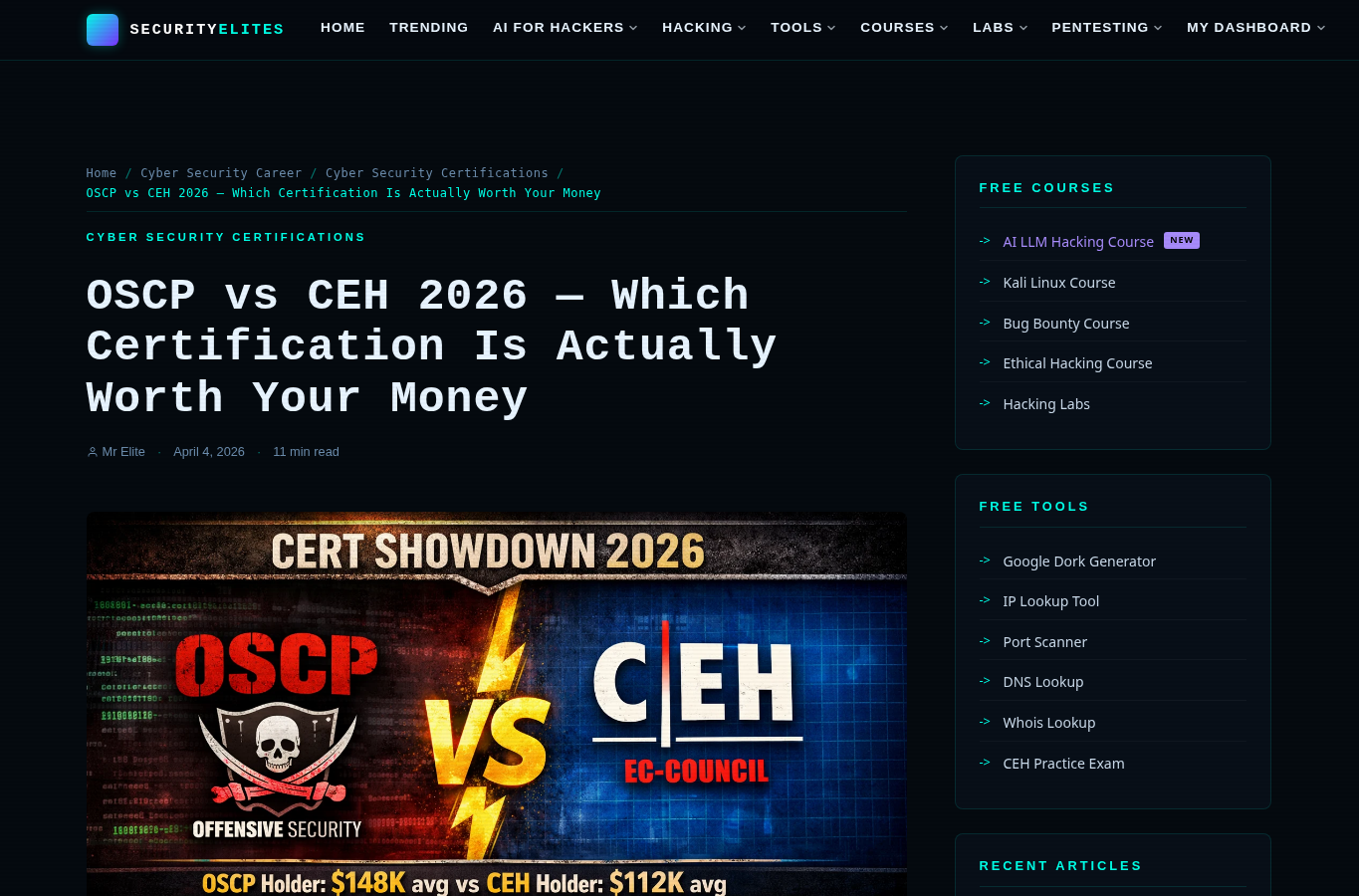
The SecurityElites comparison, updated April 2026, promises no affiliate links and anchors its conclusions on salary data, difficulty assessments, and direct hiring‑manager feedback. Their practical rule: if your employer or target job listing explicitly names CEH, that cert wins by default. If you want the credential that most pentest‑focused teams respect as a skill proof, OSCP is the gold standard. The guide also includes a section for people who aren’t ready for either exam yet and need to build foundational skills first.
3.0 University
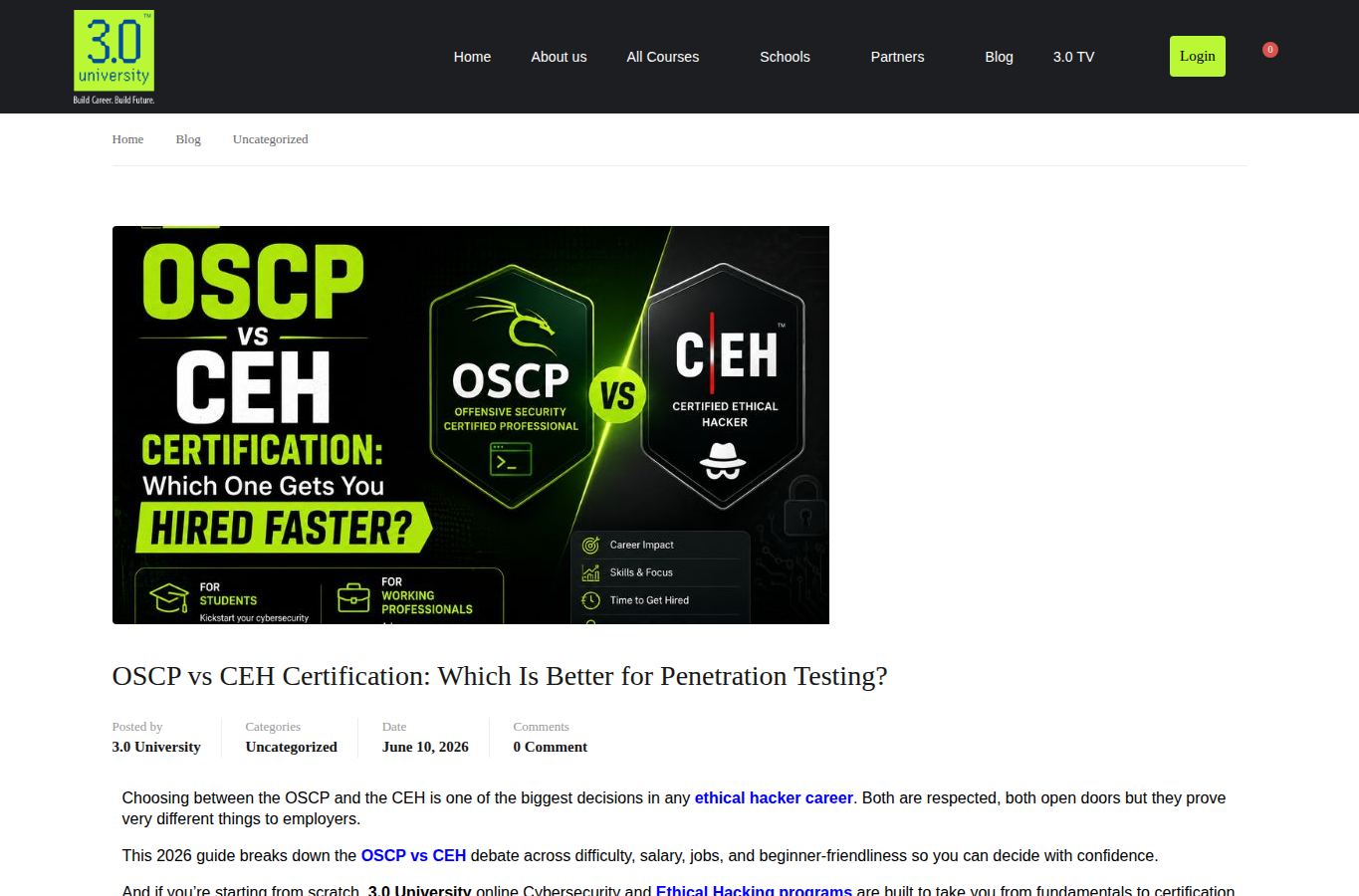
The 3.0 University article from June 2026 lays out a clean feature‑by‑feature table and notes that CEH v13 now includes AI‑powered attack labs. Their closing recommendation centers on career stage: beginners and compliance‑track professionals lean toward CEH, while mid‑career pentesters and anyone moving into offensive security should prioritize OSCP.
CertSelect
The CertSelect analysis, published April 2026, emphasizes the philosophical split — knowledge recognition versus skill execution. Their comparison table surfaces the issuing body locations (EC‑Council in Albuquerque; OffSec in New York) and reminds readers that CEH remains the stronger pick for HR keyword filters and DoD compliance, while OSCP dominates in hands‑on pentesting career tracks. CertSelect also links to a broader cybersecurity certification overview for readers who haven’t yet committed to penetration testing as a specialty.

All three sources point toward the same reality: neither certification is universally “better.” The right choice depends on how you personally learn, what role you want next, and whether you can set aside the consistent lab time OSCP demands.
Making Your Choice Without Losing Months
If you can only pick one and you have a job‑listing deadline breathing down your neck, run yourself through three questions:
- Does your target role list CEH by name or fall under DoD 8570 guidelines? Then CEH is the lower‑friction path that directly satisfies a compliance requirement. Spend your study weeks drilling timed multiple‑choice sets that mirror the real exam environment — the kind of focused practice that would have saved Jenna’s first attempt. When a weak domain keeps showing up, use flashcards and explanations until the concept sticks, then test again.
- Are you applying to a dedicated penetration testing team or a consultancy that runs client red‑team engagements? OSCP sends a stronger, more technically credible signal. Budget at least three months of active lab time, and plan to practice privilege escalation chains, Active Directory compromises, and report writing under simulated deadline pressure. A practice exam simulator won’t replace the lab, but it can gauge your readiness and reveal blind spots before you spend $1,699 on an attempt.
- Are you still building foundational cybersecurity knowledge and don’t yet have a home‑lab habit? Pass the CEH knowledge exam first. The structured curriculum gives you a map of the attack surface, and once you have that baseline, you can tackle OSCP with far less frustration — exactly the path Marcus took after his initial setback.
If your cybersecurity roadmap includes branching into defensive operations or network security, credentials like Cisco security certifications layer on top of CEH or OSCP to round out a security‑engineer profile. No single cert covers everything, but picking the one that lines up with your next job description keeps you from burning months on a credential that won’t move the needle.
Questions That Come Up Most When Deciding
Do I need both certifications? Not unless your career plan straddles compliance‑focused roles and deep‑technical pentesting at the same time. Many professionals start with CEH, work in a SOC or analyst role for a year or two, and then earn OSCP when they pivot to offensive security. The CEH knowledge base makes OSCP’s enumeration and exploitation phase easier, but it isn’t a prerequisite.
Is CEH still respected in 2026? Yes, in the right contexts. Government contractors, audit teams, and managed security service providers still value CEH because it checks a box in regulated environments. Among hands‑on red‑team leads, CEH alone without practical demonstration won’t seal a job offer, which is why EC‑Council now offers the CEH Master track to bridge that gap.
How long should I study for each exam? CEH candidates with some IT background often prepare for 8 to 12 weeks, spending an hour a day on modules and review questions. OSCP preparation takes most people 3 to 6 months of consistent lab work on top of their regular job. The Learn One subscription is designed around a one‑year timeline, and many successful candidates use most of it.
Can I retake the OSCP exam without repurchasing the whole course? Yes, you can buy a standalone exam retake for $249, which includes a short lab refresh period. The PEN‑200 bundle includes one retake, and Learn One gives you two exam attempts within the subscription window.
What happens if I fail the CEH exam? EC‑Council allows retake vouchers, typically in the $399–$499 range depending on the training partner. A 14‑day waiting period usually applies before you can sit again.
Is CEH v13 AI worth the upgrade if I hold an older CEH? If you already hold a valid CEH credential, upgrading to v13 AI requires passing the current exam again. The main draw is the updated AI‑attack curriculum, which may help in roles that are beginning to ask about adversarial AI threats. If your credential is active and your employer hasn’t required the new version, an upgrade is optional rather than urgent.
Plan Your Next Certification Move
- Best IT certifications for career changers
- Cisco CyberOps certification
- Cisco security certifications
Start a free practice exam on ExamJungle