

Earning the cphq certified professional in healthcare quality credential validates your ability to lead patient safety initiatives, manage regulatory compliance, and interpret clinical data. Because the application fee is non-refundable and testing windows run on fixed schedules, jumping into registration without checking the prerequisites can cost you hundreds of dollars and months of lost momentum.
Many candidates assume the National Association for Healthcare Quality (NAHQ) requires a clinical degree or an employer sign-off before you can sit. Others register before checking testing center availability, only to scramble through the scheduling window. This checklist breaks down the administrative, structural, and technical rules you must verify before you submit your application.
Eligibility and Professional Background Criteria
Before you create an account on the NAHQ portal, confirm how your education and career background align with the credential's standards.
Unlike state medical boards or specialized clinical licenses, NAHQ does not enforce mandatory degree minimums, nor does it require an active registered nursing or medical license. Anyone may technically apply and sit for the exam. However, sitting without practical exposure is the most common reason first-time candidates fail to achieve a passing score.
NAHQ designs the test around its healthcare quality competency framework, which reflects real work conducted across inpatient, outpatient, and managed-care environments. To gauge whether your day-to-day work matches the examination, audit your experience against these baseline recommendations:
- Two years of dedicated quality experience: NAHQ strongly advises candidates to have roughly two years of experience in healthcare quality, safety, policy, or informatics before testing. This is a recommendation rather than a locked requirement, but test questions expect you to think like an experienced quality director rather than a textbook student.
- Cross-functional clinical familiarity: If you work in health data informatics, hospital IT, or clinical documentation, you must understand clinical workflow basics, such as root cause analyses, sentinel event reporting, and infection prevention protocols. Candidates in non-clinical technical roles often benefit from validating foundational analytical skills through quality process analyst practice tests before tackling broader healthcare governance questions.
- Administrative autonomy: Questions frequently place you in the role of an advisor presenting to an executive board or medical executive committee. If your background is limited to entry-level data entry, you may struggle with situational judgment questions that ask you to select the best organizational escalation path.
Confirm this check: You are not required to upload official university transcripts or an employer endorsement letter during the initial application. However, NAHQ reserves the right to audit candidate files. You must attest to the truthfulness of your professional background during checkout.
Testing Windows, Deadlines, and Fee Structures
The CPHQ examination does not operate on an on-demand, test-any-day schedule. Instead, NAHQ conducts testing during four distinct quarterly windows every year. Missing an application deadline means waiting up to three months for the next available cycle.
Review the administrative timeline and financial commitments before you plan your study calendar:
- Quarterly testing windows: Examinations occur four times per year, typically in February, May, August, and November. Each window runs for approximately three weeks.
- Application cutoffs: Applications close roughly one month prior to the start of each testing window. For example, if you aim to test during the May window, your application and payment must be finalized by early April.
- Geographic candidate classification: NAHQ divides test-takers into domestic (US) and international categories. US candidates include anyone testing within the fifty United States and the District of Columbia. Candidates in US territories (such as Puerto Rico or Guam) and other countries are classified as international candidates and fall under separate regional scheduling policies documented in the NAHQ candidate handbooks.
- Application fees: As published by NAHQ, the standard examination fee is $495 for active NAHQ members and $595 for non-members. International candidates pay an adjusted administrative fee, often around $625. Membership discounts apply only if your membership is active at the exact moment of payment.
- Rescheduling and cancellation limits: You can reschedule your exam appointment within your approved window if you notify the testing service at least several business days in advance. However, you cannot roll your application forward into a completely different quarterly window without forfeiting your fee or paying an administrative transfer penalty.
- Retake waiting period: If you do not pass, NAHQ mandates a 90-day waiting period before you can test again. You must submit a re-examination application and pay the full testing fee once more.
Because a failed attempt carries a heavy financial and time penalty, quality coordinators often build intermediate process-improvement skills first, testing their grasp of measurement variance on Six Sigma Green Belt practice exams before investing in the CPHQ test fee.
Confirm this check: Check your calendar against the upcoming window dates. Do not submit your application until you are confident you can schedule your exam session inside the specific 21-day testing period designated for that quarter.
Structural Breakdown of the Examination Blueprint
The CPHQ test blueprint is established through an extensive HQCC job task analysis report conducted by the Healthcare Quality Certification Commission. This empirical study determines which competencies healthcare quality professionals perform most frequently and which carry the highest risk to patient safety.
When you sit for the exam, you will encounter 160 multiple-choice questions. Understanding how these questions are categorized prevents surprises on test day:
- Scored vs. unscored items: Out of the 160 questions, exactly 140 are scored. The remaining 20 questions are unscored pretest items. NAHQ uses these 20 experimental questions to gather statistical data for future exams. They are mixed randomly throughout the test. You will not know which questions count and which do not, so treat every question as scored.
- Time limit: You have exactly 3 hours (180 minutes) to complete the exam. That provides roughly 67 seconds per question. Pacing is critical, particularly when analyzing complex scenarios or data tables.
- Passing threshold: The CPHQ uses a scaled score ranging from 200 to 800. The passing standard is set using psychometric criteria, with the passing score pegged at 500. Depending on the statistical difficulty of your specific test form, you generally need to answer between 98 and 105 of the 140 scored questions correctly (around 70% to 75%).
The questions test three distinct cognitive levels, as outlined in the official exam content outline:
- Recall (roughly 25% of items): These evaluate direct memory of definitions, regulatory bodies, and quality principles. For example, recalling the definition of a sentinel event or naming the phases of the PDCA cycle.
- Application (roughly 55% of items): These require you to apply a principle to a straightforward operational problem. You might receive a set of hospital fall rates and be asked which graphical tool (a Pareto chart or a run chart) best displays the underlying causes.
- Analysis (roughly 20% of items): These present multi-layered clinical or organizational dilemmas. You will evaluate competing priorities, interpret multivariate data, or diagnose systemic breakdowns across departments.
To plan your study distribution, audit your familiarity with the seven core domains defined by the commission:
- Quality Leadership and Integration: Aligning organizational strategy, engaging executive leadership, and establishing continuous improvement cultures.
- Quality Review and Accountability: Monitoring provider profiling, clinical peer reviews, and accreditation readiness. Candidates with backgrounds in medical records often cross-train using CDIP practice exam questions to master documentation accountability principles.
- Regulatory and Accreditation: Navigating Centers for Medicare & Medicaid Services (CMS) Conditions of Participation and The Joint Commission requirements.
- Patient Safety: Conducting root cause analyses, applying Failure Mode and Effects Analysis (FMEA), managing incident reporting systems, and promoting proactive harm reduction.
- Performance and Process Improvement: Implementing Lean, Six Sigma, DMAIC, and Human Factors Engineering methodologies.
- Health Data Analytics: Calculating central tendency, standard deviation, and sampling sizes, while interpreting control charts, histograms, and scatter plots.
- Population Health and Care Transitions: Addressing social determinants of health, reducing preventable 30-day readmissions, and tracking continuum-of-care quality metrics.
Confirm this check: Review the seven domains and identify your weakest areas. If your experience is primarily in data analytics, ensure you spend sufficient time studying regulatory standards and peer review structures before booking your seat.
Testing Formats and Identification Rules
NAHQ offers two delivery methods: an in-person session at an authorized testing center or a live remotely proctored online exam. Each option comes with strict administrative requirements.
If you choose an in-person assessment center, the facility manages hardware, network stability, and room environment. Your main responsibility is arriving on time with proper identification.
If you opt for remote testing from home or your office, you assume full responsibility for your room setup, hardware compatibility, and internet connection, in accordance with NAHQ's remote online testing guidelines.
Audit your readiness against the following identification and environment requirements:
- Primary Identification: You must present an unexpired, government-issued photo ID featuring your signature. Acceptable examples include a state driver's license, passport, or military ID.
- Secondary Identification: You must also present a second form of ID that contains your printed legal name and a valid signature (such as a credit card or employee badge).
- Name Matching Rule: The first and last names on both IDs must match the names listed on your NAHQ exam confirmation email exactly. If you recently changed your name due to marriage or divorce, your documents must match your registration record, or you will be turned away without a refund.
- Workstation Environment (Remote Exam): You must test in a fully enclosed, private room with a solid door. No glass partitions with visible foot traffic are permitted. Clear the desk of all papers, pens, notebooks, sticky notes, and second monitors. Dual monitors are strictly forbidden and will cause the proctoring software to terminate your session.
- System and Network Checks (Remote Exam): Run the vendor system diagnostics tool on the exact computer and network you plan to use. Do not test on a hospital-issued laptop that runs enterprise firewalls or background VPN software, as corporate security tools routinely block the remote proctor's video feeds.
Confirm this check: Verify your IDs right now. Check the expiration dates and confirm your first and last names on file with NAHQ match the spelling on your physical identification cards character for character.
Systematic Verification Checklist Before You Register
To ensure you have covered every detail, run through this sequential verification checklist before submitting payment on the CPHQ application submission portal.
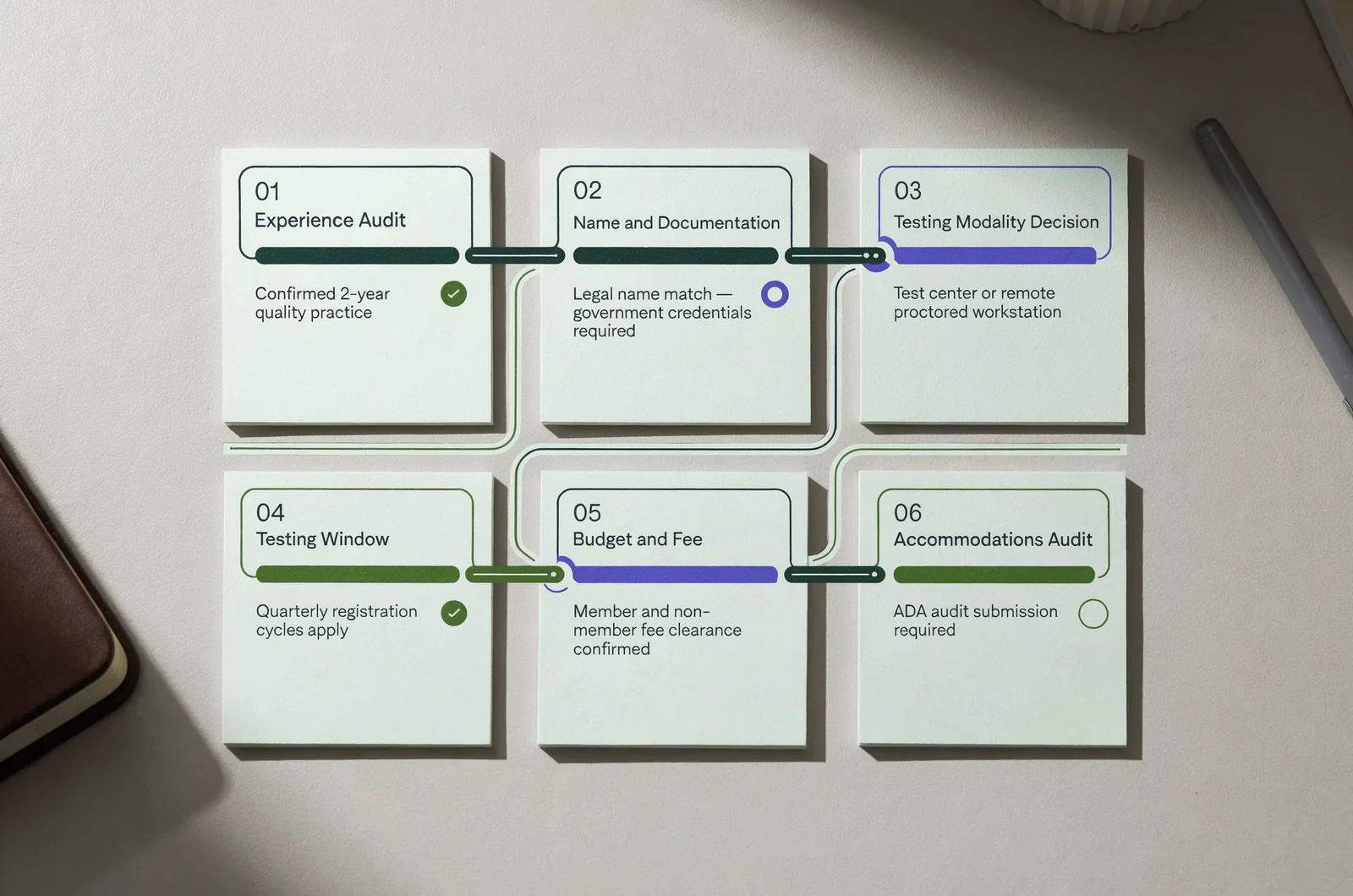
- Experience Audit
- Confirm you understand that NAHQ requires no degree verification upfront, but assumes roughly two years of healthcare quality work.
- Verify your competency across all seven content areas, not just your daily job specialty.
- Name and Documentation Audit
- Confirm your legal first and last names on your NAHQ profile match your government-issued photo ID and secondary ID.
- Check that your primary ID does not expire prior to your planned test date.
- Testing Modality Decision
- Decide between an in-person assessment center and remote proctoring.
- If testing remotely, verify that you have an isolated private room, a web camera that can pan 360 degrees, and a personal (non-hospital) computer without restrictive firewalls.
- Testing Window and Scheduling Selection
- Confirm the specific quarterly window you are targeting (February, May, August, or November).
- Confirm that your current work schedule permits taking a 3-hour exam on a weekday or Saturday within that 21-day period.
- Budget and Fee Authorization
- Confirm whether your employer requires an itemized invoice for tuition assistance or professional development reimbursement.
- Check your NAHQ membership status to see if paying the membership fee first provides a net discount on the exam package.
- Accommodations Audit
- If you require testing accommodations under the Americans with Disabilities Act (ADA), confirm that you submit your documentation and medical forms to NAHQ before finalizing your exam registration. Accommodations cannot be added retroactively to an active appointment.
Concept: Interactive CPHQ Application Timeline and Readiness Selector
An interactive readiness tool can streamline this process for busy clinicians and analysts. A candidate would enter their target test month, current work focus (clinical nursing, hospital IT, compliance, or health administration), and preferred testing format (center vs. remote). The tool would generate a personalized countdown: displaying the exact application cutoff date, when to run hardware system checks, when to submit ADA documentation, and when to transition from textbook study to timed full-length practice tests.
Transitioning from Administrative Clearance to Exam Preparation
Clearing the administrative hurdles is step one; passing the exam is step two. Once NAHQ approves your application, you receive an Authorization to Test (ATT) notice containing your unique scheduling eligibility code. At this point, your preparation must shift from passive reading to active, realistic question practice.
Many healthcare professionals struggle on their first attempt because they rely solely on passive reading of quality handbooks. The CPHQ rarely asks simple memory questions. Instead, it tests how you respond to complex hospital incidents:
- What immediate action must a quality director take when a post-operative infection spike is discovered on a surgical floor?
- How should a team interpret an out-of-control point on an X-bar control chart during a pharmacy dispensing audit?
- Which stakeholder group must approve changes to clinical privilege criteria during a Joint Commission survey cycle?
Answering these situational questions demands deliberate practice under simulated exam conditions. A high-quality test engine helps you build the necessary endurance for a 3-hour, 160-question marathon. Candidates reviewing audit processes for complex clinical settings often cross-train using medical device auditor practice questions to hone their ability to spot documentation discrepancies and non-conformances quickly.
This is where structured prep tools help. On ExamJungle, you can run timed practice exams that reproduce the pressure of the 180-minute countdown, helping you eliminate pacing anxiety. Instead of memorizing static questions, you can use Caesar AI within the ExamJungle platform to explore question variations, request expanded explanations, or increase difficulty on challenging topics like statistical run rules or risk stratification. Understanding why a distractor is incorrect is what protects you from falling into traps on test day.
Complement your scenario practice with focused flashcard drills on high-yield standards. Regulatory guidelines require precise recall of terms, such as:
- Failure Mode and Effects Analysis risk priority numbers (RPN calculation = Severity × Occurrence × Detection).
- National Patient Safety Goals established by The Joint Commission.
- Basic manufacturing and clinical distribution controls, which share foundational quality principles with pharmaceutical GMP practice tests.
- Differences between common cause variation and special cause variation in health informatics datasets.
Dedicate the final three to four weeks before your scheduled date to completing full-length, timed practice tests. Track your domain scores to pinpoint whether patient safety or health data analytics is pulling down your overall percentage, and focus your final review on those specific gaps.
Addressing Real Candidate Concerns Around CPHQ Rules
Can I sit for the exam if my degree is from outside the United States?
Yes. NAHQ welcomes international test-takers and does not require an international credential evaluation service (such as WES) to evaluate your degree before applying. As long as you review the international candidate handbook and pay the applicable international administration fee, your educational pedigree will not block your application.
What happens if my primary ID expires the week of my test?
Testing center administrators and remote proctors will not admit you with an expired ID, even if the expiration occurred only days before. If your driver's license or passport is expired, you must obtain an official temporary paper extension with a photo or present an alternative unexpired government-issued ID (such as a valid passport or military credential). If you cannot produce valid identification, your appointment will be cancelled and your fee forfeited.
Are physical calculators permitted in the testing room?
No. You cannot bring your own personal calculator into the testing room or place one on your desk during a remote proctoring session. The examination software features a built-in digital calculator accessible directly on your screen. You will use this tool for all arithmetic calculations, including rates, ratios, percentages, and risk priority numbers.
If I fail my first attempt, how soon can I test again?
NAHQ requires candidates to wait 90 days following a failed attempt before retaking the examination. This cooling-off period ensures candidates have enough time to review weak domains. You must submit a re-examination application through your NAHQ account and pay the testing fee again.
How long does the CPHQ certification remain valid?
Your credential remains active for two years. Recertification occurs biennially, with a deadline of December 31 of your renewal year. To maintain your status, you must document 30 continuing education (CE) hours focused on healthcare quality competencies and pay the renewal fee, or elect to retake and pass the CPHQ examination.
Relevant Credential Prep Guides