

To work through the AACD written exam passing standard requirements, first confirm the official scoring instructions for your intended sitting. Then build your preparation around those instructions and your ability to explain your answers. This guide provides a verification and study workflow; it does not establish an official passing percentage, score scale, or standard-setting method. Keep those details unconfirmed until you have AACD’s written guidance.
I’d start with a simple goal: finish each study week with a clearer record of what you understand, what needs work, and which exam requirements still need confirmation. Use the steps below to build that record without turning a practice percentage into an unsupported prediction.
1. Get the AACD passing standard in writing
Begin your AACD preparation by requesting current written-exam instructions and identifying the exact statement about passing. Save the document or response alongside your study plan so you can revisit the wording before booking or making your final preparation decisions.
Build a dated exam record
Create one page for the requirements you need to verify. For each entry, record the official document title, its date or version if supplied, the relevant page, and the wording that answers your question.
Include these fields:
- The full examination name and the sitting or registration period you intend to use.
- The stated passing requirement and the form in which the result is reported.
- Any explanation of how the passing standard is established.
- The question format, question count, and permitted examination time, if specified.
- Instructions about unanswered questions, marking, navigation, and reviewing previous answers.
- Rules about permitted materials, identification, breaks, and testing arrangements.
- Any applicable booking, rescheduling, retake, or result-review instructions.
Leave an unanswered field visibly marked as unresolved. Avoid filling gaps with assumptions from another certification or a preparation provider’s description.
For a separate example of checking a requirement before booking, consult the Praxis passing score guide. Confirm every AACD requirement independently.
Resolve unanswered scoring questions
If the instructions do not answer your scoring question, send AACD a concise request. Identify the written examination and your intended sitting, then ask for clarification on the unresolved points.
Useful questions include:
- What passing requirement applies to this examination?
- Is a numerical threshold available, and how should candidates interpret it?
- Does the published information explain how the passing standard is determined?
- Is there an official relationship between a percentage correct and the reported result?
- Are any additional conditions relevant to receiving a passing result?
Keep the response with your exam record. If an answer concerns a particular date or examination arrangement, preserve that context.
Before moving on, check that you can point to official wording for every requirement you intend to use. Keep a personal study target in a separate field so it cannot be mistaken for AACD policy.
2. Turn the official scope into a study map
Build your AACD study map from the scope and preparation guidance you obtain directly from AACD. Use that material to decide what belongs in your plan, then connect each study session to a specific item.
Give each topic a concrete task
Copy the official topic wording into a working document without expanding it into an invented exam blueprint. Under each topic, add the material you plan to review and a task that will let you check your understanding.
Choose tasks such as:
- Explain a concept aloud without looking at your notes.
- Write a short account of why one answer fits a practice question.
- Identify the detail that would change your answer.
- Compare two closely related ideas using the reference you are studying.
- Answer a fresh question, then locate support for your reasoning.
Keep the tasks small enough to complete during an ordinary study session. Instead of writing “review everything about this topic,” name the question you want to resolve.
If AACD supplies topic weightings, preserve their wording and source context. If you have no confirmed weightings, leave them unspecified. Allocate your study time using an openly personal plan based on unresolved topics, available time, and the preparation guidance you have verified.
Separate knowledge work from exam administration
Maintain a short administrative list beside the study map. Put registration questions, identification checks, testing arrangements, and result instructions there.
For each administrative item, assign a date to verify it and a place to store the answer. For each knowledge item, assign a study task and a review session. This gives you two clear kinds of work to complete.
At the end of the week, review the map line by line. Mark a topic complete only against the task you assigned, such as explaining a concept or resolving an answer rationale. Keep the official scope visible during that review.
If a preparation resource introduces an unfamiliar subject, compare it with the confirmed scope before adding more study time. Write down the connection you are relying on. Where the connection remains unclear, ask for clarification and continue with a topic you can place confidently.
3. Take a diagnostic you can explain
Use your first AACD practice session to create a starting record. Set the conditions in advance, answer the questions, and review both your choices and the reasoning behind them.
Choose a set with a clear purpose
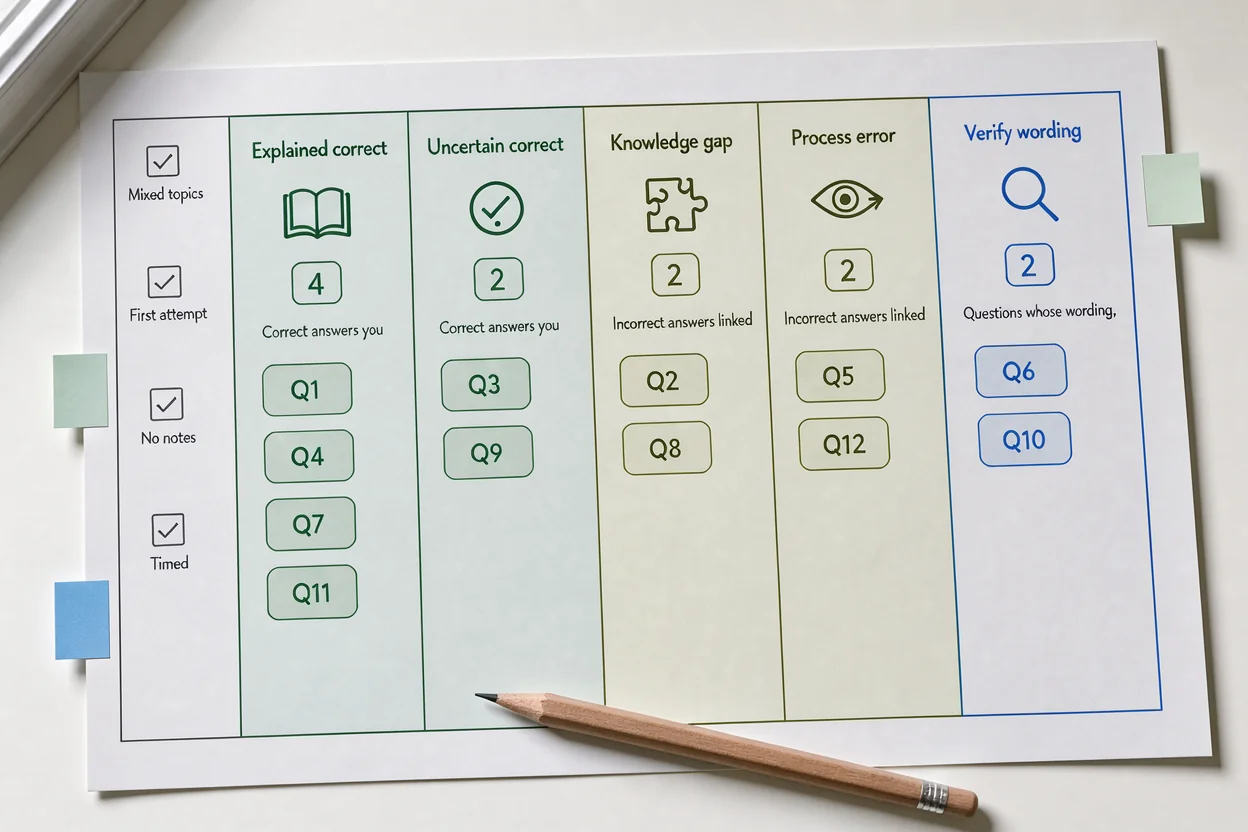
Select practice material you can connect to your study map. Before beginning, write down whether the session covers one topic or a mixture, whether you have seen the questions before, and whether you will use notes.
Choose a timing rule deliberately. Until you have confirmed the official examination conditions, describe the session as a personal timed exercise. Save any claim about matching the examination for conditions you can verify.
If you use ExamJungle for practice, record the session in the same study log as your other preparation. Note the topic you intended to assess and any questions that need checking against your study references.
For the initial attempt, commit to your answers before reviewing explanations. Record interruptions or assistance beside the result so you can account for them during review.
Record confidence alongside correctness
After answering, sort the questions into useful review groups:
- Correct answers you can explain with support from your study material.
- Correct answers you selected with uncertainty.
- Incorrect answers linked to a gap in understanding.
- Incorrect answers linked to your reading or decision process.
- Questions whose wording, explanation, or scope needs verification.
Treat a correct answer selected by guessing as a review task. For example, suppose you choose the intended answer but cannot explain why the alternatives fail. Write that question into your review log and identify the reference passage you need to examine.
Keep the total result, but inspect the individual groups before choosing your next study task. Begin with a recurring gap or an uncertain concept that appears across several questions.
For a separate exercise in interpreting reported results, use the AWS diagnostic score guide. Keep its examination-specific scoring details separate from your AACD record.
Finish the diagnostic review by assigning each unresolved question a specific action.
4. Repair the reasoning behind each missed answer
Use your AACD review sessions to resolve the decision that caused each error. For every question you revisit, identify what you selected, why you selected it, and what you need to understand before another attempt.
Write a useful correction
Create a brief correction note with enough context to make sense when you return to it later. Include the topic, your original reasoning, the point you missed, and the reference passage you used to resolve it.
Ask yourself:
- What was the question asking me to decide?
- Which detail did I overlook or interpret incorrectly?
- What support does my reference give for the intended answer?
- Under what different wording might another option become appropriate?
- What remains uncertain after reading the explanation?
Keep any unanswered question open. If a practice explanation conflicts with the material you are using, record both statements and seek an authoritative resolution. Avoid choosing whichever explanation sounds more confident.
Use your own words for the correction. Then compare your wording with the reference to check that you have preserved the meaning.
Revisit the concept with fresh wording
After reviewing the source material, write a new prompt or select another question addressing the same concept. Change the wording or the decision being asked so your follow-up attempt requires an explanation.
Set a later review date. At that session, answer before opening the correction note, then compare your reasoning with the note and reference.
Suppose your first error involved confusing two related concepts. Make the follow-up task an explicit comparison: describe the distinction, identify the deciding detail, and explain how you would recognize it in a question. Keep the example within the material you have verified.
If the same problem returns, narrow the task. Replace another broad reading session with one focused question you can resolve.
End the review by updating your study map. Mark the original gap as resolved, partly resolved, or still open, and attach the next task where needed. Keep the correction short enough that you can revisit it during your final preparation week.
5. Rehearse the conditions AACD confirms
Plan your AACD rehearsal around the format, timing, and rules you have verified. Before starting, list the conditions you intend to reproduce and any differences you need to keep in mind.
Set up the rehearsal deliberately
Choose a quiet session and prepare the materials permitted under your confirmed instructions. Decide how you will record interruptions, handle uncertainty, and review answers where the examination rules allow it.
Check the practice setup before you begin. Confirm whether you can move between questions, return to previous answers, pause, or view explanations. Use those controls according to the rehearsal plan you have written.
When practicing with ExamJungle, record any difference between your session setup and the AACD conditions you are trying to reproduce. Keep those differences beside the result when you review it.
If you are comparing practice formats, use the PMP simulator comparison to frame questions about session controls. Verify the controls and conditions relevant to your own rehearsal.
After the session, note where your process broke down: reading, deciding, navigating, reviewing, or managing the remaining time. Assign one adjustment for the next rehearsal.
Build a pacing plan from confirmed inputs
Once you have official timing and question-count information, use those inputs to draft a personal pacing plan. If the rules permit review, decide how much time you want to reserve for it.
Treat the resulting average pace as a planning aid. During rehearsal, note which questions required more attention and whether you completed the session within your chosen checkpoints.
A useful optional study tool would be a pacing calculator with fields for confirmed examination time, question count, and a personal review allowance. Label its output as a study estimate and display the inputs beside it.
Before your final rehearsal, revisit the AACD written exam passing standard requirements in your saved instructions. Check whether the document or response still applies to your planned sitting. Update unresolved administrative items before interpreting another practice result.
Finish the rehearsal review with a short instruction for your next session, such as checking the question’s requested decision before selecting an answer.
6. Review readiness against your evidence
Make your AACD preparation decision using the records you have built: confirmed requirements, study coverage, corrected reasoning, and rehearsal notes. Set aside time for a deliberate review before your final preparation period.
Inspect the pattern across your sessions
Compare several sessions using the conditions recorded beside each one. Keep first attempts distinguishable from repeated questions, and review assisted sessions separately from attempts completed under your chosen rehearsal conditions.
Look for questions you can answer:
- Which areas of the confirmed scope have I actively reviewed?
- Which explanations can I reproduce without opening my notes?
- Which errors have returned after correction?
- Where am I still relying on familiarity with the question?
- Which rehearsal difficulties remain unresolved?
Write a short response to each question. Where your record gives no answer, assign a focused check instead of treating the gap as complete.
Keep any personal practice target clearly labeled. Use it to organize your study decisions, and confirm any claimed relationship to an official passing result directly with AACD.
If your records show persistent uncertainty, choose the unresolved topic that deserves the next session. Make the task specific enough to finish and review.
Give the final study period a clear job
Use the final period to revisit open reasoning gaps and complete administrative checks. Select tasks from your record rather than creating a new list from memory.
Read the current examination instructions again. Confirm the arrangements you must follow, prepare the required items, and record where you will find official help if an administrative problem arises.
If you decide to change your booking plans, check the applicable terms before acting. Keep the relevant dates and confirmation with your exam record.
For your last practice review, choose a small set of unresolved concepts and explain them without notes. Then check each explanation against your references.
I’d finish with a one-page preparation record: verified requirements, the location of the official instructions, remaining study questions, and your test-day arrangements. Use plain wording that you can follow without reconstructing your entire study history.
Questions to settle before your AACD sitting
Resolve remaining AACD scoring questions through official written guidance. Use the answers to complete your exam record, especially where a practice resource has supplied a number or description you have not independently confirmed.
What percentage do I need to pass?
Use only a threshold confirmed by AACD for the examination you intend to take. This guide supplies no verified numerical cut score. If your instructions do not state a percentage, ask how the passing requirement should be interpreted. Leave the percentage field unconfirmed until you receive a clear answer.
How is the passing standard determined?
Ask AACD for its published explanation of the standard-setting process, if one is available. Request clarification of unfamiliar terminology and preserve the wording you receive. Keep any general explanation of examination scoring separate from the method AACD confirms. Avoid assigning a standard-setting method based on another credential’s policies.
Can I use a practice score as my passing target?
Keep a practice target as a personal study measure unless AACD explicitly supports the relationship you intend to use. Record the question set, conditions, and review findings beside it. Before making a booking decision, inspect unresolved topics and rehearsal difficulties as well as the total result.
What should I do when preparation materials disagree?
Identify the exact disagreement and the requirement or concept involved. For examination rules, request current AACD guidance. For a disputed answer explanation, locate support in the references you are using and seek clarification where needed. Keep the issue open until you can document the resolution.
Use the resulting answers to update your study map and final rehearsal plan. Give every remaining uncertainty a concrete question, a place to seek clarification, and a date to revisit it.
Compare scoring checks across other exams