

If you’re looking for praxis core writing argumentative essay prompts examples, first separate original practice material from claims about newly released ETS questions. This article does not establish that ETS has announced new argumentative prompts or changed its requirements. The examples below are original editorial exercises. Use them to practice choosing a position, developing support, and answering an objection; do not treat them as official questions or predictions about your exam.
That distinction matters for the decision in front of you: whether to change your preparation. I would reserve that decision for an attributable announcement identifying the affected test and the actual change. Meanwhile, use the exercises here to examine your reasoning without assuming that a new exam format exists.
The ETS update claim remains unconfirmed
The proposed news about new Praxis Core argumentative prompts cannot be substantiated in this article. No release date, revised wording, timing change, or source requirement is reported here as an established ETS announcement.
What would support a report of new prompts?
Before treating a prompt collection as an official update, look for an identifiable publication and a clear description of its purpose. Ask whether it presents sample material, announces revised requirements, or explains an existing task.
Those distinctions should guide your response. If a document contains a different example topic, examine the instructions before concluding that your writing task has changed. If it announces a revised requirement, identify the exact action you would need to practice.
For any claimed update, record:
- The organization responsible for the announcement.
- The publication or revision date.
- The named test and any applicable version.
- The exact requirement described as changing.
- The date when that requirement would apply.
Leave an unanswered field blank. Do not supply a date or requirement from a third-party headline.
What should you change right now?
I would not recommend changing your preparation on the strength of an unverified update claim. Instead, identify the part of writing you want to examine.
Perhaps you can state an opinion quickly but struggle to explain your examples. Perhaps your paragraphs wander away from the question. Choose one of those problems for your next practice session.
Keep a separate note for unresolved exam questions. Put timing, permitted materials, task instructions, and scoring requirements there until you have an attributable answer. For the exercises below, set your own practice conditions and label them accordingly.
What a wording change would mean for your essay
For Praxis Core preparation, examine a claimed wording change by asking what it would require you to do differently. The following distinctions are editorial examples, not descriptions of an announced ETS revision.
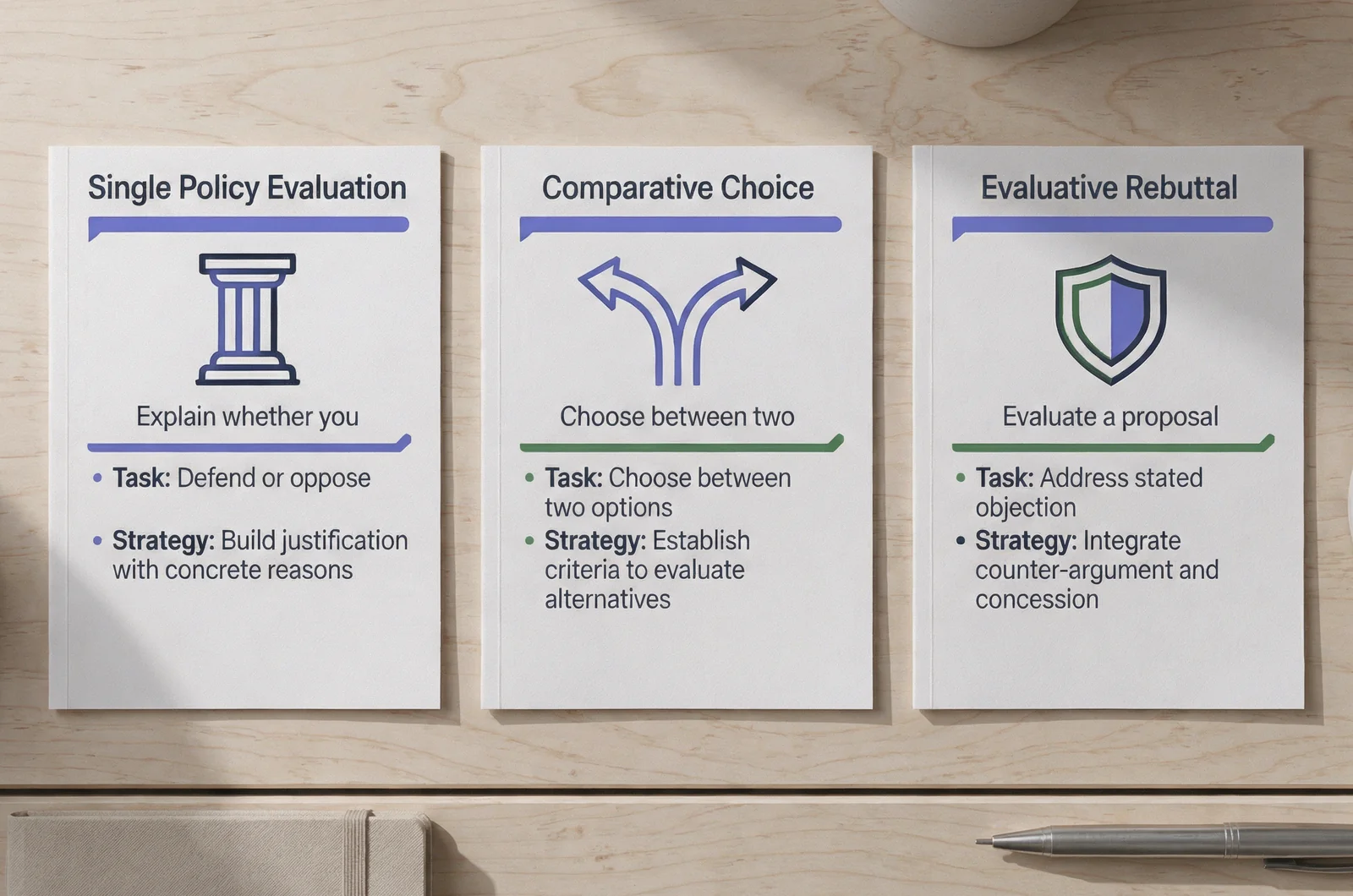
Read the requested action before choosing a position
Consider these three original instructions:
- Explain whether you agree with a proposed policy.
- Choose between two proposed policies and defend your choice.
- Evaluate a proposal while addressing a stated objection.
For the first exercise, write down your position and the reasons supporting it. For the second, name the alternative you prefer and explain your basis for comparison. For the third, include a direct response to the objection.
Avoid carrying a prepared argument into all three tasks unchanged. Underline the action words, then write a one-sentence description of the job you have been asked to complete.
For example: I need to choose a policy and explain why its benefits justify its disadvantages.
Use that sentence as a check on your outline. If a paragraph does not help complete the requested job, revise its purpose or remove it.
Keep the question’s limits visible
In these practice exercises, pay close attention to words such as all, some, required, and optional. Build your response around the proposition actually presented.
Suppose an original prompt proposes making one career workshop available to students. Do not spend your essay arguing against mandatory attendance at weekly workshops. Write the proposal at the top of your planning page, then compare each paragraph against it.
You may qualify your position. For instance, support a proposal only if participation remains optional. Explain that condition directly rather than leaving the reader to infer it.
If an exercise includes source material, follow its stated instructions for using that material. If it does not, avoid inventing a source requirement. No change to ETS source expectations is established here.
Before drafting, complete this sentence: My position applies to this specific proposal because…
Three original argumentative prompt examples
These Praxis-focused writing exercises are original editorial material. They are not attributed to ETS and should not be used to predict a future question. Each includes one possible planning approach; choose a different position if you can support it clearly.
Example 1: A required career workshop
Original practice prompt: A college is considering requiring every student to complete a career-planning workshop before graduation. Support or oppose the proposal. Develop your position with specific reasons and examples.
Try this possible thesis: The college should require a short career-planning workshop, provided students can choose sessions relevant to their goals.
For your first reason, consider the purpose of the requirement. You might argue that every student should leave with a plan connecting education to a possible next step. Develop that position through a hypothetical student who understands course requirements but has not considered how to present a project to an employer.
Then examine the objection: some students may already have substantial work experience. Address that concern by proposing different workshop options rather than repeating that career preparation matters.
For this exercise, distinguish the requirement from its implementation. You could support a workshop requirement while opposing a single session imposed on everyone.
In your outline, write one sentence explaining why your proposed flexibility supports your position. Avoid introducing graduation requirements, employment statistics, or institutional policies as facts unless you have evidence for them.
Example 2: Library hours or weekend workshops
Original practice prompt: A community library has funding for one of two proposals: longer weekday opening hours or weekend workshops. Which proposal should it choose? Support your position and address one reasonable objection.
For this exercise, choose longer weekday hours. A possible thesis is: The library should extend weekday hours because residents should have more opportunities to use its existing resources.
Use two distinct lines of reasoning. First, discuss access for a hypothetical resident whose workday overlaps with the library’s current schedule. Second, discuss flexible use: imagine residents arriving with different purposes, such as reading, studying, or using a computer.
Acknowledge the alternative fairly. Weekend workshops could provide structured instruction in your hypothetical scenario. Your response should explain why you would give access priority under the prompt’s one-proposal funding limit.
Do not assume actual attendance levels, staffing costs, or community preferences. If you introduce a detail for illustration, label it as hypothetical.
End your plan with a decision rule you can defend: I would prioritize making existing resources accessible before adding a scheduled activity. Then check whether both supporting paragraphs explain that preference.
Example 3: Individual or group projects
Original practice prompt: An instructor must choose whether a major course assignment will be completed individually or in small groups. Which approach should the instructor choose? Explain your reasoning and consider a disadvantage of your preferred approach.
Try defending individual projects. A possible thesis is: The instructor should assign individual projects when the main purpose is to evaluate each student’s understanding.
Keep the condition visible. Your argument concerns an assignment designed for individual evaluation, rather than every possible classroom activity.
For support, imagine an assignment that asks each student to make and justify a design decision. Explain why you would want each submission to reveal that student’s reasoning. Then consider a disadvantage: students would have fewer opportunities to negotiate shared decisions within that assignment.
Respond proportionately. You might recommend peer discussion during planning while keeping the final submission individual. Explain which part of your proposal addresses the disadvantage and which part preserves your main goal.
As a revision exercise, reverse your position and outline an argument for group work. Change the assignment’s purpose explicitly rather than quietly switching assumptions midway through your response.
A worked response to the library prompt
The following response develops the second original exercise. Treat it as a model to examine and revise, not an official scored sample. All residents and circumstances described within it are hypothetical.
Sample response
The community library should use the available funding to extend its weekday opening hours. Weekend workshops could give residents a structured opportunity to learn, but I would prioritize access to the resources the library already maintains. Longer hours would support that priority while leaving residents free to decide how they use the additional time.
Consider a hypothetical resident who works during the day and reaches the library shortly before it closes. That resident might want to read, complete an application, or find information for a personal project. An additional period of evening access could make those activities possible. My reason for supporting longer hours is therefore specific: the library should give residents a reasonable opportunity to use its existing resources after their other commitments.
I would also favor longer hours because residents could use the added time for different purposes. Imagine one visitor studying quietly, another choosing books with a child, and a third working on a computer. Each would benefit from access without needing to share an interest in a particular workshop topic. Under the prompt’s requirement to choose one proposal, I would give priority to that flexibility.
The strongest objection is that workshops could provide instruction that access alone would not supply. A resident who wants guidance with an unfamiliar task might prefer a scheduled session with a clear purpose. That is a reasonable argument for the workshop proposal. However, I would still choose longer hours because my priority is to make the library’s existing resources available to residents whose schedules otherwise restrict their use.
This choice would require attention to practical details. I would want the library to explain how it would staff the additional hours and how it would assess whether residents used them. Those questions do not eliminate my preference; they identify what I would examine when implementing it. Given the two proposals in this exercise, I would extend weekday hours and evaluate that decision against the goal of broader access.
Examine the reasoning before copying the structure
Notice the choice in the opening: the writer gives access priority. For your own response, identify an equally clear basis for choosing between the proposals.
Next, examine the hypothetical resident. The paragraph gives that person a relevant constraint and connects it to the proposed change. When revising your own example, ask what it demonstrates. If you remove the example, does the paragraph lose an explanation or merely a detail?
Compare the two supporting paragraphs, too. The first concerns a resident’s schedule. The second concerns different uses of the additional time. In your draft, give each paragraph a separate purpose and remove repeated reasoning.
Finally, inspect the objection. The sample grants the workshop proposal a plausible benefit before explaining the writer’s preference. Write your own objection strongly enough that it deserves an answer.
Do not assign this response an official score. Instead, mark one sentence you would make more precise and one assumption you would want to examine. For instance, ask whether the final paragraph qualifies the position enough or leaves an implementation question unresolved.
How to use these examples without assuming an exam change
Use these original exercises to diagnose your writing decisions. Keep conclusions about your performance separate from conclusions about official Praxis requirements.
Choose one revision goal
Before starting, select a narrow goal: a clearer position, better explanation, a more relevant example, or a direct response to an objection.
For a thesis exercise, write two possible positions and underline the difference between them. Choose the one you are prepared to defend. For an explanation exercise, take one supporting paragraph and add the sentence that connects its example to the thesis.
If you use ExamJungle’s Praxis Core Writing practice, keep a separate record of what you want to examine in your essay work. Do not infer an official essay requirement from this article’s exercises.
After drafting, read only your thesis and the first sentence of each body paragraph. Ask whether those sentences describe the same argument. Then read the examples and check whether each one supports its paragraph’s purpose.
Finish by making one specific revision. Replace a broad assertion, explain an assumption, or answer an objection more directly.
Set practice conditions explicitly
If you want a timed session, choose a personal practice limit and label it as your own exercise setting. This article does not establish an official essay time allowance.
Record whether you finished your planned response, where you hesitated, and what you left unexplained. Use those observations to choose the next exercise rather than treating completion alone as your goal.
For readers also using ExamJungle’s Praxis Core Reading practice, keep separate notes for reading tasks and essay drafting. Name the skill you are practicing in each session.
An optional interactive checklist could support this review. It could ask you to identify your position, connect each example to a reason, and point to your answer to an objection. Treat its output as a revision prompt, without converting it into a predicted exam score.
Questions to settle before changing your study plan
Before responding to a claimed Praxis prompt update, separate questions about official requirements from questions about your own writing.
Are these newly released ETS questions?
No. They are original editorial exercises created for this article. No ETS release date or official attribution is attached to them.
Use the examples to practice constructing an argument. If someone presents a different prompt as official material, ask for its attributable publication before accepting that description.
Should you memorize the sample response?
I recommend writing a fresh response instead. Change the position, replace the hypothetical example, or defend the alternative proposal.
Then compare your draft with the task you chose. Underline the sentence that answers the question and circle the explanation connecting each example to your position.
If you cannot identify those passages, revise them before working on more polished phrasing.
Has a new timing or source requirement been confirmed here?
No timing change or source requirement is confirmed in this article. Keep those questions open until you have an attributable explanation of the applicable instructions.
Avoid treating a practice timer, a suggested outline, or an original sample as a vendor rule. Write your practice settings at the top of your draft so you can distinguish them later.
What should you check if an announcement appears?
Identify the affected test, the precise change, and its effective date. Compare the stated requirement with your current preparation before replacing materials.
If the announcement changes only an example topic, examine whether any requested writing action also changed. If it changes a task instruction, practice that action directly.
Until then, select one original prompt above, write your position, and develop the reason you find hardest to explain.
Praxis writing and reading practice