

If you’re checking the Broadcom VMware certification voucher purchasing guidelines before paying for an exam, the headline needs an immediate qualification: a purchasing change remains unverified in this article. No dated official announcement cited here establishes a new purchase route, portal migration, effective date, or discount policy. Treat those details as unresolved. Before spending money or replacing an existing voucher, seek written terms for your specific exam and transaction.
I would separate the purchasing decision from the reported change. Confirm what you intend to buy, who will accept the payment, and which conditions apply. Then assess whether an announcement actually changes those conditions. The following checks are purchasing recommendations, not statements of Broadcom policy.
A purchasing change needs a dated announcement
For a VMware voucher update, start by asking for the announcement that describes the change and the terms that apply to your order. Avoid substituting an undated summary, an old booking instruction, or a seller’s description for that evidence.
Until those records are available, leave the proposed change, its start date, and its scope unconfirmed. Don’t add a migration deadline or purchasing requirement to your study calendar based solely on the headline.
Separate publication from implementation
Record an announcement’s publication date separately from its effective date. Ask whether the instructions address purchases, voucher redemption, appointment scheduling, or all three.
Consider a hypothetical announcement about a future purchasing transition. Before acting, ask which instructions govern an order placed before the transition but used afterward. Request an explicit answer rather than assigning the transaction to whichever date seems most convenient.
Also identify the affected group. Look for wording about individual candidates, employer-sponsored learners, training customers, or another defined audience. Apply the instructions only after establishing that your purchase falls within their scope.
Save the document’s title, date, and relevant wording beside your purchasing notes.
Identify the actual policy difference
Ask what action would change for you. Would you need to use a different purchasing destination, establish an account, select another voucher category, or follow a different approval process?
Keep each possibility as a question until documented. Don’t describe a new payment method, mandatory business account, or purchasing restriction as established without supporting terms.
If someone supplies old and new instructions, compare the specific transaction steps. Request clarification wherever the documents conflict.
For an existing order, include its purchase date and order reference in that request. Ask which version of the terms governs it. Keep the written response with the original receipt rather than relying on a general announcement alone.
Confirm the purchase route before entering payment details
For a VMware exam purchase, establish the seller, the payment destination, and the intended redemption process before entering payment details. Treat a claimed portal migration as a separate point requiring confirmation.
I would also distinguish buying a voucher from booking an appointment throughout the transaction. Verify each step independently rather than assuming that confirmation of one completes the other.
Follow the transaction through to booking
Ask the purchasing provider to explain what happens after payment. Request the expected order confirmation, delivery method, redemption instructions, and support route for a missing or rejected code.
If the instructions name Pearson VUE, confirm the exact action expected there. Ask whether you should enter a voucher during appointment checkout, follow an account-specific instruction, or use another documented process.
Do not infer the correct sequence from a familiar logo or a previously used booking page. Match the instructions to the intended exam and current order.
Before submitting payment, identify how you will establish that the purchase is complete. Separately, identify what confirmation you should receive after successfully booking an appointment. Keep those two milestones distinct in your records.
Investigate conflicting instructions before paying twice
If two pages describe different buying routes, pause the transaction and ask which instruction applies. Include the page titles, the exam you intend to take, and the point where their directions diverge.
For an existing order, check its status before attempting a replacement purchase. Ask whether the first payment was accepted, whether delivery remains pending, and whether any action is required from you.
Avoid sending complete voucher codes or payment credentials in a public discussion. Use the support channel identified in the transaction documentation and supply only the information requested for the investigation.
If you need written clarification for an employer, request an answer that names the applicable purchasing route. Save it with the approval record before proceeding.
Match the voucher to the exact exam you intend to take
For a VMware certification purchase, write down the precise exam you intend to sit before choosing a voucher. Keep the credential name, exam code, and any stated version together in your notes.
Do not treat this article, a study resource, or a search result as confirmation that a particular exam remains available or that a particular voucher covers it. Establish both points through the applicable official records.
Check the exam independently of your study material
If a Horizon 8 Administrator guide is part of your preparation, verify the credential owner, exam identifier, and booking requirements separately. Use the article for study planning within its stated scope.
Ask the purchasing provider to confirm the exact exam covered by the proposed voucher. Where the listing uses a broad certification family name, request the applicable exam identifiers rather than guessing from the category.
If you’re preparing with ExamJungle, keep your intended exam identifier beside your study notes. Before paying, compare that identifier with the purchasing documentation and your intended booking.
Confirm where and how you plan to test
State your intended testing country when requesting purchasing clarification. Ask whether the proposed voucher has geographic, currency, delivery-method, or account restrictions.
Keep these as questions; no such restrictions are confirmed here. Request an explicit response for the voucher you intend to buy rather than carrying assumptions over from another certification program.
If you plan to test away from your usual location, include that detail in the inquiry. Ask about the intended appointment location and delivery method together.
Before payment, reconcile any mismatch among the exam description, voucher listing, and booking instructions. Save the clarification that resolves it alongside the order.
Existing vouchers need an answer tied to their original terms
For a VMware voucher you already hold, begin with the original order and the conditions supplied with it. Do not replace the voucher solely because someone reports a portal migration or revised purchasing process.
No migration treatment, replacement requirement, extension policy, or refund entitlement is established here. Ask about your specific order before deciding whether to redeem, exchange, or repurchase.
Preserve the purchase record
Gather the receipt, order reference, delivery email, and any expiration wording supplied with the voucher. Keep a copy of the applicable conditions where available.
Then ask whether the reported change affects that purchase. Include its date, intended exam, and current status. Request instructions that distinguish an unused voucher from an appointment already booked.
If the response recommends replacement, ask what happens to the original purchase. Seek written details about any proposed cancellation, credit, refund, or exchange before paying again.
For an employer-funded order, give the purchasing owner the same documentation. Keep candidate-level actions consistent with the organization’s approval process rather than resolving each case through separate assumptions.
Clarify expiry and retake treatment
Ask what the stated expiration date requires you to complete. Request explicit wording about redemption, booking, and taking the exam.
If the answer depends on the original voucher terms, ask for the relevant passage. Do not substitute a general statement about another voucher category.
Handle retake planning separately. Before budgeting for another attempt, establish whether your purchase includes any retake provision and which conditions would apply. No retake inclusion is confirmed in this article.
For a separate AWS certification plan, use AWS retake scheduling guidance within that plan’s scope. Keep VMware purchasing questions in their own record and request the applicable answers independently.
Team purchases need written terms before budget approval
For a team’s VMware voucher order, I would approve the purchase only after documenting the intended exams, candidate allocation, total payable amount, and applicable conditions.
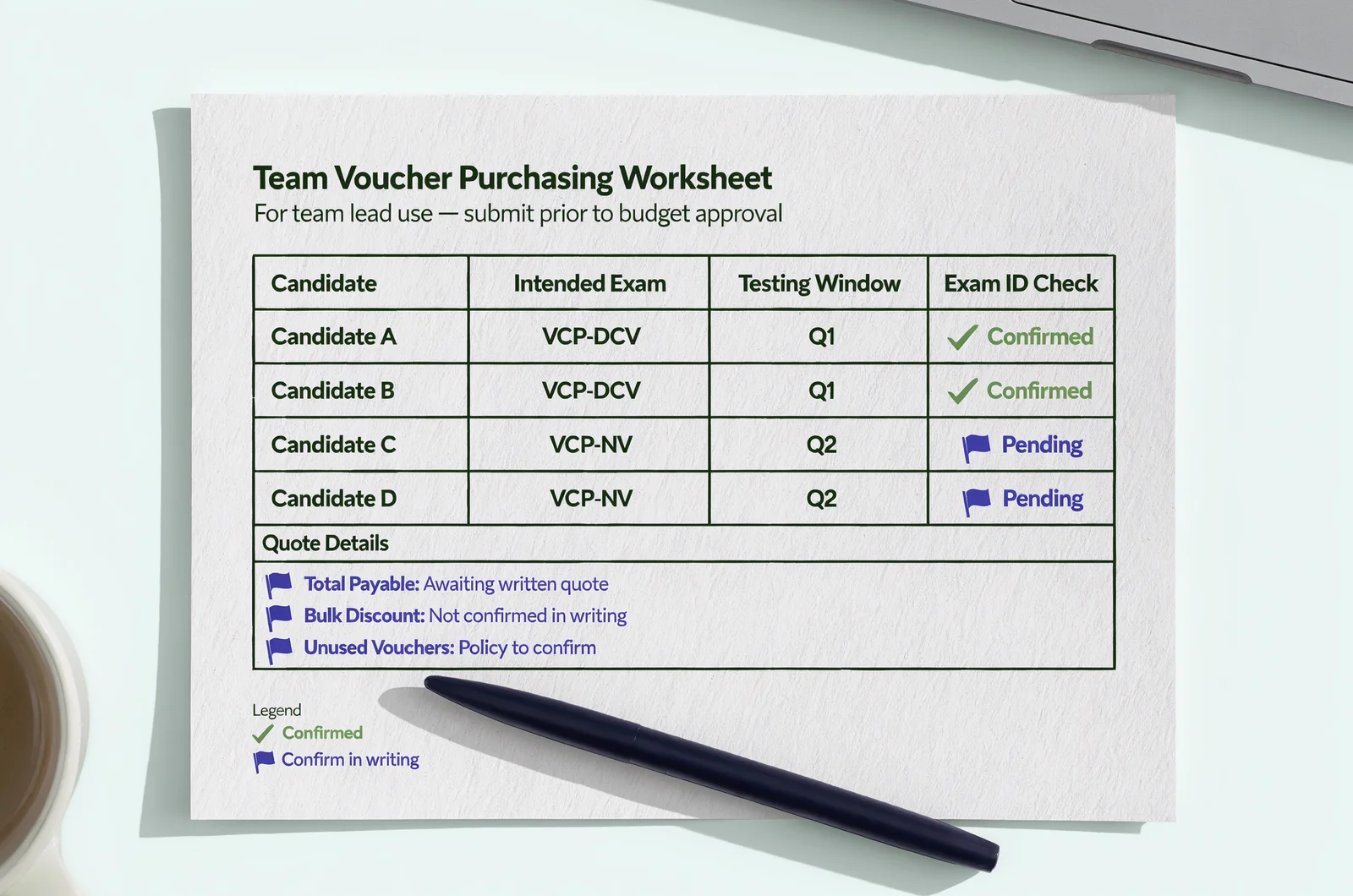
Do not include a bulk discount in the budget until the purchasing provider confirms it in writing. No discount percentage, qualifying quantity, or corporate purchasing entitlement is established here.
Build the request around actual candidates
Start with the people expected to use the vouchers and the exams they intend to take. Ask each candidate to confirm the exam identifier and a realistic testing window.
Use that information to request the appropriate quantity. Where a candidate has not selected an exam, leave that allocation unresolved rather than filling it with a broad certification label.
For a hypothetical team studying different credentials, ask whether one proposed voucher category covers every intended exam. Request separate clarification for any outlier.
Also identify the person responsible for distributing codes and maintaining order records. Decide how candidates should report receipt, booking, and use before the order is placed.
Request a complete written quote
Ask the provider to state the voucher category, quantity, unit amount, currency, and total payable amount. Request any applicable taxes or additional charges within the quote.
For a proposed discount, ask for its qualifying conditions and validity period. Confirm whether the quoted amount depends on quantity, customer status, payment timing, or another stated condition.
Seek written answers about payment methods, purchase-order handling, delivery timing, and support ownership. Treat all of these as unresolved until answered for your order.
If the same training budget includes SAP certification cost planning, maintain a separate purchasing record for that program. Approve each order against its own documented terms.
Decide how unused allocations will be handled
Before distributing vouchers, ask whether reassignment is permitted and whether any candidate or account restrictions apply. Do not promise an employee a transfer until the applicable conditions support it.
Document how the team will handle a delayed learner, a departure, or a changed certification goal. Assign an owner to request clarification when an allocation becomes uncertain.
For a simple interactive planning tool, consider a purchase-readiness checker that flags missing exam identifiers, unconfirmed expiration wording, and unassigned voucher owners.
Use its output as an administrative prompt. Attach the provider’s written answers to the purchase request before seeking final budget approval.
Keep preparation separate from purchasing assumptions
For a VMware candidate, I would maintain two short records: one for exam preparation and another for purchasing and booking. Use each to answer a different set of questions.
In the preparation record, identify what you intend to study and how you will assess your progress. In the purchasing record, retain the applicable terms, order details, and appointment status.
Base your study plan on the intended exam
Before changing your study schedule because of a purchasing headline, verify whether the underlying exam information has changed. Ask for the applicable exam objectives and any dated transition notice.
Do not infer revised objectives from a payment or portal announcement. Likewise, do not infer unchanged purchasing conditions from familiar study material.
If you’re using ExamJungle during preparation, use your practice sessions to identify topics you want to revisit. Keep administrative questions, such as voucher eligibility and expiration, in the purchasing record.
Before choosing an appointment, compare your remaining study tasks with your intended testing window. Make the timing decision deliberately rather than treating an unverified migration claim as a deadline.
Review other certification decisions independently
If you are weighing multiple credentials, record the goal behind each one. Then evaluate the corresponding exam, study commitment, and purchasing conditions separately.
A discussion of Cisco certification renewal tradeoffs can sit within your Cisco planning notes. Do not use it to establish a VMware renewal option or voucher rule.
For an employer-sponsored plan, ask whether the organization expects a specific credential, an exam attempt, or another documented outcome. Resolve that expectation before approving the purchase.
Keep any proposed alternative in the planning stage until its eligibility and purchasing requirements have been checked against the relevant program’s documentation.
Questions about VMware voucher purchases
For unresolved VMware purchasing questions, request answers tied to the intended exam or existing order. Avoid asking only whether the entire program has changed; name the transaction you need to complete.
Has Broadcom changed the buying process?
A change is not substantiated in this article. Request a dated official announcement and the purchasing instructions that apply to your situation.
Ask the provider to identify what changed, when it took effect, and which buyers or orders it covers. Until those details are documented, keep any proposed migration or new purchasing requirement unconfirmed.
Are bulk discounts available?
Availability and qualifying conditions remain unconfirmed here. Do not assume a discount or insert a percentage into a budget.
Request a quote for the intended exams and quantity. Ask the provider to state any reduction explicitly and identify the conditions attached to it. Approve the amount shown in the written quote rather than an expected reduction.
Should an older voucher be replaced?
Do not replace it solely because of an unverified change claim. Present the original order details and ask whether the voucher remains usable for your intended transaction.
If replacement is recommended, request written instructions for handling the original purchase. Confirm the proposed financial treatment before authorizing another payment.
Must an appointment be booked before the voucher expires?
Ask what the voucher’s expiration wording requires: redemption, booking, or completion of the exam. No universal deadline interpretation is established here.
Request clarification using the specific voucher terms and your intended appointment date. Keep the response with the order record and use it when selecting the appointment.
What should I do if redemption fails?
Record the error message and the step at which it appears. Check the intended exam against your purchasing documentation, then use the support route identified for the transaction.
Provide the order reference and relevant details through that channel. Before buying another voucher, ask whether the problem requires correction, replacement, or another documented action.
What a confirmed purchasing update should tell you
A useful VMware voucher update should leave you able to complete a specific transaction. Before treating a report as purchasing authority, look for a dated announcement, an effective date, an identified audience, and instructions applicable to your exam.
For an existing purchase, seek an explanation of how the transition affects that order. For a new purchase, seek the current buying route and the conditions presented before payment. Request separate clarification wherever the announcement leaves either situation unresolved.
I would also look for a named support route for exceptions. Ask how to resolve an unsuccessful redemption, an order awaiting delivery, or conflicting instructions. Save the answer with the transaction it addresses.
Until that evidence is available, avoid presenting a new portal, discount, deadline, or voucher restriction as established policy. Keep the purchase decision anchored to the written terms you can obtain for your intended exam.
Before paying, reconcile the exam identifier, provider instructions, quoted amount, and expiration wording in one record. Resolve any remaining contradiction with the purchasing provider.
Budgeting for other certification exams