
For a CPB vs CMRS medical billing certification decision, I’d start with the jobs you want, then compare the documented requirements for each credential. Choose CPB if your target employer specifically prefers it. Choose CMRS if that employer specifically prefers CMRS. When both are accepted, compare the exam scope, preparation commitment, and complete cost against your circumstances. I wouldn’t rank either credential above the other without that context. Below, we’ll work through the questions to answer before committing your study time or paying an exam fee.
What should decide your choice between CPB and CMRS?
Give the strongest weight to a credential requirement attached to a job you actually want. Then consider the work you want to perform and the preparation you can realistically complete.
Start by writing a specific career goal. Replace “get certified” with something concrete, such as qualifying for a billing position at a particular employer or meeting a requirement for an internal promotion.
For the CPB route, ExamJungle’s CPB practice test identifies the credential as Certified Professional Biller. Use the full credential name when checking a job description, training package, or reimbursement policy.
Apply the same care to CMRS. Request the full credential title and issuing organization’s requirements before comparing packages that use abbreviated labels.
I’d organize the decision around four questions:
- Does the employer explicitly accept or prefer this credential?
- Does its documented exam scope match the responsibilities I want?
- Can I meet its eligibility and testing requirements?
- Can I afford preparation, the exam, and any applicable continuing obligations?
If one route satisfies an explicit employer requirement and the other leaves acceptance uncertain, resolve that uncertainty first. Ask the hiring contact whether the alternative would satisfy the same requirement.
Keep the response with your comparison notes, including the employer, role, and date.
Does CPB or CMRS have better employer recognition?
I wouldn’t declare a national winner without a direct comparison of employer requirements. For your decision, prioritize evidence from the employers and positions you intend to pursue.
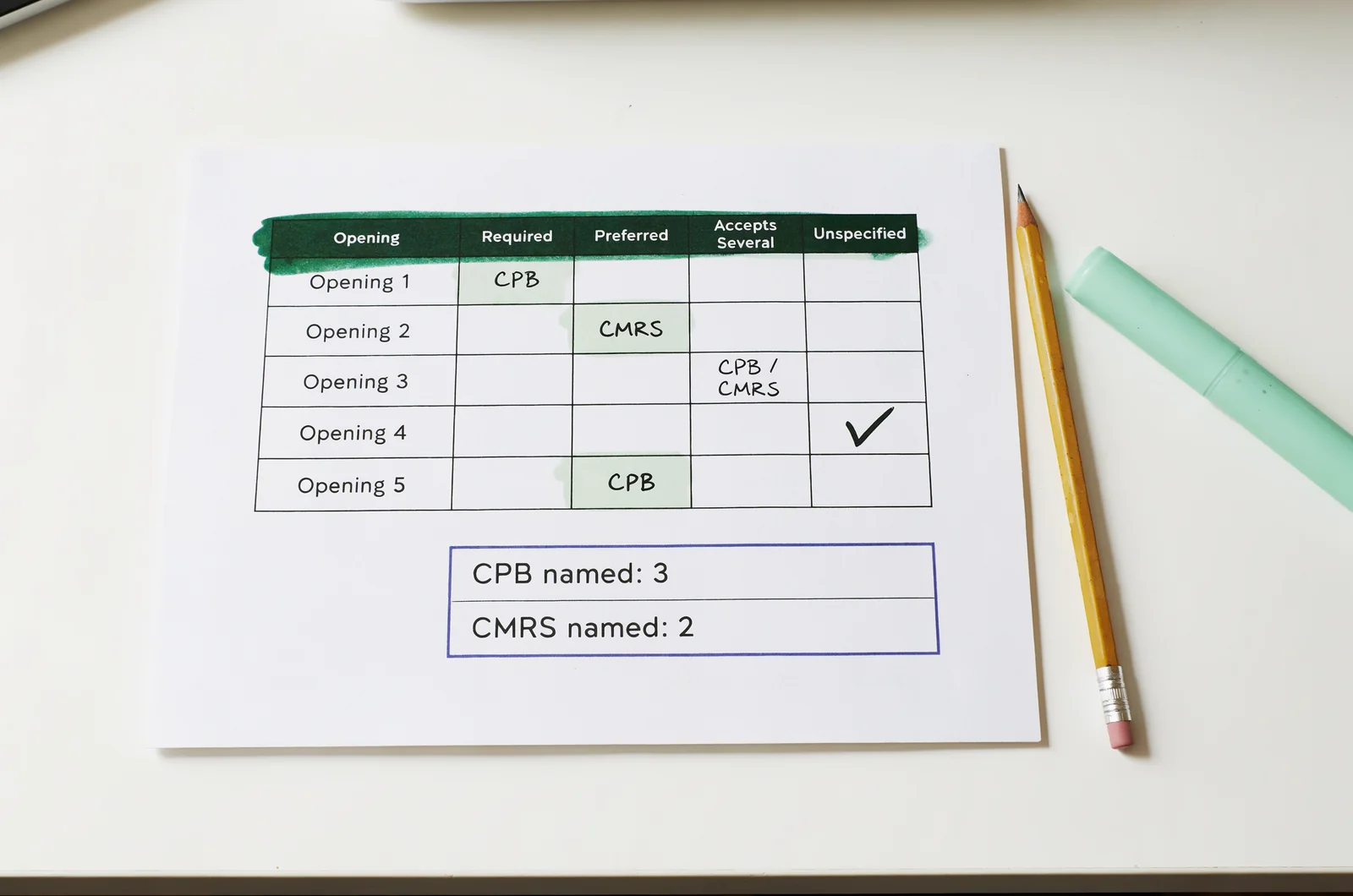
Build a small sample of relevant openings. Keep the location, seniority, and responsibilities reasonably consistent. Compare entry-level billing roles with other entry-level billing roles, for example, rather than mixing them with management positions.
For each opening, record whether it names CPB, names CMRS, accepts several credentials, or leaves certification unspecified. Keep “required” and “preferred” in separate columns.
Then examine the wording closely. If a listing asks for a named credential “or equivalent,” ask whether your alternative qualifies. If certification is absent from the description, ask about it before treating either option as an advantage.
A useful message is:
“Would CPB and CMRS both satisfy the certification expectation for this position, or does your team prefer one?”
Keep that question separate from asking whether you would be hired. Request clarification about the qualification itself.
For a sponsored certification, ask your manager which credential would satisfy the development plan and qualify for reimbursement. Get approval before choosing a training package.
Use your findings narrowly. Describe them as preferences within your target employers, rather than turning a handful of listings into a claim about the entire medical billing job market.
How should you compare the exam topics without guessing?
Compare the current exam outlines side by side. Match each published topic to the billing responsibilities you want to handle.
Request the outline directly from each credentialing organization. Record its publication date or version when available, and confirm that it applies to your intended exam.
Build a working document with the official topic name, your confidence level, and the preparation resource you plan to use. Keep the wording recognizable so you can trace your study plan back to the outline.
For a billing-focused comparison, consider asking whether each outline addresses subjects such as claim preparation, reimbursement, payment review, account follow-up, and billing compliance. Treat these as questions to verify against the documents.
Where a topic appears, examine the stated depth. Look for the difference between recognizing terminology, interpreting information, and choosing an action in a scenario.
Use a hypothetical example to test your own priorities. Suppose your target role emphasizes following up on unpaid claims. Ask what preparation you would need to explain an appropriate follow-up decision and the information required to support it.
Avoid assigning either exam a topic or emphasis based on its name alone. Copy the relevant outline wording into your comparison.
If an area remains unclear, send the credentialing organization a focused question that names the topic. Resolve the uncertainty before buying supplementary material specifically for that area.
Which testing format should influence your choice?
Use the confirmed testing rules to judge practical fit. I wouldn’t choose either credential because someone describes its exam as easier.
Ask each organization to confirm the question format, time allowance, delivery arrangements, permitted materials, and completion rules. Request clarification about any requirement that could affect your ability to sit the exam.
Keep the format comparison separate from the content comparison. Assess both what you must know and how you will need to demonstrate it.
For a timed exam, plan practice sessions around the published time limit once you have verified it. For permitted reference materials, practice locating information under the applicable rules. For an online delivery arrangement, review the stated equipment and environment requirements.
Ask about accommodations early if you intend to request them. Use the organization’s documented process to establish what approval and scheduling steps apply.
To compare difficulty for yourself, choose a sample of topics from each official outline. Try explaining the concepts and working through relevant practice material. Record where you need instruction, more practice, or faster reference use.
Treat that exercise as a personal preparation assessment. Keep it separate from claims about which exam has a higher pass rate.
Before selecting a date, write down the testing conditions you expect to reproduce during your final practice sessions.
How should you compare the full cost of CPB and CMRS?
Build a complete budget for each route before comparing the totals. Include only charges you have confirmed, and mark unanswered items as pending.
Ask for an itemized breakdown of what you are considering buying. Keep the examination itself separate from optional training and supplementary preparation.
Check each applicable category:
- Initial examination registration.
- Membership or application charges.
- Required books or other materials.
- Optional courses and practice resources.
- Retake charges and eligibility conditions.
- Continuing education and renewal obligations.
For a package, ask which items are included and which require separate payment. Confirm any expiration dates, access limits, or conditions attached to an additional attempt.
I’d calculate two totals: the amount needed to complete the initial plan and the amount needed if another attempt becomes necessary. Add your own preparation purchases to both.
Keep study time in a separate estimate. List the weekly hours you can protect and the topics that need the most work. Avoid assigning an hourly dollar value unless that helps your personal budgeting.
A useful comparison calculator would accept confirmed fees, optional preparation costs, and an attempt allowance, then display an initial budget and a repeat-attempt budget.
Save dated copies of the prices and terms used in your calculation. Reconfirm the payable amount and included items at checkout before authorizing payment.
Which route makes sense if you’re new to medical billing?
Choose the route that matches your target role and gives you a preparation plan you can explain. I’d avoid choosing solely around a promised completion date.
Begin with the official outline and identify unfamiliar terminology. Separate subjects you need to learn from subjects you recognize but cannot yet apply.
If you’re moving from IT or another field, use your existing habits to organize the work. Build a terminology list, map unfamiliar processes, and keep a record of unresolved questions. Assess your billing knowledge directly rather than assuming your previous experience covers it.
Before purchasing a course, ask how its lessons map to the selected exam. Request a sample explanation or lesson if available. Examine whether you can follow the reasoning and identify what you would need to study afterward.
Consider this hypothetical choice: both credentials satisfy your target employer, but you understand one route’s requirements much more clearly. Investigate the other route enough to make a fair comparison before committing.
You don’t need to settle every future career decision now. Choose an initial objective and define what successful preparation would look like.
Write your study commitment as a weekly schedule, including time for learning, answering questions, and reviewing errors. Use the hours you can consistently protect when selecting a possible exam window.
Should an experienced biller choose differently?
Start with the requirement behind the certification request. For an experienced candidate, I’d make that requirement explicit before building a study plan.
If your employer is sponsoring the exam, ask which credential satisfies the intended purpose. Clarify whether the goal is meeting a role requirement, supporting a promotion application, or documenting a particular area of knowledge.
Then compare your experience with the official outline. For each topic, record a concrete example you can explain. Identify the information you used, the action you chose, and the reason for that action.
Mark topics you can explain confidently, topics that need review, and topics you haven’t encountered. Use that assessment to allocate study time.
Check answers against the published exam scope and relevant preparation materials. Keep a question list for situations where your workplace process and the material seem to differ.
I wouldn’t use confidence alone to decide whether preparation is complete. Require yourself to work through unfamiliar scenarios and explain the answer choices.
For career advancement, ask your manager what additional evidence will be considered alongside certification. Keep those expectations separate from your exam preparation goals.
Before registering, confirm that the chosen credential matches the written requirement attached to your sponsorship or development plan.
Are you choosing a billing credential or a coding path?
Clarify the intended work before comparing credential names. If the position description emphasizes coding responsibilities, investigate that path before committing to a billing certification.
Use the CPC credential overview to frame questions about the Certified Professional Coder route. Then compare the credential named in each target job description.
Ask the employer to describe the work behind broad titles. Request examples of the tasks you would perform and which qualifications apply to them.
For a position combining several responsibilities, ask whether one credential would satisfy the current opening. Establish whether another qualification is expected later or simply encouraged.
Keep training-provider recommendations separate from employer requirements. Ask what a proposed bundle adds to your immediate goal before paying for multiple preparation tracks.
I’d pursue a second credential only after identifying its purpose, cost, and place in the schedule. Put those details alongside the first credential’s preparation plan.
If your immediate goal remains medical billing, return to the CPB and CMRS requirements. Record the job responsibilities you want each option to support, then check those expectations against its published scope.
How should you study after choosing CPB or CMRS?
Build your study plan from the selected exam’s official outline. Give each study activity a clear purpose: learning a topic, applying it, or checking readiness.
How can you turn the outline into weekly work?
Divide the outline into manageable study blocks. For each block, assign a learning resource, a practice activity, and a review date. Give unfamiliar areas more room in the schedule.
Write a short explanation after studying a concept. Then attempt relevant questions without consulting that explanation. Compare your reasoning with the answer explanation and return to the underlying material when needed.
Keep an error log with the topic, your chosen answer, and the reason you need to revisit it. Include correct answers reached by guessing.
If you use ExamJungle for CPB practice, pair each session with that log. Select the next session’s focus from the topics you still cannot explain clearly.
When reference books are permitted, check the applicable rules before adding notes or tabs. Use the discussion of AAPC code-book notes to prepare questions, then confirm the rules for your specific exam and materials.
What should you do with a question you missed?
Reconstruct your decision before reading the explanation again. Write what you thought the question was asking and which detail influenced your choice.
Then compare that reasoning with the explanation. Identify whether you need to review terminology, understand a process, interpret the scenario more carefully, or practice using an approved reference.
Create a brief follow-up task. For example, explain the concept without answer choices or work through a different scenario on the same topic.
Use fictional scenarios for your own exercises. Label them as practice examples and keep them aligned with the outline.
At the end of the week, revisit a selection of unresolved questions. Require a written reason for the answer you choose. Carry any remaining uncertainty into the following week’s plan.
What should you confirm before paying for the exam?
Confirm your eligibility, the complete payable amount, and the testing conditions before purchasing an attempt. Use the credentialing organization’s written requirements to resolve outstanding questions.
Check the credential and exam names carefully. Match your registration to the option you evaluated rather than relying on a course title or an abbreviated description.
Review the scheduling and completion rules that apply to your purchase. Ask about any deadline you don’t understand. Confirm what happens if you need to move the appointment or cannot complete the planned attempt.
Verify the identification requirements, permitted materials, and delivery arrangements. For an online exam, review the stated technical requirements and any required checks.
If your employer will reimburse the expense, establish which receipts and approvals are needed. Confirm whether the reimbursement applies to the exam, preparation, or both.
Keep a separate record of any ongoing obligations you have verified. Note the applicable deadlines and where you will confirm future requirements.
I’d book only after completing these administrative checks and reviewing my study progress. Choose a date that leaves room for the topics still marked unresolved.
Save the registration confirmation, applicable terms, and any written clarification you relied on. Put the appointment and preparation milestones on the same calendar.
How can you settle the decision when both credentials still fit?
Choose the option with the clearest documented connection to your immediate goal. If both remain suitable, use preparation fit and the confirmed budget to settle the choice.
Write one sentence for each route:
“I would choose CPB because it meets this employer requirement, matches these study priorities, and fits this budget.”
“I would choose CMRS because it meets this employer requirement, matches these study priorities, and fits this budget.”
Fill in the details using your notes. Leave a blank wherever you still need confirmation. Resolve any blank that could change the choice.
Avoid adding points for assumed salary differences or unverified claims about national recognition. Ask what evidence would make those factors useful to your decision.
If the two routes remain evenly matched, choose a realistic preparation schedule for each. Compare the resources you understand, the requirements you have confirmed, and the time you can commit.
Record your choice and the reasons behind it. Add a review trigger, such as a changed employer requirement, rather than reopening the comparison after every new opinion you encounter.
Once you commit, organize the official outline, verified requirements, budget, and study calendar in one place. Begin with the first topic you identified as needing instruction.
Which AAPC preparation topics deserve a closer look?