

Choosing between the NCMA National Certified Medical Assistant credential and CMA (AAMA)? I’d start with the jobs you want, then work backward through eligibility, preparation, and cost. Put the credential named by your target employer at the front of the comparison. If that employer accepts both, give more weight to the route you can document and complete within your budget.
I wouldn’t name a nationwide winner without current evidence about employer acceptance. Likewise, specific eligibility thresholds, exam details, fees, and renewal requirements need confirmation in each organization’s current documents. The practical comparison below helps you make that choice without relying on an unsupported ranking.
Use four questions throughout: Will this credential meet my hiring goal? Can I qualify? What will the complete route require? How will I prepare for the specific exam?
Let your target jobs determine which credential gets priority
For your NCMA versus CMA decision, I’d treat written requirements from prospective employers as the first filter. Choose a manageable set of jobs you would realistically pursue, including the location, schedule, and setting you want.
Read each posting separately. Copy its exact certification wording into a personal comparison document, and keep the posting date beside it.
When an employer names one credential
If a posting specifically names CMA (AAMA), prioritize confirming whether that is a firm requirement. Ask whether NCMA would also satisfy the employer’s screening criteria.
Reverse the question when a posting names NCMA. Avoid assuming that an abbreviation, a general phrase, or a recruiter’s informal description settles acceptance.
A useful question is: “For this position, would you accept either NCMA or CMA (AAMA), provided the applicant meets your other requirements?”
Request a written answer when possible. Keep it with the posting so you can distinguish the employer’s stated policy from your interpretation.
Before committing, also check the other requirements you care about. Review the requested experience, schedule, education, and responsibilities. Keep the certification choice connected to a role you would actually accept.
When an employer accepts either option
If an employer confirms that both credentials meet its requirement, I’d treat acceptance as a tie for that position. Move to eligibility, total expense, and preparation demands.
For example, imagine that your preferred clinic explicitly accepts either credential. Give priority to the route for which you can produce the required documentation and sustain the associated costs.
Avoid turning that single employer’s answer into a claim about an entire city, specialty, or hospital network. Record the answer at the level it supports: that position or that employer.
When you have several hiring targets
Compare your findings across the positions you selected. Separate “required,” “preferred,” “accepted after clarification,” and “still unclear.”
Use those categories to judge your own shortlist. If one credential meets more of your chosen employers’ confirmed requirements, I’d give it the advantage for your search.
For every unclear posting, add one concrete follow-up question before counting it toward either credential.
Compare eligibility against the background you can document
For NCMA and CMA (AAMA), verify eligibility before buying exam-specific materials or choosing an exam date. I’d make this a documentation exercise rather than a guess based on your job title or school description.
Gather your education records, completion dates, training details, and employment history. Then compare those records with the current application requirements for each option.
NCMA: clarify the route that applies to you
For the NCCT option, ask which current eligibility route matches your circumstances. If you are approaching graduation, request the requirements that apply to your program and expected completion date.
If you want your work experience considered, ask whether an applicable route exists and what evidence it requires. Request details about duties, dates, hours, verification, and supporting documents where relevant.
Use a precise description of your background. “I have healthcare experience” leaves too much open to interpretation. Instead, describe the position, employment dates, responsibilities, and records you can supply.
Ask these questions before treating the route as available:
- Which eligibility category should I use?
- Does my specific education or experience satisfy that category?
- What must I submit, and who must verify it?
- Which deadlines or timing conditions apply to my application?
Keep any response with the dated requirements you used.
CMA (AAMA): verify your education and application category
For the AAMA option, request the current eligibility requirements and identify the category that applies to your background.
Ask about your particular program, its relevant status, your completion date, and any additional documentation. If you are considering an alternative route, seek a direct answer about whether it applies to you.
Before enrolling in training primarily to pursue this credential, request confirmation that the proposed program would support your intended application. Keep the answer specific to the program and your anticipated timeline.
If you have an older qualification, overseas training, or an unusual employment history, describe that situation directly. Ask for a determination or the process for obtaining one.
For either credential, I’d mark eligibility as “confirmed” only after matching your records to the applicable requirements. Use “needs clarification” while a material question remains unanswered.
If both routes remain possible, carry both forward. If only one is confirmed, concentrate your detailed budgeting on that option while resolving the other.
Compare the exams before choosing your preparation plan
For NCMA versus CMA (AAMA), compare preparation against the current exam documents for each credential. I’d resist choosing based on an unsourced claim that one test is easier.
Build a separate preparation outline for each option still under consideration. Keep the exam name, document date, and relevant instructions together.
Check content, timing, and testing arrangements
Request the current content outline and candidate instructions for each exam. Look for the information needed to plan a realistic attempt:
- Content areas and any published weighting.
- Question format and any published item counts.
- Testing time and break instructions.
- Scheduling, identification, and testing-location requirements.
- Result reporting and retake instructions.
Record the details exactly as published. Keep any unresolved item as a question rather than filling it with a number from memory.
Next, compare the content with your own study needs. Mark topics you can explain, topics you need to review, and topics that require substantial preparation.
Use that review to estimate your study commitment. If you feel confident about a subject, test that confidence with relevant questions and an explanation in your own words.
Ask your training program or instructor to help interpret an unfamiliar outline term. Keep the final preparation plan tied to the credential you intend to pursue.
Use practice to investigate readiness
After selecting a likely route, use timed practice as a structured rehearsal. Match the session to the exam instructions you have confirmed.
Review both incorrect answers and uncertain correct answers. For each, write down the missing concept, the reasoning you should have used, and a specific review task.
When comparing practice resources, check the stated exam alignment and inspect the explanations. Ask whether you can understand why the selected answer fits the question.
If you choose the AAMA route, ExamJungle’s CMA practice test questions are a separate preparation resource to consider alongside your official exam documents.
Keep your credential decision and your practice-resource decision separate. Choose the qualification against your hiring goal, then assess preparation materials against that qualification’s current outline.
Budget for the application, a possible retake, and ongoing requirements
For the NCMA and CMA comparison, I’d build a complete budget for each eligible route. Use current written prices and policies, and put a date beside every amount.
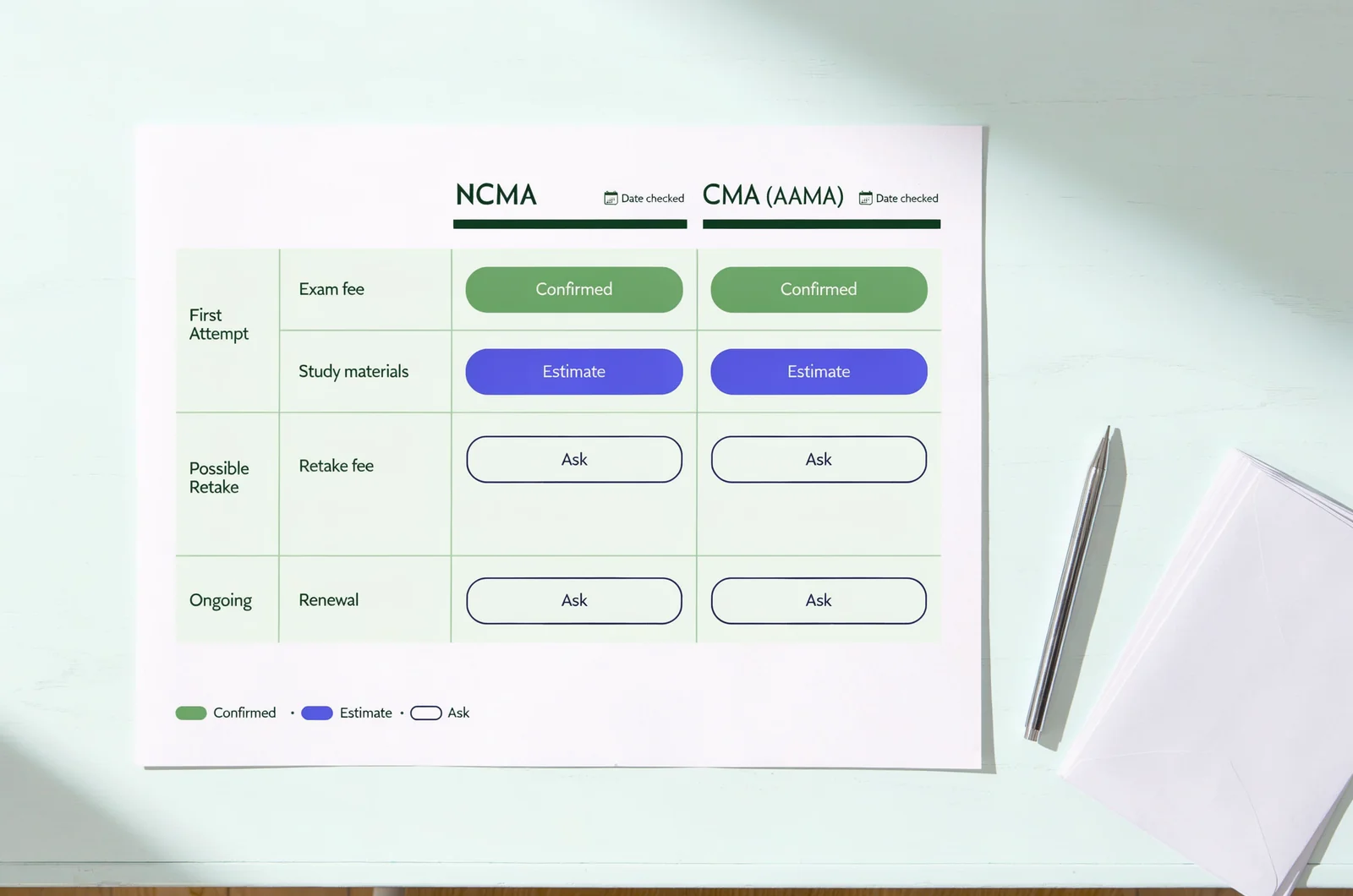
Keep confirmed charges separate from estimated personal expenses. Include only items that apply to your circumstances.
Calculate the first-attempt expense
Start with the application and examination charges listed for your category. Ask whether the quoted amount includes everything needed to schedule and sit the exam.
Then consider your own preparation and attendance expenses. Depending on your plan, investigate books, practice materials, travel, childcare, and time away from paid work.
If membership or another status affects a quoted fee, calculate the full amount associated with that choice. Include any payment required to obtain the quoted rate.
Write down refund and rescheduling terms before paying. Ask what happens if eligibility is not approved or your intended testing date changes.
Use the same budget categories for both credentials. Compare the totals only after you have checked whether any unresolved charge remains.
Add a realistic second-attempt scenario
For each option, request the current retake rules and associated charges. Ask about any waiting period, attempt restrictions, or additional application steps.
Build a separate contingency budget rather than assuming you will need another attempt. Include any applicable exam charge and your likely personal expenses.
Also decide how you would use additional preparation time. Set aside a review period focused on the topics and reasoning that need attention.
Keep the contingency amount visible when deciding how much you can comfortably spend upfront. Choose a payment schedule that leaves room for your ordinary expenses.
Include renewal and status requirements
Ask each certifying organization what you would need to do after earning its credential. Verify any renewal cycle, continuing education requirement, fees, documentation, and status rules that apply.
If continuing education is required, investigate which activities count and how completion must be recorded. Check whether your employer would cover any related expense.
Ask about late renewal and reinstatement terms as well. Keep those details in your comparison without assuming you will need them.
A small personal calculator could help here: enter confirmed application costs, preparation spending, a retake allowance, and any ongoing charges. Show a separate total for each route over the same chosen period.
Keep unknown amounts visibly blank until you obtain them. Recalculate before making a payment.
Apply the comparison to your own candidate situation
For NCMA versus CMA (AAMA), I’d use a conditional recommendation that matches your circumstances. The following situations are hypothetical; use them to test your reasoning against your own records.
You are approaching graduation
Imagine that you are finishing training and both credentials interest you. Begin by asking your program which current eligibility requirements your education supports.
Then verify that guidance with the relevant certifying organization. Compare application timing with your expected completion date and intended job search.
If both options remain available, use your target employers’ written requirements to set priority. Budget and preparation can break the tie.
Choose a study start date after you have identified the intended credential and obtained its current exam outline. Keep any pending education documents on a dated follow-up list.
You want employment experience considered
Suppose you have relevant work experience and want to know whether it supports certification eligibility. Ask each organization whether a current route applies to your exact background.
Describe your duties and employment dates. Request the required verification process before asking an employer to prepare documents.
If one route is confirmed and the other remains uncertain, I’d prioritize the confirmed route only if it also satisfies your hiring goal.
Give any unresolved application question a follow-up date. Avoid purchasing a complete preparation package while the eligibility decision remains material to your choice.
You already hold one of the credentials
Imagine that you already hold NCMA or CMA (AAMA) and are considering the other. Start by identifying the specific outcome you expect.
Ask whether a target employer requires the additional credential, whether it changes eligibility for a named position, or whether another qualification would better support your intended work.
Price the additional application and any ongoing obligations. Compare that spending with your other career priorities.
I’d pursue the second credential when you can state the intended benefit and identify the evidence supporting it. Write that reason beside the employer requirement or other decision document.
Questions to resolve before you commit to either exam
For your final NCMA versus CMA check, use direct questions that can produce a clear decision. Keep unresolved details visible until the appropriate organization or employer answers them.
Which credential will help me get hired?
I’d choose against the actual requirements of the positions you want. Ask each employer whether it accepts NCMA, CMA (AAMA), or both.
If your shortlist produces mixed answers, prioritize the employers and roles that matter most to you. Record your reasoning rather than declaring a universal winner.
If every answer remains unclear, continue the employer checks before paying for an exam primarily to improve access to those jobs.
Can work experience replace a particular education requirement?
Ask the certifying organization about your specific application category. Describe the education you have, the experience you want considered, and the records available.
Request confirmation of any applicable route and its documentation requirements. Keep that answer separate for NCMA and CMA (AAMA).
Use the confirmed requirements when deciding whether further training belongs in your budget.
Which exam should I consider easier?
I wouldn’t choose on that label. Compare each published outline with your preparation, then investigate your weaker areas through appropriate practice.
Ask how much review time you can realistically commit and which subjects need guided instruction. Keep your employer and eligibility priorities in place while making that assessment.
Choose a preparation schedule you can sustain through the intended test date.
Should I pay for both credentials immediately?
I’d require a clear purpose for each application. Identify the hiring requirement or career objective that each credential would serve.
Confirm eligibility, calculate both sets of expenses, and check any ongoing obligations before committing to two routes.
If one credential already meets your documented goal, decide what additional outcome would justify the second payment.
Make a written choice before moving into exam preparation
For NCMA or CMA (AAMA), I’d finish with a short decision statement supported by the documents you collected. Keep it practical enough to review before paying.
Write: “I am choosing this credential because it meets these employers’ requirements, I qualify through this confirmed route, and the complete expense fits this budget.”
Then name any remaining conditions. Perhaps you still need a transcript, employer clarification, or a current fee confirmation. Assign each item a person to contact and a follow-up date.
If both credentials meet your hiring goal and eligibility is confirmed for both, choose using the preparation commitment and ongoing requirements you are prepared to manage. Keep your reasons specific.
Once you commit, set a study schedule around the chosen exam’s current outline. Reserve time for content review, timed practice, and careful answer explanations. Review uncertain answers alongside incorrect ones.
Before scheduling the official attempt, check your documents, budget, and testing instructions again. Finish with one credential choice, a dated preparation plan, and a clear list of remaining application tasks.
Explore billing, coding, and healthcare quality credentials