
CBRN Sample Questions & Answers
Free Certified Burn Registered Nurse (CBRN) practice questions with worked answers and explanations. See how the ExamJungle simulator prepares you — then jump into the full test.
Launch the full CBRN simulator →Showing 6 of 12 free samples.
- Question 1Advanced
Clinical Practice: Initial Management (<72 hours) · ABA transfer criteria
A 48-year-old chemical manufacturing operator is transported to a community emergency department following an industrial pipeline rupture. The patient sustained splash injuries with an alkaline cleaning solvent across the face, anterior neck, bilateral hands, and anterior chest.
Physical assessment reveals white, indurated, insensate plaques across the dorsal hands and fingers, with erythematous blistering across the facial cheeks and perioral region, encompassing approximately 12% TBSA. Copious water decontamination was initiated on-site and continued in the trauma bay for 30 minutes. The emergency physician contemplates admitting the patient to the local intensive care unit for daily topical wound care.
Based on American Burn Association (ABA) transfer criteria, which recommendation and clinical rationale must the burn liaison nurse communicate?
flowchart TD A[Industrial Chemical Burn Patient] --> B{Check ABA Criteria} B -->|Chemical burn + Critical zones| C[Immediate Consultation & Transfer] B -->|Minor non-critical burn| D[Local Outpatient Management]Show answer & explanation
Correct answer: B
ABA guidelines mandate immediate consultation and transfer for all chemical burns and burns involving high-risk functional zones (hands, face, genitalia, major joints), regardless of total burn size.
- Question 2Beginner
Clinical Practice: Initial Management (<72 hours) · ABA transfer criteria
According to American Burn Association (ABA) transfer criteria, which electrical injury scenario requires immediate burn center consultation with consideration for emergent transfer?
Show answer & explanation
Correct answer: D
The ABA designates all high-voltage electrical injuries (1,000 V or greater) and lightning injuries as criteria for immediate consultation with consideration for transfer. Low-voltage injuries (<1,000 V) warrant outpatient consultation.
- Question 3Intermediate
Clinical Practice: Initial Management (<72 hours) · Fluid resuscitation and titration
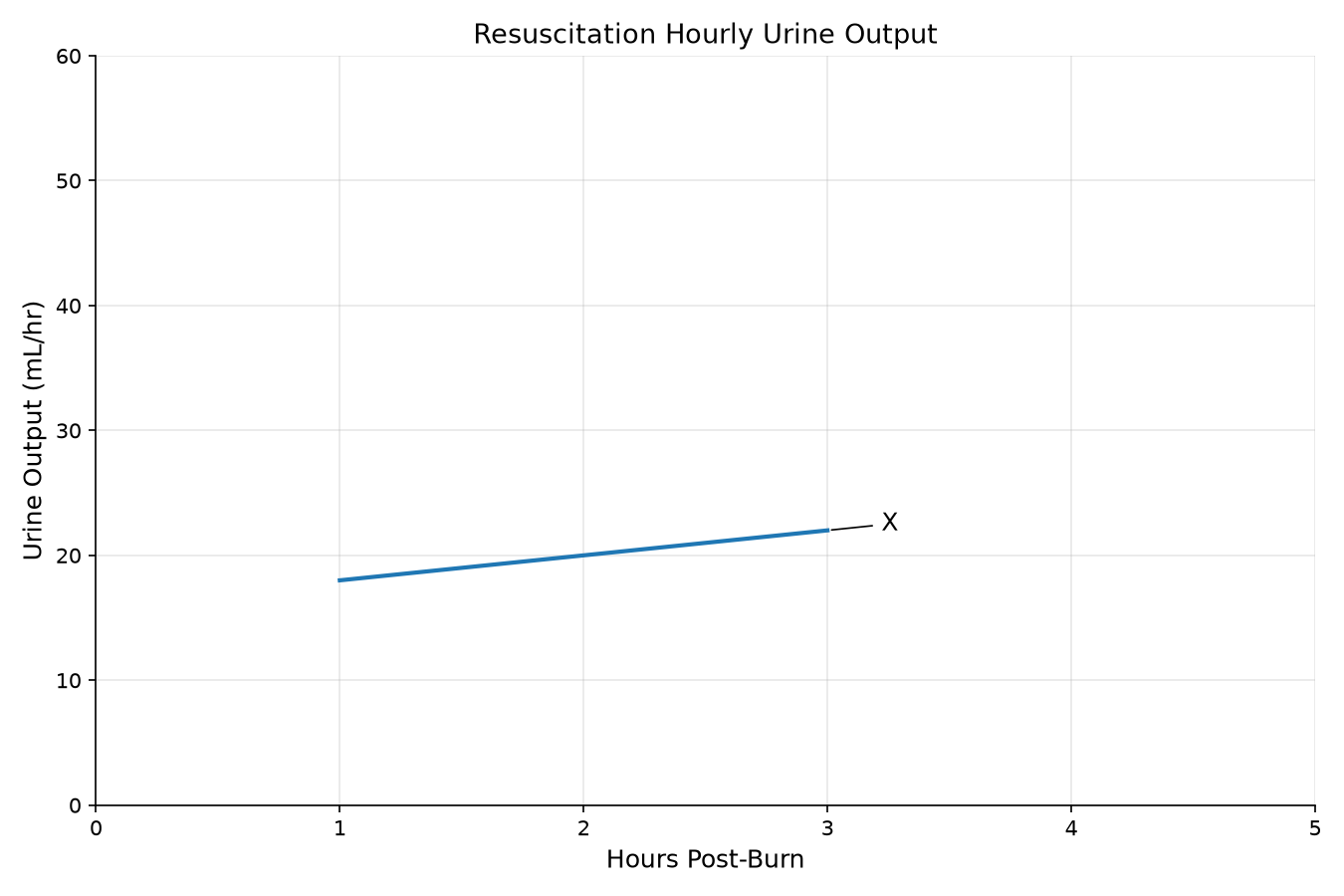
A 70-kg adult with 40% TBSA deep partial- and full-thickness burns is undergoing fluid resuscitation initiated at 2 mL/kg/%TBSA of Lactated Ringer's. Referring to the hourly urine output trend in the chart, which titration adjustment is indicated at hour 3?
Show answer & explanation
Correct answer: C
Adult target urine output is 0.5 mL/kg/hr (35 mL/hr for 70 kg). Because output at point X is 22 mL/hr, resuscitation fluid must be titrated up by 10% to 20% hourly until target is met.
- Question 4Intermediate
Clinical Practice: Initial Management (<72 hours) · Fluid resuscitation and titration
During hour 7 of burn shock resuscitation for an 80-kg patient with 50% TBSA burns, the nurse notes that the hourly urine output has remained between 95 and 105 mL/hr for two consecutive hours. The patient is hemodynamically stable with a heart rate of 84 bpm and MAP of 82 mm Hg. Which titration action should the nurse take next?
Show answer & explanation
Correct answer: B
The target adult urine output is 0.5 mL/kg/hr (40 mL/hr for 80 kg). Output near 100 mL/hr indicates over-resuscitation; fluids must be decreased by 10% to 20% hourly to prevent fluid creep.
- Question 5Intermediate
Clinical Practice: Acute Care · Sepsis
A patient with 45% TBSA burns on post-burn day 8 exhibits a sudden temperature elevation to 39.4°C, heart rate of 128 bpm, respiratory rate of 28 breaths/min, thrombocytopenia with platelets dropping from 180,000/μL to 72,000/μL, and new enteral feeding intolerance with high gastric residuals. Which clinical condition should the nurse suspect?
flowchart TD A[Post-Burn Patient Day 8] --> B{Sepsis vs Hypermetabolism} B -->|Thrombocytopenia + Feeding Intolerance + Sudden Fever| C[Burn Sepsis] B -->|Chronic Tachycardia + Baseline Warmth| D[Expected Hypermetabolic State]Show answer & explanation
Correct answer: C
While baseline hypermetabolism causes mild tachycardia and fever, acute thrombocytopenia, enteral feeding intolerance, and sudden physiological deterioration point to systemic sepsis.
- Question 6IntermediateSelect 2
Clinical Practice: Acute Care · Enteral nutrition
Which TWO nutritional interventions represent evidence-based standards for mitigating severe hypermetabolism and preserving lean body mass in critically ill patients with extensive burns? (Select TWO)
Show answer & explanation
Correct answers: A, C
High protein delivery (1.5 to 2.0 g/kg/day) provides essential amino acids to offset negative nitrogen balance and support collagen synthesis and graft take.
Early enteral nutrition (within 12 hours) preserves gut mucosal integrity, reduces bacterial translocation, and blunts the systemic hypermetabolic stress response.
Ready for the real thing?
The full CBRN simulator has every exam-style question, timed mode, and instant scoring.