
CFRN Sample Questions & Answers
Free Certified Flight Registered Nurse (CFRN) practice questions with worked answers and explanations. See how the ExamJungle simulator prepares you — then jump into the full test.
Launch the full CFRN simulator →Showing 6 of 12 free samples.
- Question 1Intermediate
General Principles of Flight Transport Nursing Practice · Landing Zone Operations
During a night rotorcraft emergency scene response to a multi-vehicle highway collision, the flight team establishes two-way radio communications with the incident commander on the ground. Which operational procedure is required by CAMTS and FAA standards before the helicopter makes final approach and touchdown at an off-airport landing zone?
Show answer & explanation
Correct answer: C
CAMTS and FAA standards mandate high and low reconnaissance before landing at an unapproved scene LZ to verify wind direction, approach/departure corridors, terrain slope, wires, and obstacles.
- Question 2Beginner
General Principles of Flight Transport Nursing Practice · EMTALA
True or False: Under federal EMTALA regulations, a tertiary specialized receiving hospital with available specialized pediatric intensive care capability and capacity is legally obligated to accept the interfacility transfer of an unstable pediatric trauma patient from a referring rural emergency department that lacks critical care capabilities.
Show answer & explanation
Correct answer: B
Under EMTALA's nondiscrimination provision, a Medicare-participating hospital with specialized capabilities and capacity cannot refuse an appropriate transfer of an unstable individual from a facility lacking capability.
- Question 3IntermediateSelect 2
General Principles of Flight Transport Nursing Practice · Landing Zone Operations
During an emergency scene landing zone operation, which TWO safety practices are mandatory for ground responders and transport crew members operating around an active rotorcraft? (Select TWO)
Show answer & explanation
Correct answers: B, C
CAMTS and FAA guidelines instruct personnel to stay strictly clear of the tail rotor and aircraft battery compartments to prevent fatal strikes, thermal runaway, and electrical fires.
Approaching within the pilot's forward field of view after explicit eye contact and signal prevents accidental entry into the hazardous tail rotor and low main rotor arc areas.
- Question 4Beginner
Resuscitation Principles · Post-intubation management, including pharmacology
The flight team is providing ongoing mechanical resuscitation to an intubated 58-year-old male in cardiac arrest during a critical care interfacility flight. According to current AHA resuscitation guidelines, once an advanced airway is in place, at what rate and interval should manual or mechanical ventilations be delivered during continuous uninterrupted chest compressions?
Show answer & explanation
Correct answer: C
AHA adult advanced life support guidelines recommend delivering 10 breaths/min (one breath every 6 seconds) once an advanced airway is placed, without pausing chest compressions.
- Question 5Intermediate
Resuscitation Principles · Pharmacologic assisted intubation
A 3-year-old child with severe croup and worsening respiratory failure requires emergent rapid sequence intubation (RSI) by the flight team. Which statement reflects evidence-based best practice regarding airway adjuncts and pharmacologic pretreatment during pediatric emergent intubation?
Show answer & explanation
Correct answer: B
Pediatric resuscitation guidelines advise against routine cricoid pressure because it fails to consistently prevent aspiration and can deform the airway caliber, impairing glottic visualization.
- Question 6Intermediate
Resuscitation Principles · Post-intubation management, including pharmacology
During critical care air medical transport of a paralyzed, mechanically ventilated adult patient with ARDS, the flight nurse observes the capnography monitor trace shown in the figure. The continuous waveform capnography suddenly drops from an EtCO2 of 38 mmHg directly to 0 mmHg. In this clinical setting, this sudden change indicates _____ until ruled out by direct assessment.
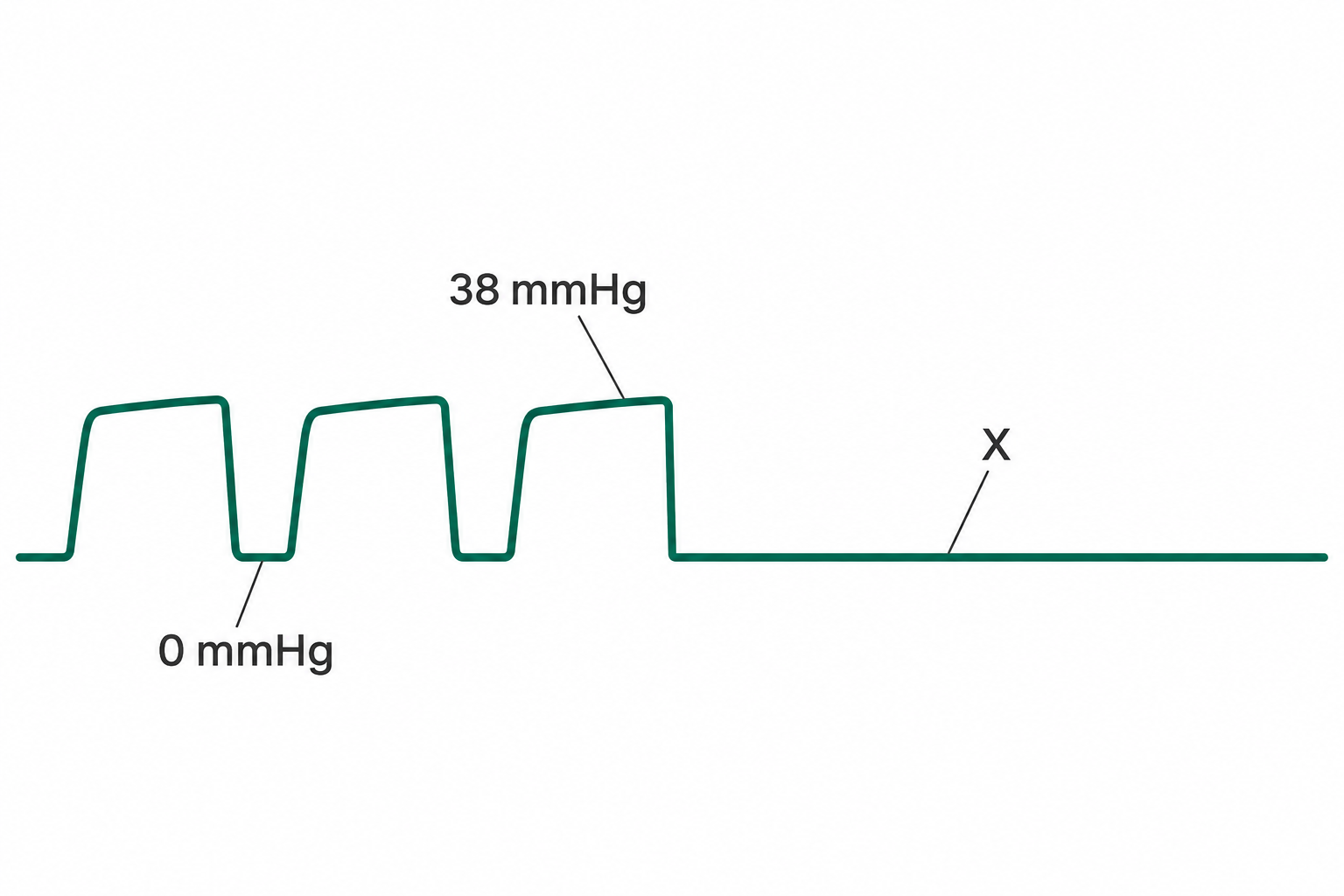
Show answer & explanation
Correct answer: C
A catastrophic and instantaneous drop of the EtCO2 waveform to zero indicates loss of ventilation through the sensor, caused by circuit disconnect, accidental extubation, or total airway obstruction.
Ready for the real thing?
The full CFRN simulator has every exam-style question, timed mode, and instant scoring.