
TCRN Sample Questions & Answers
Free Trauma Certified Registered Nurse (TCRN) practice questions with worked answers and explanations. See how the ExamJungle simulator prepares you — then jump into the full test.
Launch the full TCRN simulator →Showing 6 of 12 free samples.
- Question 1Intermediate
Clinical Practice: Head and Neck · 1.A.2 Spinal cord injuries
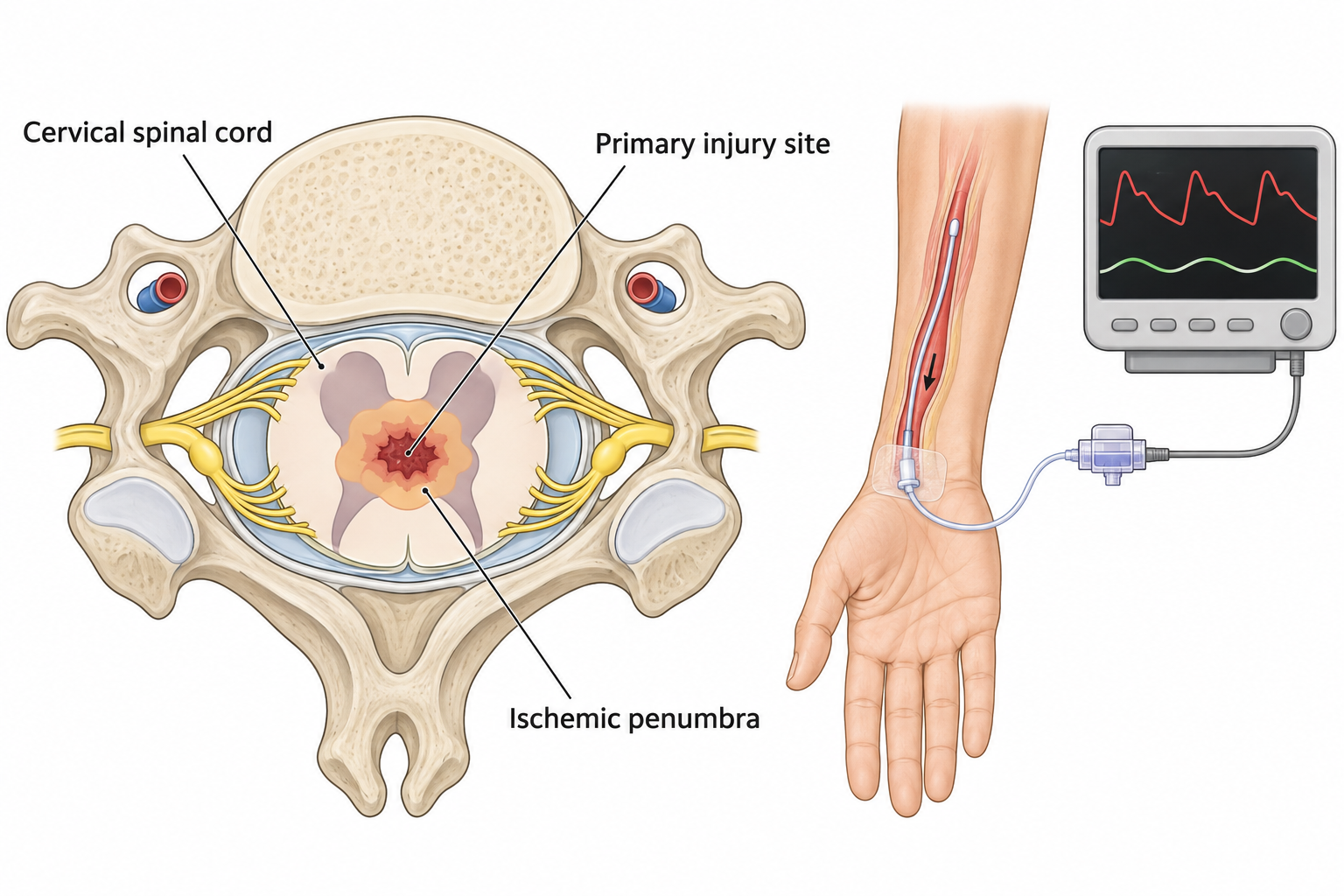
Following acute traumatic cervical spinal cord injury, clinical practice guidelines recommend maintaining a mean arterial pressure (MAP) target of _____ for 7 days to prevent secondary ischemic injury to the spinal cord.
Show answer & explanation
Correct answer: D
ACS TQP guidelines recommend maintaining MAP between 85 and 90 mm Hg for 7 days after acute spinal cord injury to sustain spinal cord perfusion pressure and limit secondary cord ischemia.
- Question 2Intermediate
Clinical Practice: Head and Neck · 1.A.2 Spinal cord injuries
A 24-year-old patient arrives following a diving accident resulting in a complete C5 spinal cord injury. Vital signs are: blood pressure 82/46 mm Hg, heart rate 48 beats/min, respiratory rate 12 breaths/min, and temperature 36.4 °C. The skin of the extremities is warm and dry. After receiving an initial 1,000 mL intravenous crystalloid fluid bolus without hemodynamic improvement, which intervention is most appropriate?
flowchart TD A[C5 Spinal Cord Injury] --> B[Loss of Sympathetic Tone] B --> C[Vasodilation: Hypotension] B --> D[Unopposed Vagal Tone: Bradycardia] C & D --> E[Neurogenic Shock] E --> F[Fluid Resuscitation] F -->|Inadequate Response| G[Pressor with Alpha + Beta Activity]Show answer & explanation
Correct answer: B
Neurogenic shock causes loss of sympathetic tone, producing hypotension and bradycardia. After initial fluids, pressors with both alpha and beta activity treat vasodilation and bradycardia while avoiding pulmonary edema.
- Question 3Advanced
Clinical Practice: Trunk and Pelvis · 2.A.4 Great vessel injuries
A 29-year-old patient presents with a stab wound within the "cardiac box" of the anterior chest. The patient is hypotensive (blood pressure 84/50 mm Hg) with tachypnea. A Focused Assessment with Sonography in Trauma (FAST) examination of the subxiphoid view shows no pericardial fluid, but the left thoracic view reveals a massive left hemothorax. What is the most likely physiological explanation for the negative pericardial FAST?
Show answer & explanation
Correct answer: A
FAST can yield a false-negative for hemopericardium if a pericardial laceration decompresses pericardial blood into the pleural cavity, manifesting instead as a large hemothorax.
- Question 4Intermediate
Clinical Practice: Trunk and Pelvis · 2.A.2 Pulmonary injuries
A 31-year-old patient sustains a low-velocity stab wound to the right lateral chest wall. The patient is hemodynamically stable, and the initial upright portable chest radiograph reveals no evidence of pneumothorax or hemothorax. According to trauma clinical practice guidelines, what is the required imaging management before discharge or clearance?
Show answer & explanation
Correct answer: B
In hemodynamically stable penetrating non-mediastinal chest trauma with a normal initial radiograph, a repeat radiograph at 3 to 6 hours is mandatory to rule out delayed hemothorax or pneumothorax.
- Question 5Beginner
Clinical Practice: Trunk and Pelvis · 2.C.1 Fracture patterns
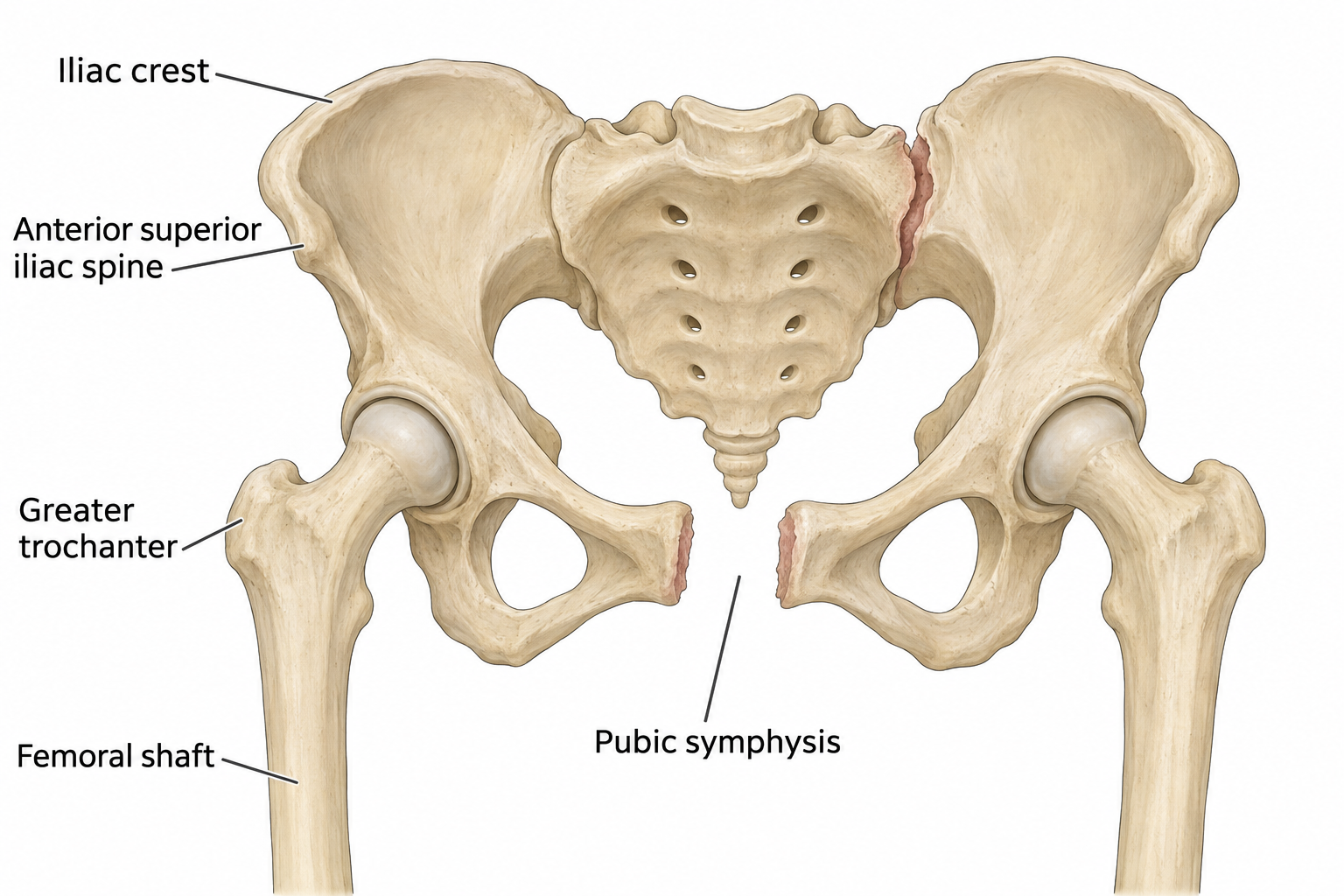
A trauma team prepares to apply a commercial pelvic stabilization binder on an unstable patient with an open-book pelvic fracture. Over which anatomical landmark must the binder be centered circumferentially to effectively reduce pelvic volume?
Show answer & explanation
Correct answer: A
Centering the pelvic binder over the greater trochanters provides optimal mechanical compression across the pelvic ring, reducing internal pelvic volume and controlling retroperitoneal venous bleeding.
- Question 6Intermediate
Clinical Practice: Trunk and Pelvis · 2.C.2 Vascular injuries
An unstable pelvic fracture patient is undergoing catheter angiography for ongoing arterial pelvic hemorrhage. Why do trauma clinical practice guidelines specifically recommend selective embolization over nonselective bilateral internal iliac artery embolization whenever technically feasible?
Show answer & explanation
Correct answer: D
Selective embolization targeting specific bleeding branches prevents extensive tissue ischemia, reducing the severe risks of gluteal muscle necrosis, perineal breakdown, and rectal infarction.
Ready for the real thing?
The full TCRN simulator has every exam-style question, timed mode, and instant scoring.